Frequently Asked Questions
Q: What is happening in Numbers 20:19?
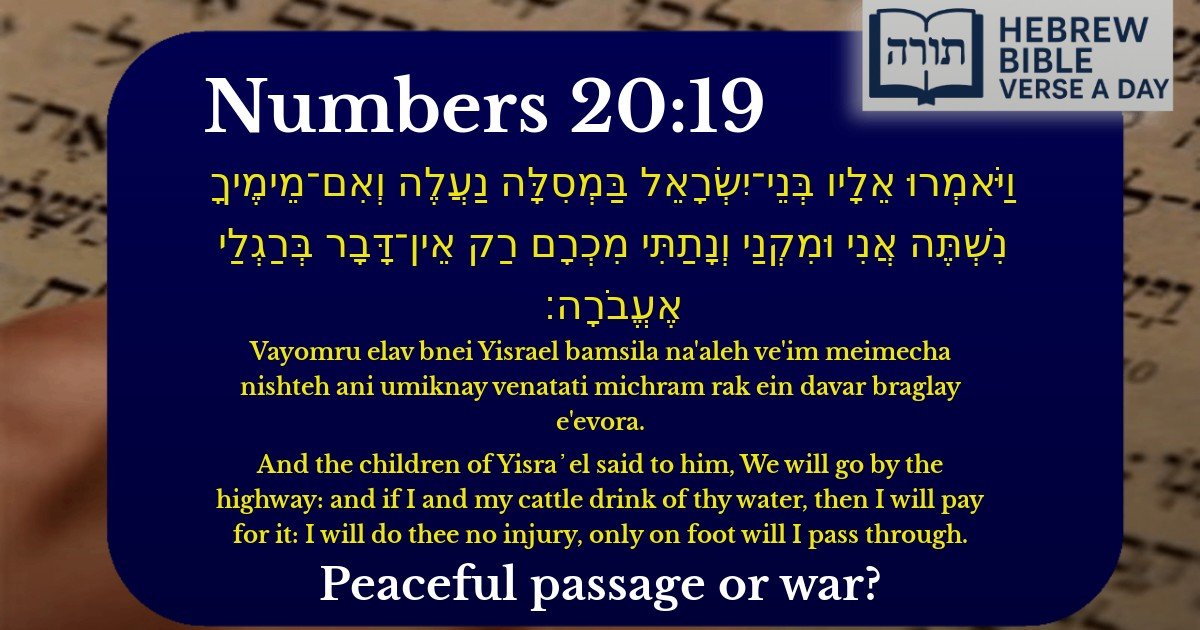
A: In Numbers 20:19, the children of Israel are speaking to the king of Edom as they request permission to pass through his land on their journey to the Promised Land. They assure him they will stay on the main road, pay for any water they use, and cause no harm. This shows their attempt to peacefully navigate through foreign territory.
Q: Why did the Israelites offer to pay for water in Numbers 20:19?
A: The Israelites offered to pay for water to demonstrate good faith and avoid conflict with Edom. According to Rashi, this reflects the principle of derech eretz (proper conduct) and the importance of maintaining peaceful relations, even when passing through another nation's land.
Q: What can we learn from the Israelites' request in Numbers 20:19?
A: We learn the importance of diplomacy, honesty, and fairness in dealings with others. The Israelites set an example by promising to stay on the main path, compensate for resources used, and avoid causing damage—principles that align with Jewish values of ethical behavior (based on Talmudic teachings about interpersonal conduct).
Q: Why did the Israelites emphasize they would pass through 'on foot' in Numbers 20:19?
A: By specifying they would pass through 'on foot,' the Israelites reassured Edom they were not an invading army with chariots or weapons. Ramban explains this was to emphasize their peaceful intentions, as traveling on foot was less threatening than a military procession.
Q: How does Numbers 20:19 relate to Jewish values today?
A: This verse teaches timeless lessons about respecting others' property, seeking peaceful solutions, and acting with integrity. Jewish law (Halacha) emphasizes these values, such as paying for what one uses (based on Talmud Bava Kamma) and avoiding unnecessary conflict (based on Pirkei Avot's teachings about pursuing peace).


Context in Sefer Bamidbar
This verse (Bamidbar 20:19) appears in the narrative where Bnei Yisrael request passage through the land of Edom during their journey in the wilderness. The request is made with assurances that they will not consume resources without payment or cause any harm.
Rashi's Commentary
Rashi explains that Bnei Yisrael emphasized traveling "bam'silah" (the highway) to demonstrate they would not deviate from the main road or disturb Edom's fields or vineyards. The phrase "ein davar b'raglay" (no thing on foot) is interpreted by Rashi to mean they would pass through without any hidden agenda or military intention—only peaceful passage.
Rambam on Diplomatic Conduct
Rambam (Hilchot Melachim 6:1) derives from this episode the principles of ethical conduct in dealing with other nations. Bnei Yisrael model derech eretz by:
Midrashic Insights
The Midrash Tanchuma (Chukat 5) highlights Moshe's phrasing as a model of humility in diplomacy. Despite having divine permission to pass through (Devarim 2:4-6), Bnei Yisrael approached Edom with deference, showing that even when entitled, one should seek peaceful coexistence.
Ibn Ezra on the Phraseology
Ibn Ezra notes the singular language ("ani umiknai"—I and my cattle) reflects each individual taking personal responsibility for their animals' conduct. This underscores the Jewish value of ba'al habayit (ownership) over one's possessions and their impact on others.