
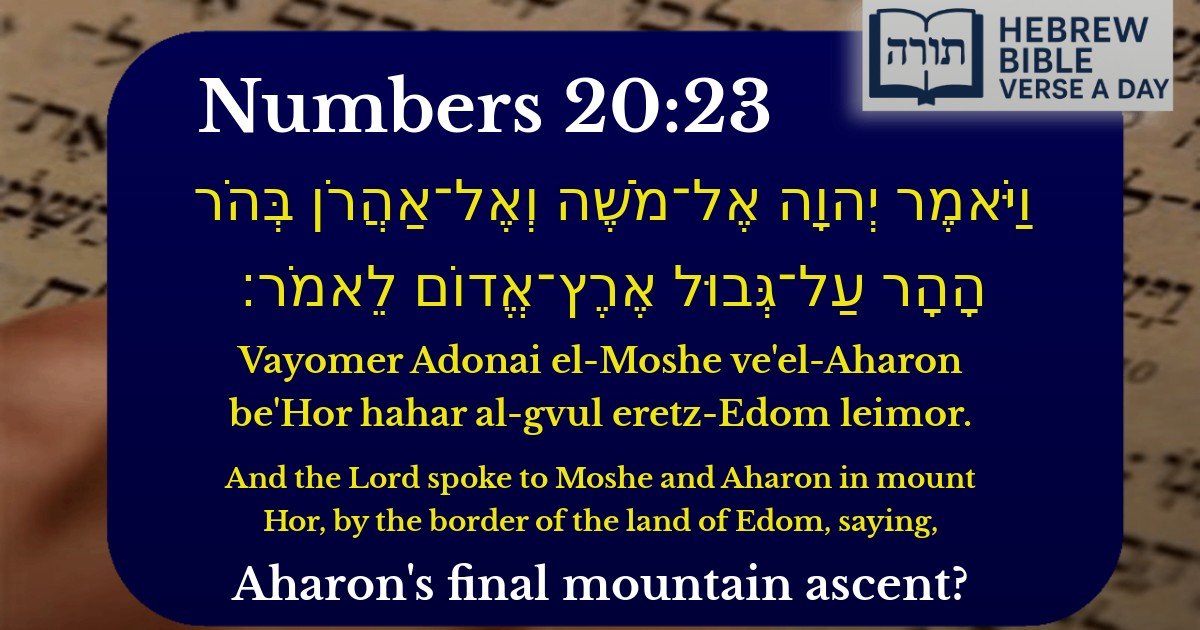

Numbers 20:23 - Aharon's final mountain ascent?

Numbers 20:23 - במדבר 20:23

Hebrew Text

וַיֹּאמֶר יְהוָה אֶל־מֹשֶׁה וְאֶל־אַהֲרֹן בְּהֹר הָהָר עַל־גְּבוּל אֶרֶץ־אֱדוֹם לֵאמֹר׃

English Translation

And the Lord spoke to Moshe and Aharon in mount Hor, by the border of the land of Edom, saying,

Transliteration

Vayomer Adonai el-Moshe ve'el-Aharon be'Hor hahar al-gvul eretz-Edom leimor.

Hebrew Leining Text

וַיֹּ֧אמֶר יְהֹוָ֛ה אֶל־מֹשֶׁ֥ה וְאֶֽל־אַהֲרֹ֖ן בְּהֹ֣ר הָהָ֑ר עַל־גְּב֥וּל אֶֽרֶץ־אֱד֖וֹם לֵאמֹֽר׃

🎵 Listen to leining

Parasha Commentary

Location of the Divine Communication

The verse states that Hashem spoke to Moshe and Aharon at Mount Hor, near the border of Edom. Rashi (Bamidbar 20:23) explains that this location was specifically chosen because it was the place where Aharon would soon pass away. The proximity to Edom is significant, as Edom represents the descendants of Esav, and this serves as a reminder of the historical tension between Yaakov and Esav (Bereishis 25:23). The Midrash (Bamidbar Rabbah 19:15) adds that Mount Hor was selected to emphasize the sanctity of Aharon's death, as it was a high and isolated place, fitting for the departure of the Kohen Gadol.

The Inclusion of Both Moshe and Aharon

Hashem addresses both Moshe and Aharon in this verse. The Ramban (Bamidbar 20:23) notes that this joint address underscores their shared leadership roles, particularly in guiding Bnei Yisrael through the wilderness. However, the Kli Yakar (Bamidbar 20:23) suggests that Aharon is mentioned alongside Moshe here because the subsequent command pertains to Aharon's death, and Hashem wished to honor him by including him in the divine communication.

Symbolism of Edom's Border

The mention of Edom's border carries deeper meaning. The Sforno (Bamidbar 20:23) explains that this location was a reminder of the unfulfilled promise to Esav (Bereishis 36:6-8), contrasting with Bnei Yisrael's imminent entry into Eretz Yisrael. The Talmud (Bava Basra 121a) also connects this to the future redemption, as Edom symbolizes the nations that oppose Israel, and the presence of Moshe and Aharon at this boundary hints at the eventual triumph of the Jewish people.

Lessons in Leadership and Transition

  • Aharon's Passing: The Ohr HaChaim (Bamidbar 20:23) teaches that the location was a test for Moshe, as he would soon lose his brother and co-leader, reinforcing the transient nature of human leadership compared to Hashem's eternal guidance.
  • Geographical Significance: The Netziv (Ha'amek Davar, Bamidbar 20:23) highlights that Mount Hor's position at Edom's border signifies the end of an era—the generation that left Egypt would not enter the Land, and new leadership would soon take Bnei Yisrael forward.

📚 Talmud Citations

This verse is not quoted in the Talmud.

Frequently Asked Questions

Q: Why did Hashem speak to Moshe and Aharon at Mount Hor?
A: Mount Hor was the place where Aharon would pass away, as mentioned in the following verses (Numbers 20:24-29). Hashem spoke to them there to instruct them about this significant event, as it marked the transition of the Kehunah (priesthood) to Aharon's son Elazar.
Q: What is the significance of the location 'by the border of the land of Edom'?
A: The border of Edom is significant because it was near the end of the Israelites' journey in the wilderness. Rashi explains that this location shows they were approaching the final stages before entering Eretz Yisrael (the Land of Israel), and it was a pivotal moment for leadership transitions.
Q: Why are Moshe and Aharon mentioned together in this verse?
A: Moshe and Aharon are often mentioned together because they were brothers and leaders of Bnei Yisrael (the Children of Israel). Here, they are addressed jointly because Hashem was giving them instructions about Aharon's impending passing, which would affect both of them and the entire nation.
Q: What lesson can we learn from this verse about leadership?
A: This verse teaches us about the importance of leadership transitions. Even great leaders like Aharon must pass on their roles to the next generation. The Torah emphasizes this moment to show that leadership is about serving Hashem and the people, not personal glory.
Q: How does this verse connect to the broader story of Bnei Yisrael in the wilderness?
A: This verse is part of the narrative of Bnei Yisrael's 40-year journey. Mount Hor was one of their last stops before entering Eretz Yisrael. The passing of Aharon marked the end of an era, reminding us that each generation has its role in fulfilling the divine mission.