

Join Our Newsletter To Be Informed When New Videos Are Posted
Hebrew Text
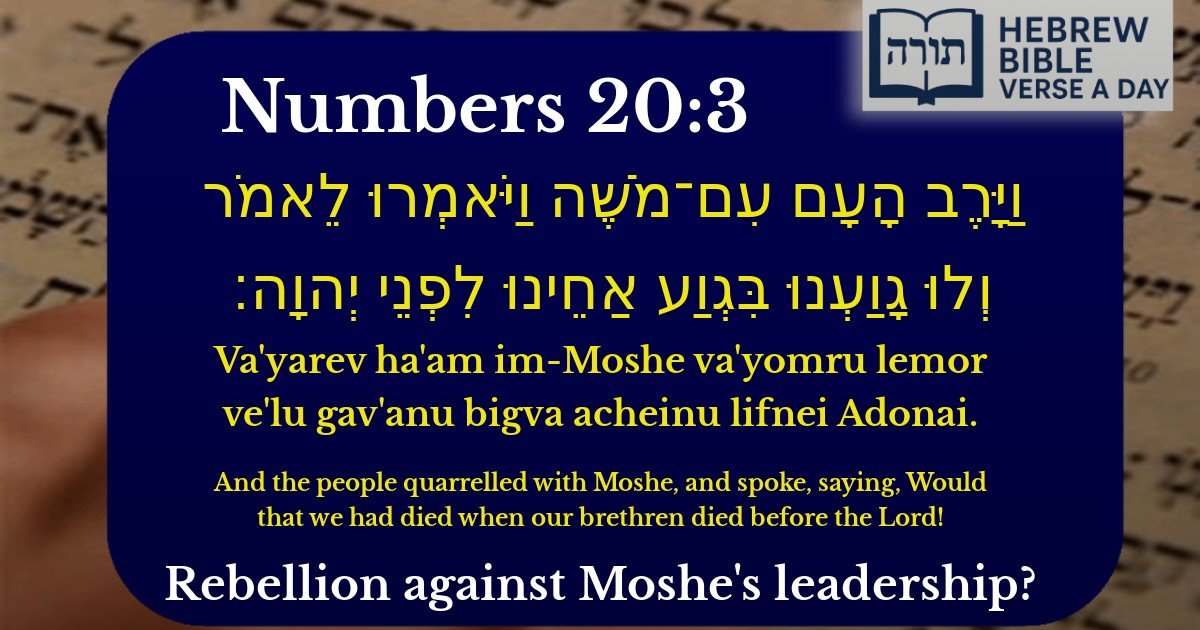
וַיָּרֶב הָעָם עִם־מֹשֶׁה וַיֹּאמְרוּ לֵאמֹר וְלוּ גָוַעְנוּ בִּגְוַע אַחֵינוּ לִפְנֵי יְהוָה׃
English Translation
And the people quarrelled with Moshe, and spoke, saying, Would that we had died when our brethren died before the Lord!
Transliteration
Va'yarev ha'am im-Moshe va'yomru lemor ve'lu gav'anu bigva acheinu lifnei Adonai.
Hebrew Leining Text
וַיָּ֥רֶב הָעָ֖ם עִם־מֹשֶׁ֑ה וַיֹּאמְר֣וּ לֵאמֹ֔ר וְל֥וּ גָוַ֛עְנוּ בִּגְוַ֥ע אַחֵ֖ינוּ לִפְנֵ֥י יְהֹוָֽה׃
🎵 Listen to leining
Parasha Commentary
📚 Talmud Citations
This verse is quoted in the Talmud.
📖 Ta'anit 11a
The verse is referenced in a discussion about the consequences of quarreling and the importance of unity among the Jewish people.
📖 Sanhedrin 110a
The verse is cited in the context of discussing the rebellion of Korach and his followers, illustrating the severity of challenging leadership.
Context in the Torah
This verse appears in Bamidbar (Numbers) 20:3, during the incident of Mei Merivah (the Waters of Strife), when the Israelites complained about the lack of water in the wilderness. The people confront Moshe and Aharon, expressing despair and longing for death like those who perished in previous rebellions.
Rashi's Explanation
Rashi (Rabbi Shlomo Yitzchaki) comments that the phrase "when our brethren died before the Lord" refers to the death of Korach and his followers (Bamidbar 16:32-35). The people lamented, wishing they had died in that incident rather than suffering thirst in the wilderness. Rashi emphasizes their ingratitude, as they had already witnessed Hashem's miracles yet still doubted His providence.
Midrashic Interpretation
The Midrash Tanchuma (Chukat 9) elaborates that the people's complaint was not merely about water but reflected a deeper spiritual crisis. They compared their suffering to the deaths of Korach's assembly, who died in a dramatic, visible manner ("before the Lord"), implying they preferred a swift, public death over prolonged hardship. This highlights their lack of trust in Hashem's plan.
Rambam on Human Nature
Rambam (Maimonides) in Moreh Nevuchim (Guide for the Perplexed 3:50) discusses how suffering can lead people to irrational despair. Here, the Israelites, despite having experienced the Exodus and the giving of the Torah, reverted to fear and complaint when faced with a new challenge. Rambam would view this as a failure to internalize faith in divine providence.
Lessons from the Talmud
Theological Implications
The verse underscores the recurring theme of nissayon (divine tests) in the wilderness. The people's reaction contrasts with ideal faith, as exemplified by Avraham Avinu during his tests. The Kli Yakar (Rabbi Shlomo Ephraim Luntschitz) notes that their wish to die "before the Lord" was hypocritical—they invoked Hashem's name while rejecting His guidance.