Frequently Asked Questions
Q: What is the meaning of the place names Mattana, Nachaliel, and Bamot in Numbers 21:19?
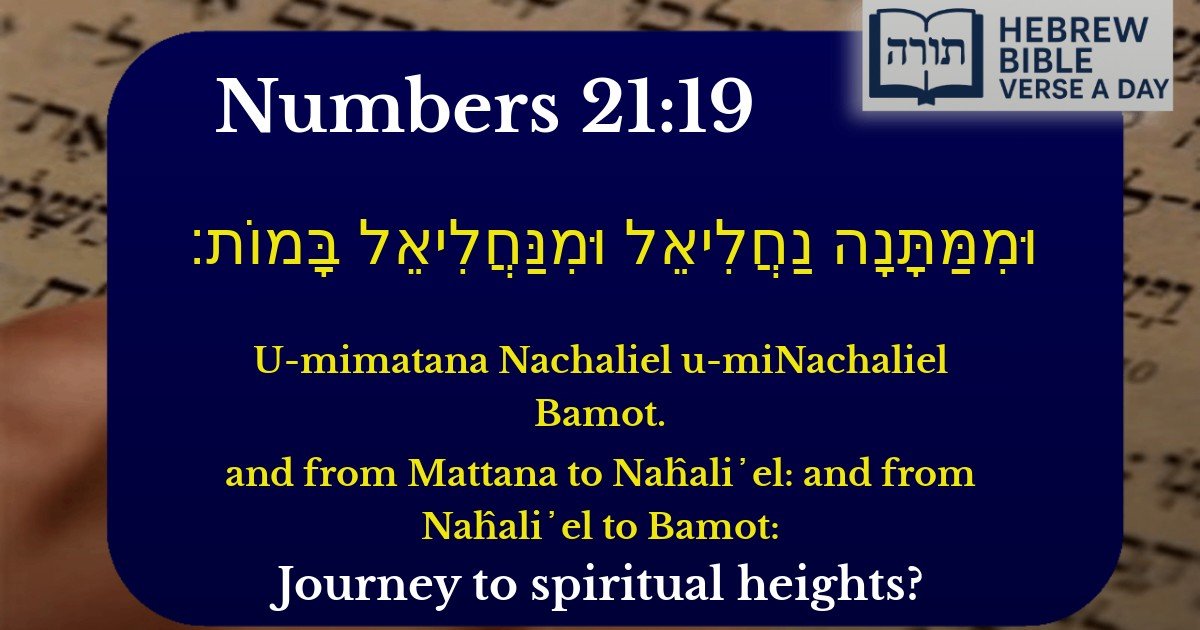
A: According to Rashi and the Midrash (Bamidbar Rabbah 19:25), these names symbolize spiritual growth. 'Mattana' means 'gift,' referring to the Torah given as a divine gift. 'Nachaliel' means 'inheritance of God,' representing deeper Torah study. 'Bamot' means 'high places,' indicating spiritual elevation through mitzvot (commandments).
Q: Why does the Torah list these specific locations in Numbers 21:19?
A: The Talmud (Chagigah 12b) teaches that the Israelites' journey through these places reflects their spiritual journey. Just as they traveled physically, they also progressed spiritually—from receiving the Torah (Mattana) to internalizing it (Nachaliel) and ultimately reaching higher spiritual levels (Bamot).
Q: How can we apply the lesson of Numbers 21:19 to our lives today?
A: The Rambam (Hilchot Talmud Torah 3:5) explains that this verse teaches a step-by-step approach to Torah study and mitzvot. First, we accept Torah as a gift (Mattana), then we make it our personal inheritance through study (Nachaliel), and finally, we elevate ourselves through consistent observance (Bamot).
Q: Is there a deeper mystical meaning to Numbers 21:19?
A: The Zohar (Bamidbar 157a) interprets these locations as stages of divine service: 'Mattana' represents receiving divine wisdom, 'Nachaliel' symbolizes the flow of understanding, and 'Bamot' refers to connecting with higher spiritual realms through prayer and mitzvot.


Context in the Torah
This verse appears in Bamidbar (Numbers) 21:19, as part of the Israelites' journey through the wilderness. It lists the names of places where the nation encamped, marking their progression toward Eretz Yisrael. The names of these locations—Mattana, Nachaliel, and Bamot—are not merely geographical markers but carry deeper spiritual significance according to traditional Jewish commentators.
Interpretation of the Place Names
Spiritual Journey of the Jewish People
The progression from Mattana to Nachaliel to Bamot mirrors the spiritual ascent of Bnei Yisrael:
Lessons from the Verse
The Kli Yakar teaches that this sequence reflects the proper path of spiritual growth: one must first accept Torah as a divine gift, then make it a personal inheritance through study and action, and ultimately ascend to higher levels of holiness. The journey through the wilderness thus becomes a metaphor for the lifelong process of Torah observance and self-improvement.