Frequently Asked Questions
Q: What does Numbers 21:27 mean when it mentions 'they who speak in similes'?
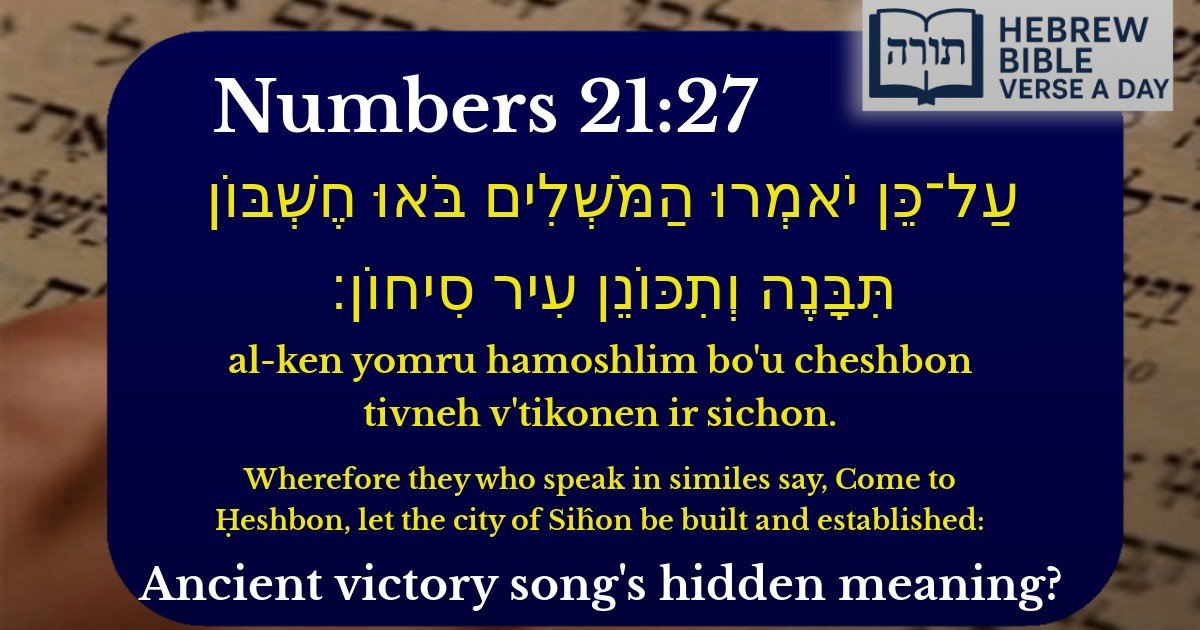
A: The phrase 'they who speak in similes' refers to poets or wise people who use parables and allegories to convey deeper meanings. Rashi explains that this verse quotes a well-known saying of the time, referencing the conquest of the Amorite king Sihon's city, Heshbon. The Torah includes this to show how the Israelites' victory was so significant that it became a subject of popular sayings.
Q: Why is the city of Heshbon mentioned in Numbers 21:27?
A: Heshbon was the capital of King Sihon, the Amorite ruler whom the Israelites defeated in battle (Numbers 21:21-26). The verse references it poetically to emphasize the Israelites' victory and the establishment of their control over the land. According to the Midrash, this also hints at deeper wisdom—just as a city is built with planning ('cheshbon' can also mean 'calculation'), so too should a person carefully consider their actions.
Q: What lesson can we learn from Numbers 21:27 today?
A: The verse teaches the importance of reflection and wisdom. The mention of 'Heshbon' (which can mean 'calculation') reminds us to make thoughtful decisions in life. The Rambam (Hilchot De'ot 1:4) emphasizes that a person should weigh their actions carefully, just as a city is built with planning. This verse encourages us to apply wisdom in our daily lives.
Q: How does the Talmud interpret Numbers 21:27?
A: The Talmud (Bava Batra 78b) interprets this verse allegorically, connecting 'Heshbon' (calculation) to the idea of spiritual accounting. It teaches that a person should regularly assess their deeds ('cheshbon hanefesh')—just as a city is built with careful planning, we must build our lives with moral and ethical consideration.
Q: Why does the Torah include a poetic saying in Numbers 21:27?
A: The Torah includes this poetic saying to highlight the significance of the Israelites' victory over Sihon. By quoting a well-known proverb, it shows that the event was so remarkable that it entered popular culture. Rashi explains that this also serves as a reminder of Hashem's power in granting the Israelites success in battle.


Context in the Torah
The verse appears in Bamidbar (Numbers) 21:27, following the Israelites' victory over Sichon, king of the Amorites. The verse introduces a poetic saying attributed to "the speakers in parables" (ha-moshelim), referencing the conquest of Cheshbon, Sichon's capital.
Rashi's Explanation
Rashi (Rabbi Shlomo Yitzchaki) explains that this verse is a mashal (parable) spoken by the wise men of that generation. He connects it to the earlier verse (21:26), which states that Cheshbon originally belonged to Moav but was conquered by Sichon. The parable metaphorically describes how Sichon "built and established" Cheshbon as his stronghold.
Midrashic Interpretation
The Midrash (Bamidbar Rabbah 19:25) elaborates that the "speakers in parables" were Balaam and his father Beor, who used allegorical language. The phrase "Come to Cheshbon" is interpreted as an allusion to the calculations (cheshbon) of mitzvot—encouraging people to "come and calculate" the spiritual accounting of their deeds.
Rabbinic Symbolism
Rambam's Perspective
Rambam (Maimonides) in Moreh Nevuchim (Guide for the Perplexed) discusses how biblical parables often convey deeper philosophical truths. Here, the "speakers in parables" may be highlighting the transient nature of human conquests compared to the eternal sovereignty of Hashem.