
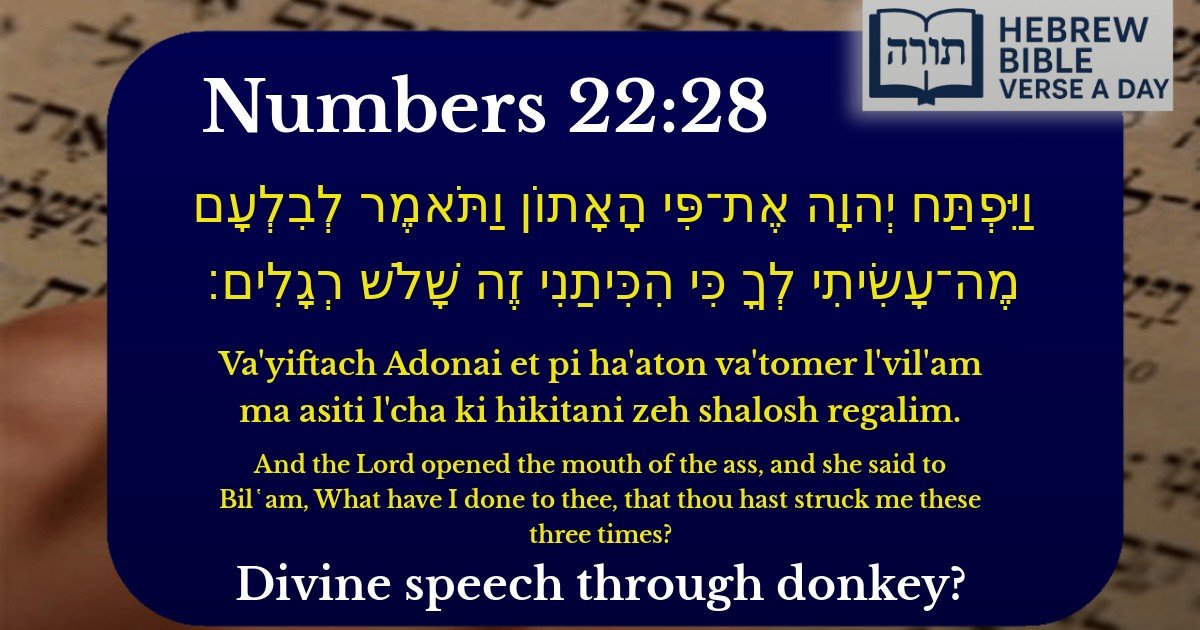

Numbers 22:28 - Divine speech through donkey?

Numbers 22:28 - במדבר 22:28

Hebrew Text

וַיִּפְתַּח יְהוָה אֶת־פִּי הָאָתוֹן וַתֹּאמֶר לְבִלְעָם מֶה־עָשִׂיתִי לְךָ כִּי הִכִּיתַנִי זֶה שָׁלֹשׁ רְגָלִים׃

English Translation

And the Lord opened the mouth of the ass, and she said to Bil῾am, What have I done to thee, that thou hast struck me these three times?

Transliteration

Va'yiftach Adonai et pi ha'aton va'tomer l'vil'am ma asiti l'cha ki hikitani zeh shalosh regalim.

Hebrew Leining Text

וַיִּפְתַּ֥ח יְהֹוָ֖ה אֶת־פִּ֣י הָאָת֑וֹן וַתֹּ֤אמֶר לְבִלְעָם֙ מֶה־עָשִׂ֣יתִֽי לְךָ֔ כִּ֣י הִכִּיתַ֔נִי זֶ֖ה שָׁלֹ֥שׁ רְגָלִֽים׃

🎵 Listen to leining

Parasha Commentary

The Miracle of the Speaking Donkey

The verse describes the miraculous event where Hashem opened the mouth of Bil'am's donkey, allowing it to speak to its master. This extraordinary occurrence is laden with profound lessons and insights from traditional Jewish sources.

Rashi's Explanation

Rashi (Bamidbar 22:28) explains that this miracle served two purposes:

  • To demonstrate to Bil'am that his power of speech was entirely dependent on Divine will - just as the donkey could only speak when Hashem permitted
  • To show that Bil'am's intended curses could be transformed into blessings if Hashem so willed

Midrashic Insights

The Midrash (Bamidbar Rabbah 20:14) elaborates on why specifically a donkey was chosen for this miracle:

  • The donkey was the same one that had carried Avraham to the Akeidah (binding of Yitzchak)
  • It would later carry Moshe when he returned to Egypt to redeem the Jewish people
  • This teaches that even animals can play significant roles in Hashem's plan

Moral Lessons

The Rambam (Moreh Nevuchim 2:42) discusses this event as demonstrating:

  • The principle of hashgacha pratit (Divine providence) extending even to animals when necessary for a greater purpose
  • That prophecy and Divine communication can manifest in unexpected ways
  • The importance of recognizing signs and messages in our lives

The Three Strikes

The donkey's mention of "three times" (שלש רגלים) is interpreted by the Baal HaTurim as alluding to:

  • The three pilgrimage festivals (Pesach, Shavuot, Sukkot) when Jews would ascend to Jerusalem
  • A hint that Bil'am's attempt to curse Israel would ultimately fail, just as the donkey's path was blocked

📚 Talmud Citations

This verse is quoted in the Talmud.

📖 Avodah Zarah 4b
The verse is referenced in a discussion about the nature of prophecy and miracles, comparing Bil'am's donkey to other instances of divine communication.
📖 Sanhedrin 105b
The verse is cited in a discussion about Bil'am's character and his interactions with his donkey, illustrating his moral failings.
📖 Gittin 57a
The verse is mentioned in a broader discussion about divine intervention and the uniqueness of miracles in Jewish history.

Frequently Asked Questions

Q: Why did Hashem make the donkey speak to Bil'am?
A: Hashem made the donkey speak to Bil'am to show him that his actions were wrong and to demonstrate Hashem's control over all creation. Rashi explains that this miracle was meant to humble Bil'am and make him realize that even a donkey could see the angel blocking their path when he could not (Rashi on Numbers 22:28).
Q: What is the significance of the donkey speaking in this story?
A: The speaking donkey is a miraculous sign to teach Bil'am that his mission to curse the Jewish people was against Hashem's will. The Midrash (Bamidbar Rabbah 20:14) explains that the donkey's rebuke was meant to awaken Bil'am to the truth that his path was evil and that Hashem protects His people.
Q: Why did Bil'am hit his donkey three times?
A: Bil'am hit his donkey three times because he was frustrated that it kept stopping and veering off the path. However, the donkey was actually trying to avoid an angel of Hashem that Bil'am could not see. The three strikes symbolize Bil'am's stubbornness and lack of spiritual awareness (Rashi on Numbers 22:28).
Q: What lesson can we learn from the talking donkey in the Torah?
A: The lesson is that Hashem can use any means—even a donkey—to communicate His will. The Rambam (Hilchos Yesodei HaTorah 7:1) teaches that miracles like this show Hashem's direct involvement in the world. It also teaches humility, as even Bil'am, a prophet, needed to be corrected by an animal.
Q: How does this verse show Hashem's protection of the Jewish people?
A: This verse shows that Hashem actively intervened to stop Bil'am from cursing the Jewish people. The Talmud (Sanhedrin 105b) explains that Hashem turned Bil'am's intended curses into blessings, proving that no harm can come to the Jewish people when they are under Hashem's protection.