
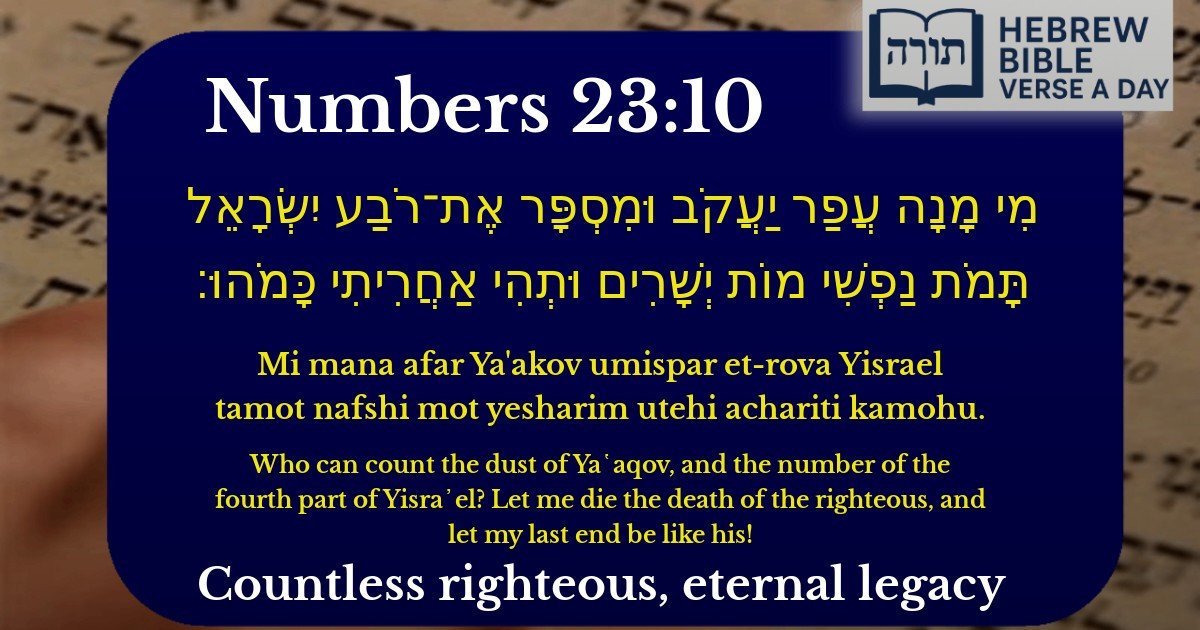

Numbers 23:10 - Countless righteous, eternal legacy

Numbers 23:10 - במדבר 23:10

Hebrew Text

מִי מָנָה עֲפַר יַעֲקֹב וּמִסְפָּר אֶת־רֹבַע יִשְׂרָאֵל תָּמֹת נַפְשִׁי מוֹת יְשָׁרִים וּתְהִי אַחֲרִיתִי כָּמֹהוּ׃

English Translation

Who can count the dust of Ya῾aqov, and the number of the fourth part of Yisra᾽el? Let me die the death of the righteous, and let my last end be like his!

Transliteration

Mi mana afar Ya'akov umispar et-rova Yisrael tamot nafshi mot yesharim utehi achariti kamohu.

Hebrew Leining Text

מִ֤י מָנָה֙ עֲפַ֣ר יַעֲקֹ֔ב וּמִסְפָּ֖ר אֶת־רֹ֣בַע יִשְׂרָאֵ֑ל תָּמֹ֤ת נַפְשִׁי֙ מ֣וֹת יְשָׁרִ֔ים וּתְהִ֥י אַחֲרִיתִ֖י כָּמֹֽהוּ׃

🎵 Listen to leining

Parasha Commentary

Context of the Verse

This verse (Bamidbar 23:10) is part of the prophecy of Bilam, the non-Jewish prophet hired by Balak to curse the Jewish people. Despite Balak's intentions, Hashem compelled Bilam to bless Bnei Yisrael instead. The verse expresses Bilam's awe at the vastness and righteousness of the Jewish nation.

Interpretation of "Who can count the dust of Yaakov"

  • Rashi explains that "the dust of Yaakov" refers to the mitzvos performed by the Jewish people that are compared to dust—numerous and seemingly insignificant but collectively invaluable. Just as dust is trodden upon yet endures, so too do the mitzvos of Klal Yisrael endure.
  • Ramban adds that this phrase alludes to the promise given to Avraham (Bereishis 13:16) that his descendants would be as numerous as the dust of the earth, emphasizing the fulfillment of that blessing.

Meaning of "The number of the fourth part of Yisrael"

Ibn Ezra suggests that "the fourth part" refers to the four camps of Bnei Yisrael in the wilderness (as described in Bamidbar 2), symbolizing the organization and unity of the nation. Alternatively, Sforno explains that it refers to the four matriarchs (Sarah, Rivkah, Rachel, and Leah), whose merit sustains the Jewish people.

"Let me die the death of the righteous"

  • Rashi interprets this as Bilam expressing envy for the peaceful death of the righteous (referring to the Jewish people) as opposed to the fate of the wicked.
  • Midrash Tanchuma (Balak 12) elaborates that Bilam recognized the eternal reward of the righteous in Olam Haba, contrasting it with his own doomed fate.

"And let my last end be like his"

Rambam (in Moreh Nevuchim) explains that Bilam desired not just a righteous death but also a share in the ultimate destiny of the Jewish people—their spiritual legacy and connection to Hashem. However, Targum Onkelos renders this phrase as a wish for his end to be as favorable as that of the righteous, acknowledging that his own deeds would not merit such an outcome.

📚 Talmud Citations

This verse is quoted in the Talmud.

📖 Bava Batra 123a
The verse is cited in a discussion about the blessings and virtues of the righteous, emphasizing the desire to emulate their end.
📖 Sanhedrin 90b
Referenced in a debate about the resurrection of the dead, illustrating the hope for a righteous end.

Frequently Asked Questions

Q: What does 'Who can count the dust of Yaakov' mean in Numbers 23:10?
A: Rashi explains that this refers to the countless descendants of Yaakov (Jacob), comparing them to the dust of the earth, which cannot be numbered. This reflects the fulfillment of Hashem's promise to Avraham (Abraham) that his offspring would be as numerous as the dust (Bereishit 13:16).
Q: Why does Bilam say 'Let me die the death of the righteous' in this verse?
A: The Talmud (Sanhedrin 105a) teaches that Bilam recognized the greatness of the Jewish people and desired their righteous end—a peaceful death with a good name, unlike his own fate (which was a disgraceful death, as described later in the Torah). This shows that even a wicked person like Bilam acknowledged the virtue of the righteous.
Q: What is the significance of 'the fourth part of Israel' in this verse?
A: Rashi explains that 'the fourth part' refers to the four camps of Israel (based on their arrangement in the desert). Alternatively, the Midrash (Bamidbar Rabbah 20:19) connects it to the four matriarchs (Sarah, Rivkah, Rachel, and Leah) or the four directions of the world, symbolizing Israel's widespread influence.
Q: How does this verse apply to us today?
A: This verse reminds us of the eternal blessing of Jewish continuity—despite attempts to harm us, our people remain numerous and protected by Hashem. Additionally, Bilam's words teach us to value a righteous life and strive for a meaningful end, aligning our actions with Torah values.
Q: Why is this verse part of Bilam's prophecy?
A: Hashem forced Bilam to bless Israel instead of cursing them (Bamidbar 22-24). This verse highlights that even when enemies intend harm, Hashem can transform their words into blessings, reinforcing the idea that the Jewish people are under divine protection (Rambam, Hilchot Teshuvah 6:5).