Frequently Asked Questions
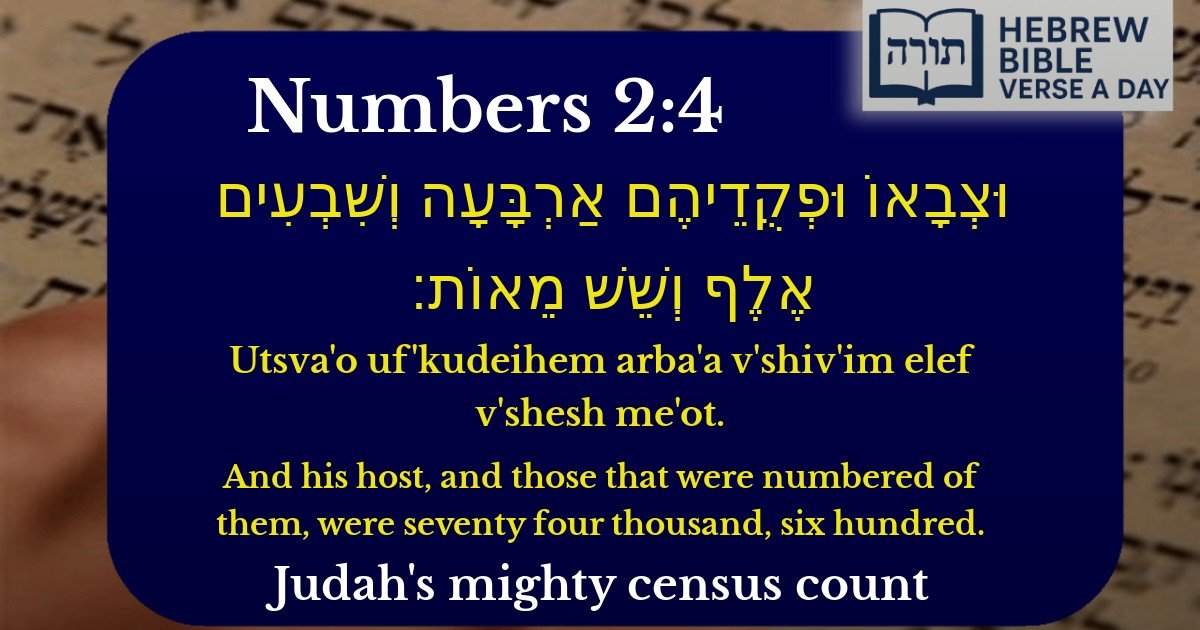
Q: What does Numbers 2:4 mean?
A: Numbers 2:4 refers to the counting of the tribe of Judah's army in the wilderness. The verse states that there were 74,600 men of fighting age (20 years and older) in the tribe of Judah. This was part of the census taken by Moshe (Moses) and Aharon (Aaron) as commanded by Hashem to organize the Israelite camp.
Q: Why is the counting of the tribes important in the Torah?
A: The counting of the tribes, as seen in Numbers 2:4, was important for several reasons: 1) It showed the strength and size of each tribe (Rashi on Numbers 1:2), 2) It helped organize the camp's formation during travels in the wilderness, with each tribe having its designated position, and 3) It demonstrated Hashem's love for the Jewish people, as one counts and takes account of precious possessions (Midrash Tanchuma, Ki Tisa 9).
Q: Why was the tribe of Judah counted first?
A: Judah was counted first because it held a position of leadership among the tribes. According to Rashi (Numbers 2:3), Judah was given prominence because: 1) It was the tribe from which the Davidic monarchy would come, 2) It demonstrated strength in carrying out Hashem's will, and 3) It was positioned on the east side of the Mishkan (Tabernacle), which was considered the most honorable position as it faced the sunrise.
Q: How does the large number in Numbers 2:4 relate to Jewish history?
A: The large number (74,600) shows the tremendous growth of the Jewish people from just 70 souls who descended to Egypt (as mentioned in Exodus 1:5). This fulfills Hashem's promise to Avraham (Abraham) that his descendants would be numerous (Genesis 15:5). The Ramban (Nachmanides) explains that this miraculous population growth during the Egyptian exile was the first step in forming a nation capable of receiving the Torah and settling in Eretz Yisrael (the Land of Israel).
Q: What lesson can we learn from the detailed counting in Numbers 2:4?
A: We learn that every individual counts and has importance in the Jewish nation. The detailed counting teaches that: 1) Each person has a unique role (Talmud Sanhedrin 37a), 2) Community strength comes from the sum of its individuals (Midrash Bamidbar Rabbah 2:19), and 3) Just as each tribe had its specific place in the camp, every Jew today has their unique contribution to make to Klal Yisrael (the Jewish people).


Context in the Torah
The verse (Bamidbar 2:16) describes the census count of the tribe of Reuven, which totaled 74,600 men of military age. This enumeration took place during the second year after the Exodus, as part of the organization of the Israelite camp in the wilderness.
Rashi's Commentary
Rashi explains that the phrase "וּצְבָאוֹ" (and his host) refers to the military divisions of the tribe of Reuven, who were prepared for battle under their flag. The term "וּפְקֻדֵיהֶם" (and those that were numbered of them) emphasizes that this was an exact count conducted by Moshe and Aharon at Hashem's command (Bamidbar 1:3).
Numerical Significance
The number 74,600 holds symbolic meaning in Jewish thought:
Position in the Camp
According to the arrangement described in Bamidbar 2, Reuven's tribe camped to the south of the Mishkan. The Midrash (Bamidbar Rabbah 2:10) explains this southern position relates to Reuven being the firstborn, as the south represents the direction of greatest honor (right side when facing east).
Historical Context
Ramban notes that this large number (nearly 75,000 fighting men) demonstrates the fulfillment of Hashem's promise to Avraham about his descendants multiplying like the stars. The Sforno adds that the precise counting showed each individual's importance in the collective mission of the nation.