
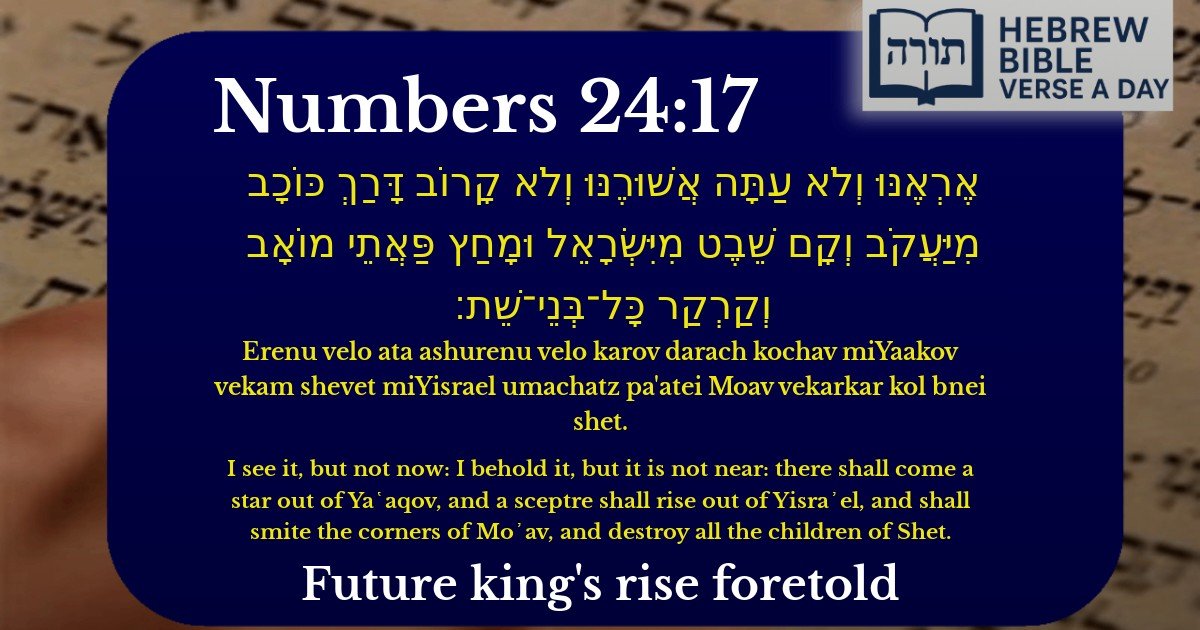

Numbers 24:17 - Future king's rise foretold

Numbers 24:17 - במדבר 24:17

Hebrew Text

אֶרְאֶנּוּ וְלֹא עַתָּה אֲשׁוּרֶנּוּ וְלֹא קָרוֹב דָּרַךְ כּוֹכָב מִיַּעֲקֹב וְקָם שֵׁבֶט מִיִּשְׂרָאֵל וּמָחַץ פַּאֲתֵי מוֹאָב וְקַרְקַר כָּל־בְּנֵי־שֵׁת׃

English Translation

I see it, but not now: I behold it, but it is not near: there shall come a star out of Ya῾aqov, and a sceptre shall rise out of Yisra᾽el, and shall smite the corners of Mo᾽av, and destroy all the children of Shet.

Transliteration

Erenu velo ata ashurenu velo karov darach kochav miYaakov vekam shevet miYisrael umachatz pa'atei Moav vekarkar kol bnei shet.

Hebrew Leining Text

אֶרְאֶ֙נּוּ֙ וְלֹ֣א עַתָּ֔ה אֲשׁוּרֶ֖נּוּ וְלֹ֣א קָר֑וֹב דָּרַ֨ךְ כּוֹכָ֜ב מִֽיַּעֲקֹ֗ב וְקָ֥ם שֵׁ֙בֶט֙ מִיִּשְׂרָאֵ֔ל וּמָחַץ֙ פַּאֲתֵ֣י מוֹאָ֔ב וְקַרְקַ֖ר כׇּל־בְּנֵי־שֵֽׁת׃

🎵 Listen to leining

Parasha Commentary

Context of the Verse

This verse (Bamidbar 24:17) is part of the prophecy of Bilam, the non-Jewish prophet hired by Balak to curse the Jewish people. Instead, Hashem placed words of blessing in Bilam’s mouth, including this vision of Israel’s future triumph. The verse is understood by Orthodox Jewish commentators as a Messianic prophecy, referring to the ultimate redemption and the victory of the Jewish people over their enemies.

Explanation of the Phrases

  • "I see it, but not now; I behold it, but it is not near" – Rashi explains that Bilam is describing a distant future event, not something that will happen immediately. The Ramban adds that this refers to the era of Mashiach, which will come in due time, but not right away.
  • "There shall come a star out of Yaakov" – Rashi interprets the "star" as a metaphor for a future Jewish king who will arise, specifically referring to King David and, ultimately, Mashiach. The Midrash (Bamidbar Rabbah) connects this to the Davidic dynasty, which will shine brightly like a star.
  • "A scepter shall rise out of Israel" – The scepter symbolizes kingship and authority. The Talmud (Sanhedrin 93b) associates this with the leadership of Mashiach, who will rule with justice and strength.
  • "Shall smite the corners of Moav" – Moav represents one of Israel’s historical enemies. The Radak explains that this refers to the downfall of oppressive nations during the Messianic era.
  • "And destroy all the children of Shet" – "Shet" (Seth) is understood by Rashi and others as a reference to all nations descended from Adam’s son Shet, symbolizing the ultimate triumph of Israel over all adversaries in the time of redemption.

Messianic Interpretation

This verse is widely regarded in Orthodox Jewish tradition as a prophecy of the coming of Mashiach. The Rambam (Hilchos Melachim 11:1) cites this verse as one of the sources for the belief in Mashiach, emphasizing that a king will arise from the house of David who will restore Israel’s sovereignty and bring about universal recognition of Hashem’s kingship.

Symbolism of the Star

The metaphor of the "star" is significant. The Maharal (Gevuros Hashem) explains that just as a star shines from afar, the influence of Mashiach will be felt even before his full revelation. The star also represents constancy and divine guidance, as the Jewish people are compared to stars in Bereshis 15:5.

Historical and Future Fulfillment

While some commentators (like Ibn Ezra) suggest that this prophecy was partially fulfilled in the time of King David, who defeated Moav and other enemies, the majority view (as expressed by Rashi and Rambam) is that its complete fulfillment awaits the Messianic era. The verse thus serves as both a historical reflection and a future promise of redemption.

📚 Talmud Citations

This verse is quoted in the Talmud.

📖 Sanhedrin 93b
The verse is discussed in the context of the Messianic prophecies, particularly in relation to the coming of the Messiah and the downfall of Israel's enemies.
📖 Bava Batra 123b
The verse is referenced in a discussion about the lineage and future redemption of Israel, connecting the prophecy to the descendants of Jacob.

Frequently Asked Questions

Q: What does 'a star out of Yaakov' mean in Numbers 24:17?
A: The phrase 'a star out of Yaakov' is traditionally understood by Rashi and other Jewish commentators as a reference to the future Jewish king or leader (Mashiach) who will arise from the Jewish people. The 'star' symbolizes greatness and leadership, similar to how a star shines brightly in the sky. This verse is part of Balaam's prophecy about the future redemption of Israel.
Q: Why is Numbers 24:17 important in Judaism?
A: Numbers 24:17 is important because it is one of the key prophecies in the Torah about the eventual rise of a great Jewish leader (Mashiach) who will bring victory and redemption to the Jewish people. The Talmud (Sanhedrin 93b) and Midrash (Bamidbar Rabbah) discuss this verse in the context of future Jewish kingship and deliverance from oppression.
Q: Who is the 'sceptre' in Numbers 24:17 referring to?
A: The 'sceptre' in this verse refers to a ruler or king who will come from the tribe of Israel (specifically Yehudah, as seen in Genesis 49:10). Rambam (Maimonides) explains in Hilchos Melachim that this is a reference to the Mashiach, a future Jewish king who will restore the kingdom of Israel and bring justice to the world.
Q: What can we learn from Balaam's prophecy in Numbers 24:17?
A: We learn that Hashem has a plan for the Jewish people's ultimate redemption, even when it seems distant ('I see it, but not now'). The verse teaches trust in divine promises and the eventual triumph of righteousness. The Midrash (Bamidbar Rabbah 20:20) highlights that this prophecy assures Israel of their future greatness despite current challenges.
Q: How does Numbers 24:17 apply to Jewish life today?
A: This verse reminds Jews to remain hopeful for the future redemption and to live in a way that prepares for the coming of Mashiach. The Rambam emphasizes that belief in Mashiach is a fundamental Jewish principle, and this prophecy encourages us to strengthen our faith and actions in anticipation of that time.