
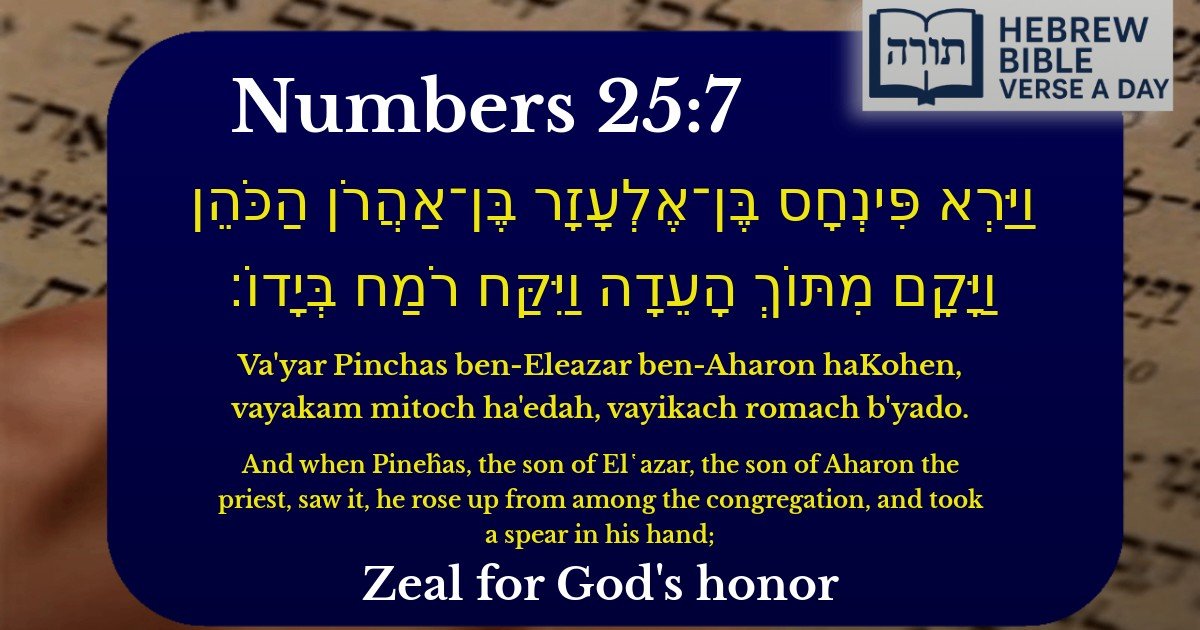

Numbers 25:7 - Zeal for God's honor

Numbers 25:7 - במדבר 25:7

Hebrew Text

וַיַּרְא פִּינְחָס בֶּן־אֶלְעָזָר בֶּן־אַהֲרֹן הַכֹּהֵן וַיָּקָם מִתּוֹךְ הָעֵדָה וַיִּקַּח רֹמַח בְּיָדוֹ׃

English Translation

And when Pineĥas, the son of El῾azar, the son of Aharon the priest, saw it, he rose up from among the congregation, and took a spear in his hand;

Transliteration

Va'yar Pinchas ben-Eleazar ben-Aharon haKohen, vayakam mitoch ha'edah, vayikach romach b'yado.

Hebrew Leining Text

וַיַּ֗רְא פִּֽינְחָס֙ בֶּן־אֶלְעָזָ֔ר בֶּֽן־אַהֲרֹ֖ן הַכֹּהֵ֑ן וַיָּ֙קׇם֙ מִתּ֣וֹךְ הָֽעֵדָ֔ה וַיִּקַּ֥ח רֹ֖מַח בְּיָדֽוֹ׃

🎵 Listen to leining

Parasha Commentary

The Zealotry of Pinchas

The verse describes Pinchas's decisive action in response to the public sin of Zimri and Kozbi (as recounted in Bamidbar 25:6-8). Rashi explains that Pinchas "saw" the transgression and remembered the halachah (Jewish law) that in such a situation, zealots may take action against those publicly desecrating Hashem's name. The Talmud (Sanhedrin 82a) elaborates that Pinchas acted based on a halachic principle that one who engages in relations with a non-Jewish woman in public may be killed by zealots.

Pinchas's Lineage

The Torah emphasizes Pinchas's lineage as "the son of Elazar, the son of Aharon the priest." Ramban notes this serves two purposes:

  • To connect his zealous act to the priestly tradition of serving Hashem with complete devotion
  • To counter those who might criticize his violent action by showing he came from noble, righteous ancestry

The Spear in Hand

The Midrash (Bamidbar Rabbah 20:25) explains that Pinchas took a spear specifically because:

  • It was the weapon readily available in the Mishkan (Tabernacle) courtyard
  • Its length allowed him to strike both Zimri and Kozbi simultaneously
  • It symbolized the piercing clarity of his halachic understanding in this moment

Rising from the Congregation

The phrase "he rose up from among the congregation" is interpreted by the Sifrei to mean:

  • Pinchas separated himself from the general passivity of the people
  • He elevated himself spiritually to act as Hashem's agent
  • His action came from within the community, not as an outside force

📚 Talmud Citations

This verse is quoted in the Talmud.

📖 Sanhedrin 82a
The verse is discussed in the context of Pinchas's zealous action and its implications for the laws of zealotry.
📖 Sotah 43a
Referenced in a discussion about the qualities and actions of Pinchas.

Frequently Asked Questions

Q: Who was Pinchas and why is he important in this verse?
A: Pinchas was the grandson of Aharon the High Priest. In this verse, he takes bold action to stop a public sin, demonstrating zealousness for Hashem's honor. The Talmud (Sanhedrin 82a) explains that his actions saved the Jewish people from further punishment.
Q: Why did Pinchas take a spear in his hand?
A: According to Rashi on this verse, Pinchas took a spear to stop a public violation of Jewish law that was occurring at that moment. His action was an extreme measure taken to prevent further desecration of G-d's name during a time of crisis for the Jewish people.
Q: What lesson can we learn from Pinchas's actions?
A: The Midrash (Bamidbar Rabbah 20:25) teaches that Pinchas acted out of pure devotion to Hashem, not personal motives. We learn that defending Torah values sometimes requires courage, but must always be done with proper intentions and only in situations where halacha permits such actions.
Q: Why does the verse mention Pinchas's lineage?
A: Rashi explains that the Torah mentions Pinchas as the son of Elazar and grandson of Aharon to emphasize that he came from righteous lineage, countering those who criticized his actions. The Rambam (Hilchos Isurei Bi'ah 12:5) notes this shows zealousness must come from pure motives like his ancestors'.
Q: How does this story relate to us today?
A: While we don't take physical action like Pinchas did, the Talmud (Sanhedrin 82a) derives principles about defending Torah values. Today, we express this zealousness through standing up for Jewish values, protesting desecration of holy things, and strengthening our own commitment to mitzvos - all done within halachic boundaries.