
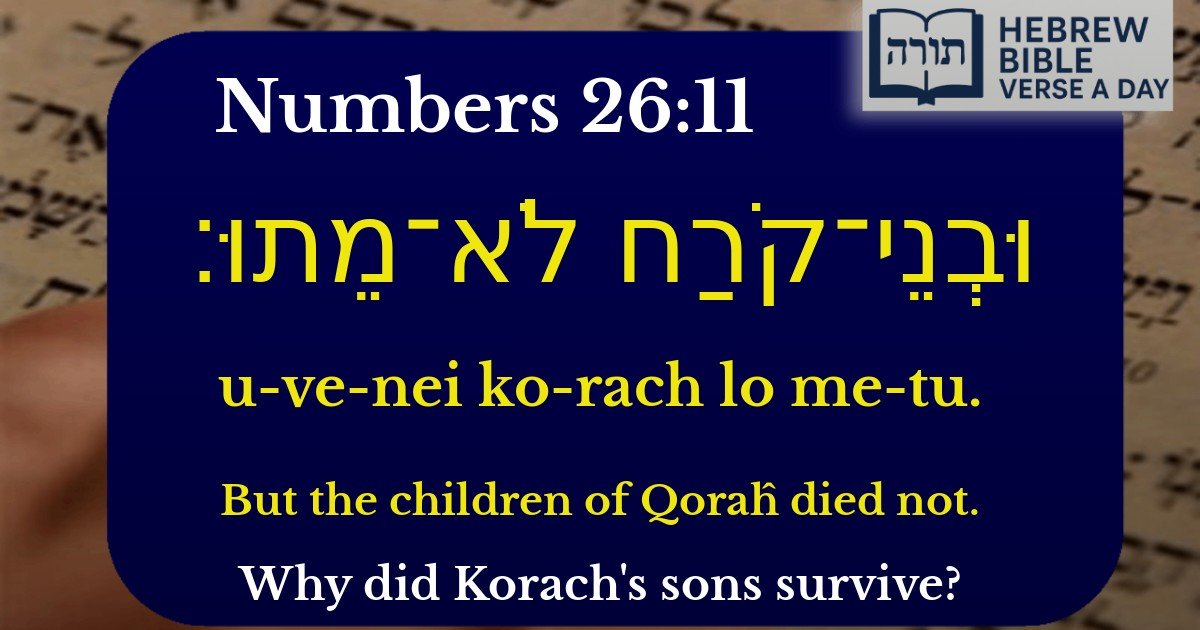

Numbers 26:11 - Why did Korach's sons survive?

Numbers 26:11 - במדבר 26:11

Hebrew Text

וּבְנֵי־קֹרַח לֹא־מֵתוּ׃

English Translation

But the children of Qoraĥ died not.

Transliteration

U-ve-nei ko-rach lo me-tu.

Hebrew Leining Text

וּבְנֵי־קֹ֖רַח לֹא־מֵֽתוּ׃ {ס}        

🎵 Listen to leining

Parasha Commentary

The Survival of Korach's Children

The verse "וּבְנֵי־קֹרַח לֹא־מֵתוּ" (But the children of Korach did not die) appears in Bamidbar (Numbers) 26:11, following the account of Korach's rebellion and its aftermath. This statement raises questions about why Korach's children were spared despite their father's severe sin.

Rashi's Explanation

Rashi (Bamidbar 26:11) explains that Korach's children initially joined their father's rebellion but later repented (חָזְרוּ בִּתְשׁוּבָה) in their hearts. As a result, they merited survival. This teaches that sincere repentance can overturn even a harsh decree.

Talmudic and Midrashic Insights

  • The Talmud (Sanhedrin 110a) states that Korach's children had a place reserved for them in Gehinnom, but they sang praises to Hashem, and this elevated them to safety.
  • The Midrash (Bamidbar Rabbah 18:20) suggests that Korach's sons separated themselves from their father's sin at the last moment, demonstrating that one is not punished for another's wrongdoing if they choose righteousness.

Rambam's Perspective

Rambam (Maimonides), in Hilchot Teshuvah (Laws of Repentance), emphasizes that repentance is always possible, even in dire circumstances. The survival of Korach’s children serves as a powerful example of how teshuvah can save a person from destruction.

Legacy in Tehillim

Korach’s descendants became prominent Levitical singers and composers, as seen in Tehillim (Psalms) 42-49, which are attributed to the "sons of Korach." This further illustrates how their repentance led to a lasting spiritual legacy.

📚 Talmud Citations

This verse is quoted in the Talmud.

📖 Sanhedrin 110a
The verse is discussed in the context of the fate of Korah's descendants, with the Talmud noting that while Korah's assembly perished, his sons did not die as they repented.
📖 Megillah 14a
Mentioned in relation to the lineage of the prophet Samuel, who was descended from Korah's sons, highlighting their survival and continued lineage.

Frequently Asked Questions

Q: What does the verse 'But the children of Qoraḥ died not' mean?
A: This verse (Numbers 26:11) teaches that while Qoraḥ (Korach) and his followers were punished for rebelling against Moshe (Moses), his children did not share their father's fate. According to Rashi and the Midrash (Sanhedrin 110a), they repented and were spared. This shows that even in severe punishments, Hashem recognizes individual merit and repentance.
Q: Why is it important that Qoraḥ's children survived?
A: It is important because it demonstrates the principle that children are not punished for their parents' sins if they choose a righteous path (Deuteronomy 24:16). The Talmud (Sanhedrin 110a) explains that Qoraḥ's children distanced themselves from their father's rebellion and repented. This teaches the value of personal responsibility and the power of teshuvah (repentance).
Q: What can we learn from the survival of Qoraḥ's children?
A: We learn that even in a family or community that strays, individuals can choose righteousness and be saved. The Midrash (Bamidbar Rabbah 18:8) states that Qoraḥ's children sang praises to Hashem, showing their devotion. This teaches that sincere repentance and good deeds can overturn harsh decrees.
Q: How does this verse apply to us today?
A: This verse reminds us that no one is doomed by their family background or past mistakes. The Rambam (Hilchot Teshuvah) emphasizes that repentance is always possible. Like Qoraḥ's children, we must take responsibility for our actions and strive for righteousness, regardless of our surroundings.