Frequently Asked Questions
Q: What is the meaning of Numbers 26:12?
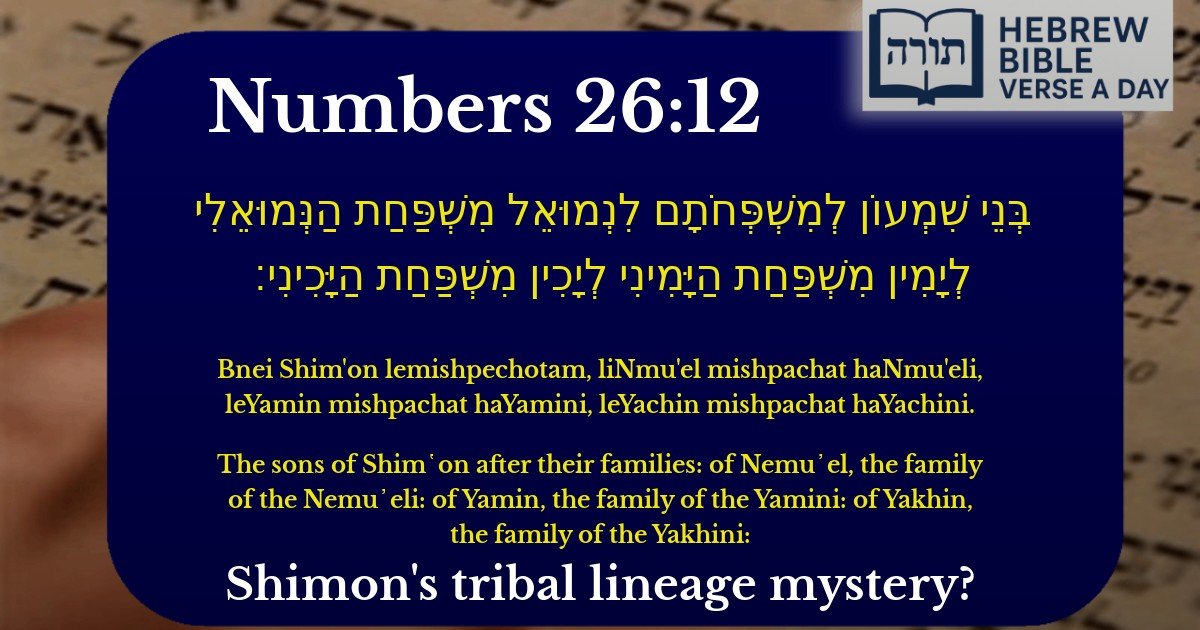
A: Numbers 26:12 lists the families descended from Shimon (Simeon), one of the twelve tribes of Israel. It mentions three main families: the Nemu'eli (from Nemu'el), the Yamini (from Yamin), and the Yakhini (from Yakhin). This verse is part of the census taken in the wilderness to count the Israelite men eligible for military service and to allocate land in the Promised Land.
Q: Why is the listing of families important in the Torah?
A: The listing of families in the Torah, like in Numbers 26:12, is important because it establishes the lineage and tribal identity of the Israelites. According to Rashi and other commentators, these genealogies ensure proper inheritance of land, maintain tribal distinctions, and fulfill God's promise to the forefathers that their descendants would be numerous and organized into tribes (see Genesis 48:5).
Q: What can we learn from the names in Numbers 26:12?
A: The names in Numbers 26:12—Nemu'el, Yamin, and Yakhin—reflect the heritage of the tribe of Shimon. Some Midrashic sources suggest that names in the Torah often carry deeper meanings or hint at the character of the individuals or families. For example, 'Yamin' means 'right hand,' symbolizing strength or favor. These names remind us of the importance of family identity and divine providence in shaping the tribes of Israel.
Q: How does this verse apply to Jewish identity today?
A: While tribal identities like those in Numbers 26:12 are not as prominent today, Orthodox Judaism still values lineage (yichus) for certain mitzvot, such as the Kohen, Levi, and Yisrael distinctions. The verse teaches the importance of preserving family heritage and recognizing our roots, as emphasized in Jewish tradition. Rambam (Hilchot Melachim 12:3) also discusses how tribal identities will be restored in the Messianic era.


Context in the Torah
This verse appears in Bamidbar (Numbers) 26:12, as part of the census of the Israelites in the wilderness. The verse lists the descendants of Shimon (Simeon) according to their families, specifically mentioning the families of Nemuel, Yamin, and Yachin.
Rashi's Commentary
Rashi (Rabbi Shlomo Yitzchaki) notes that the names of Shimon's sons here differ slightly from those listed earlier in Bereishit (Genesis) 46:10. In Bereishit, the sons are Nemuel, Yamin, Ohad, Yachin, Tzochar, and Shaul. Here, only Nemuel, Yamin, and Yachin are mentioned. Rashi explains that some families may have diminished in number or were not counted separately due to their involvement in the sin of Baal Peor (as referenced in Bamidbar 25:14).
Midrashic Insights
The Midrash Bamidbar Rabbah (21:4) elaborates that the tribe of Shimon suffered significant losses during the plague following the incident at Baal Peor. This explains why fewer families are enumerated here compared to the original listing in Bereishit. The Midrash emphasizes the consequences of sin and the importance of maintaining spiritual integrity.
Rambam's Perspective
While Rambam (Maimonides) does not comment directly on this verse, his broader teachings in Mishneh Torah (Hilchot Teshuvah) highlight the importance of repentance and the potential for individuals or families to rectify their spiritual standing. The diminished numbers in Shimon's tribe serve as a reminder of the need for vigilance in moral conduct.
Significance of the Names
Lessons for Today
The verse and its commentaries remind us of the enduring impact of our actions on future generations. The tribe of Shimon's experience underscores the importance of collective responsibility and the need for continuous spiritual growth. It also highlights the Torah's meticulous recording of family lineages, affirming the value of each individual's role in the broader Jewish community.