

Join Our Newsletter To Be Informed When New Videos Are Posted
Hebrew Text
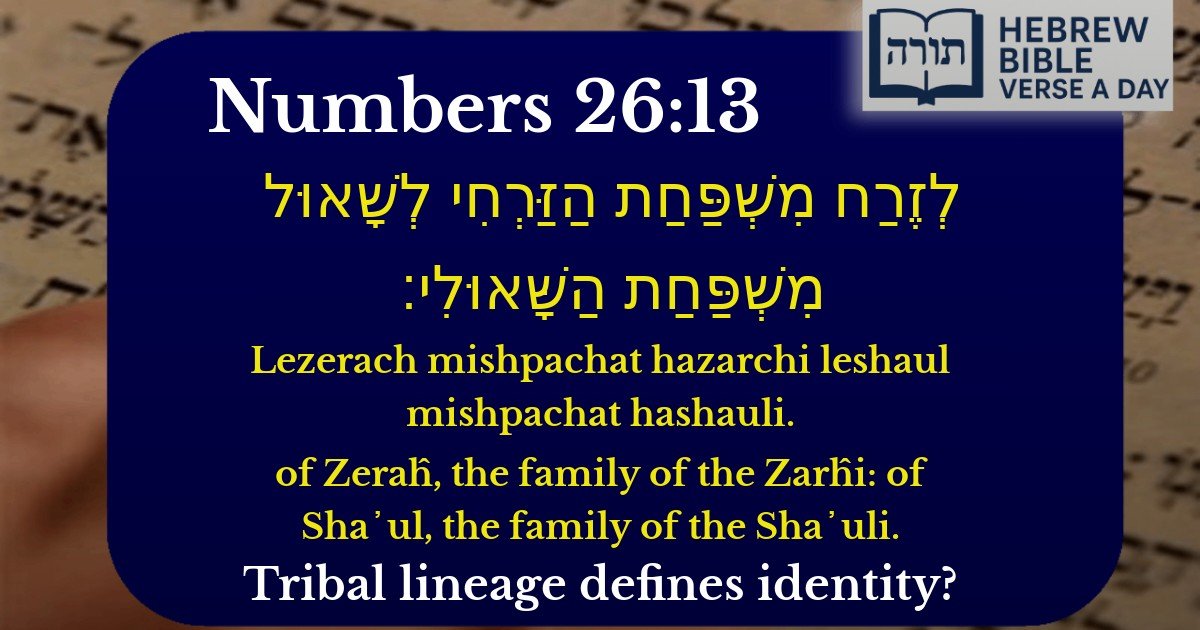
לְזֶרַח מִשְׁפַּחַת הַזַּרְחִי לְשָׁאוּל מִשְׁפַּחַת הַשָּׁאוּלִי׃
English Translation
of Zeraĥ, the family of the Zarĥi: of Sha᾽ul, the family of the Sha᾽uli.
Transliteration
Lezerach mishpachat hazarchi leshaul mishpachat hashauli.
Hebrew Leining Text
לְזֶ֕רַח מִשְׁפַּ֖חַת הַזַּרְחִ֑י לְשָׁא֕וּל מִשְׁפַּ֖חַת הַשָּׁאוּלִֽי׃
🎵 Listen to leining
Parasha Commentary
📚 Talmud Citations
This verse is not quoted in the Talmud.
Context in the Torah
The verse (Numbers 26:13) appears in the census of the Israelites taken in the plains of Moav before entering Eretz Yisrael. It lists the families of the tribe of Shimon, specifically mentioning the descendants of Zeraḥ and Shaul.
Rashi's Commentary
Rashi (Rabbi Shlomo Yitzchaki) explains that the family of the Zarḥi and Shauli are subdivisions of the tribe of Shimon, tracing their lineage back to Zeraḥ and Shaul, the sons of Shimon (Genesis 46:10). He notes that this enumeration follows the same pattern as the earlier census in the wilderness (Numbers 1:22-23), reinforcing the continuity of the tribal lineages.
Midrashic Insights
The Midrash (Bamidbar Rabbah 16:7) highlights that the tribe of Shimon was smaller in number compared to other tribes, which is attributed to the incident of Zimri (Numbers 25:14), where many from Shimon perished due to their involvement in sin. The mention of these families serves as a reminder of the tribe’s resilience despite their diminished numbers.
Rambam's Perspective
Rambam (Maimonides) in Mishneh Torah (Hilchot Shemita v’Yovel 10:8) emphasizes the importance of tribal lineage in matters of inheritance and land distribution in Eretz Yisrael. The detailed listing of families, including the Zarḥi and Shauli, underscores the Torah’s precision in preserving familial and tribal identities for halachic purposes.
Significance of Names
Halachic Implications
The Talmud (Bava Batra 117a) discusses how family divisions like the Zarḥi and Shauli were essential for determining inheritance rights and tribal land allocations. This verse thus serves as a legal foundation for the orderly division of Eretz Yisrael among the tribes and their families.