
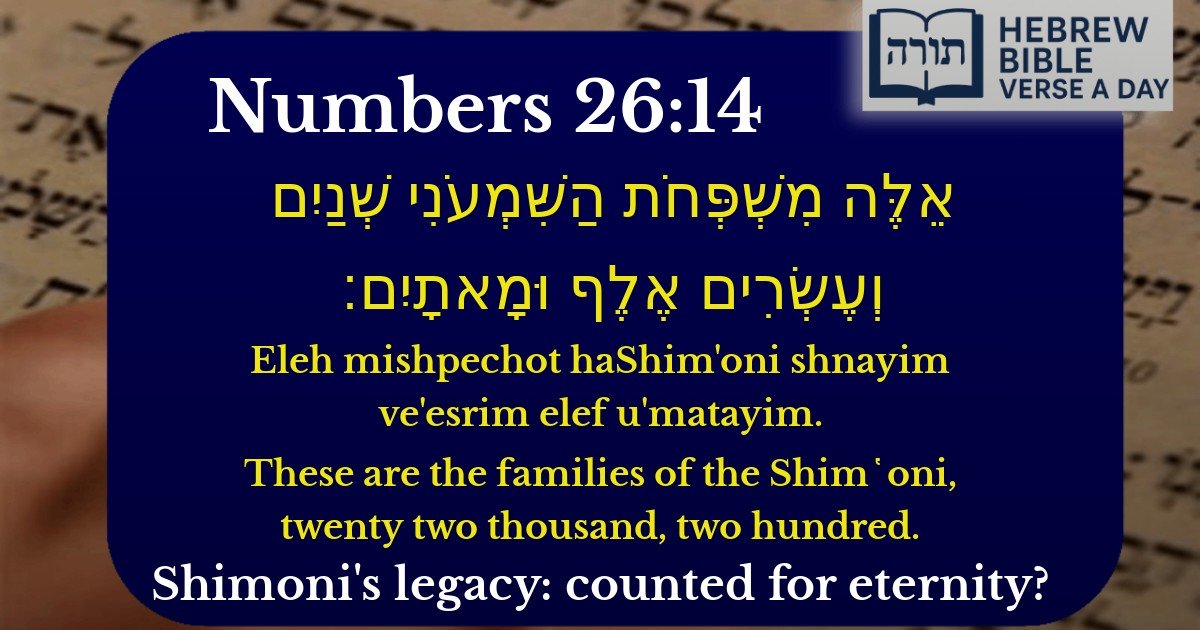

Numbers 26:14 - Shimoni's legacy: counted for eternity?

Numbers 26:14 - במדבר 26:14

Hebrew Text

אֵלֶּה מִשְׁפְּחֹת הַשִּׁמְעֹנִי שְׁנַיִם וְעֶשְׂרִים אֶלֶף וּמָאתָיִם׃

English Translation

These are the families of the Shim῾oni, twenty two thousand, two hundred.

Transliteration

Eleh mishpechot haShim'oni shnayim ve'esrim elef u'matayim.

Hebrew Leining Text

אֵ֖לֶּה מִשְׁפְּחֹ֣ת הַשִּׁמְעֹנִ֑י שְׁנַ֧יִם וְעֶשְׂרִ֛ים אֶ֖לֶף וּמָאתָֽיִם׃ {ס}        

🎵 Listen to leining

Parasha Commentary

Context of the Verse

The verse (Numbers 26:14) appears in the census of the Israelites taken in the wilderness, specifically listing the families and numbers of the tribe of Shimon (Shimoni). This census occurs before the Israelites enter the Land of Israel, serving both as a record of the nation's size and as a means of allocating tribal portions in the land.

Rashi's Commentary

Rashi (Rabbi Shlomo Yitzchaki) notes that the tribe of Shimon experienced a significant decrease in population compared to the previous census (Numbers 1:23), where they numbered 59,300. Here, they are only 22,200. Rashi explains this drastic reduction as a consequence of the plague in Numbers 25:9, which resulted from the sin of Baal Peor. Since the tribe of Shimon was heavily involved in that transgression (as indicated by Zimri ben Salu, a Shimonite prince), they suffered greater losses.

Midrashic Insights

  • Bamidbar Rabbah (21:3): The Midrash emphasizes that the tribe of Shimon's decline was a direct result of their moral failings, particularly their involvement in idolatry and immorality at Baal Peor. This serves as a lesson on the consequences of straying from Torah values.
  • Sifrei: The Sifrei highlights that the phrase "אֵלֶּה מִשְׁפְּחֹת הַשִּׁמְעֹנִי" ("These are the families of the Shimoni") underscores that despite their diminished numbers, the families and lineage of Shimon remained intact, preserving their tribal identity.

Rambam's Perspective

While Rambam (Maimonides) does not comment directly on this verse, his teachings in Mishneh Torah (Hilchot Teshuvah) about divine justice and collective punishment align with the principle seen here. The tribe's suffering was a corrective measure, intended to inspire repentance and reinforce the severity of violating Torah commandments.

Numerical Significance

The number 22,200 may also carry symbolic meaning. Some commentators suggest that the repetition of the number 2 (in "twenty-two thousand, two hundred") reflects the duality of the tribe's struggle—both in their external battles and their internal moral challenges.

📚 Talmud Citations

This verse is not quoted in the Talmud.

Frequently Asked Questions

Q: What does the verse 'These are the families of the Shimoni, twenty two thousand, two hundred' mean?
A: This verse is part of the census taken in the wilderness (Bamidbar 26), counting the Israelite tribes. It specifies the number of men from the tribe of Shimon (Shimoni) who were eligible for military service—22,200. Rashi explains that this census was taken before entering Eretz Yisrael to allocate land fairly among the tribes.
Q: Why is the number of the tribe of Shimon important?
A: The number shows the strength and size of each tribe before entering the Land of Israel. The tribe of Shimon had 22,200 men, which was smaller compared to other tribes. The Midrash (Bamidbar Rabbah) notes that this reflects consequences from earlier events, such as the sin of Zimri (a Shimonite leader), which may have impacted their numbers.
Q: What can we learn from the census of the tribes in this verse?
A: The census teaches us that every individual counts in Klal Yisrael (the Jewish people). Rambam (Hilchot Melachim) explains that counting emphasizes the value of each person in fulfilling the nation's mission. Additionally, the decrease in Shimon's numbers (compared to an earlier census) reminds us of the consequences of sin and the importance of repentance.
Q: How does this verse apply to us today?
A: Just as each tribe was counted for a purpose (military service and land inheritance), every Jew today has a unique role in serving Hashem. The Talmud (Sanhedrin 17b) teaches that communal responsibility depends on each person’s contribution. The smaller number of Shimon also reminds us to strengthen our commitment to Torah and mitzvot.