Frequently Asked Questions
Q: What does Numbers 26:18 mean?
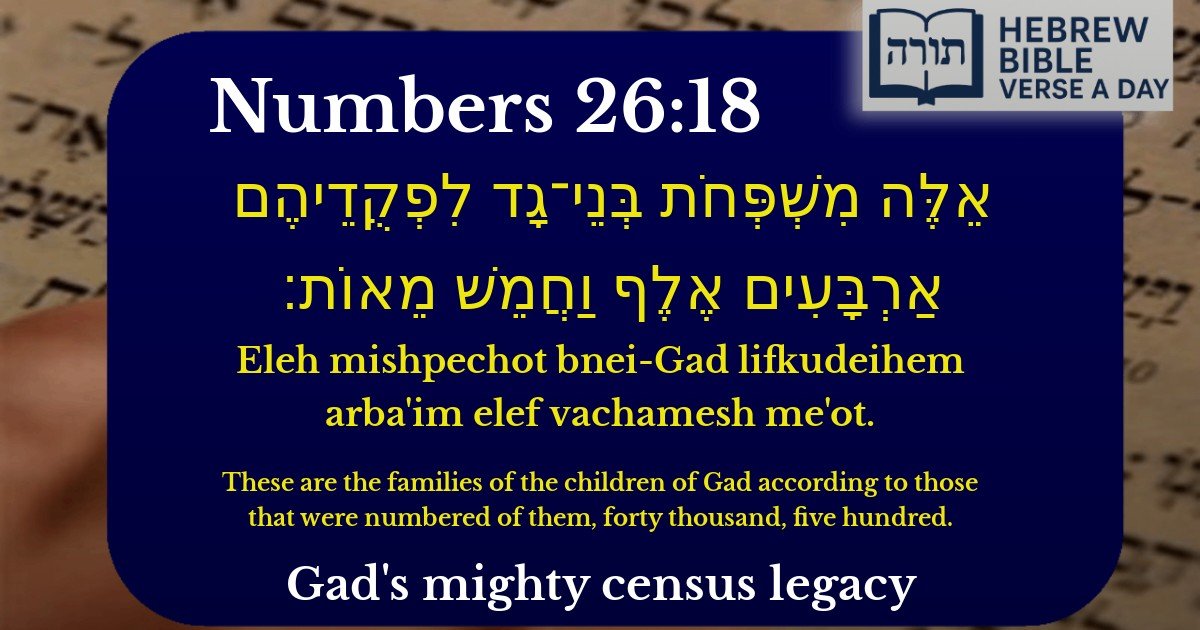
A: Numbers 26:18 records the census count of the tribe of Gad during the Israelites' journey in the wilderness. It states that there were 40,500 men eligible for military service from the families of Gad. This verse is part of a larger census taken before entering the Land of Israel, as commanded by Hashem (Numbers 26:2).
Q: Why is the counting of the tribe of Gad important?
A: The counting of each tribe, including Gad, was important for several reasons: 1) To know the military strength of Israel before entering the Land (Rashi on Numbers 26:2), 2) To show Hashem's care for each individual (Midrash Tanchuma Ki Tisa 9), and 3) To establish the tribal inheritances in the Land of Israel (Numbers 26:52-56).
Q: How does the number 40,500 for Gad compare to their previous count?
A: In the first census (Numbers 1:25), Gad had 45,650 men. The decrease to 40,500 shows a loss of 5,150 men. Our Sages explain this decrease was due to punishments during the wilderness years (Rashi on Numbers 26:18), teaching us the importance of learning from past mistakes.
Q: What can we learn from the mention of 'families' in this verse?
A: The Torah emphasizes 'these are the families of Gad' to teach that each family maintained its unique identity even within the larger tribe. This shows the value of preserving family traditions and lineage, which remains important in Jewish life today (Rambam, Hilchot Issurei Bi'ah 19:17).
Q: How does this verse about Gad apply to us today?
A: Just as each tribe was counted individually, we learn that every Jew matters to Hashem. The specific counting of Gad reminds us that we each have unique roles in serving Hashem and contributing to the Jewish people (Likutei Sichos vol. 33, p. 176).


Context in the Torah
The verse (Bamidbar 26:18) appears in the census of the tribes of Israel taken in the wilderness before entering Eretz Yisrael. It specifies the number of men from the tribe of Gad who were eligible for military service. The count of 40,500 reflects the strength of Gad's descendants at that time.
Rashi's Commentary
Rashi notes that the tribe of Gad decreased in number from the first census (Bamidbar 1:25), where they were counted as 45,650. He explains this decrease by citing the Midrash (Tanchuma Pinchas 12) that the tribe of Gad was particularly affected by the plague in Baal Peor (Bamidbar 25:9), as they were more susceptible to the enticements of the Midianites.
Significance of the Number
The Baal HaTurim points out that the numerical value (gematria) of "Gad" (גד) is 7, and the tribe's count of 40,500 can be divided by 7 (40,500 ÷ 7 = 5,785 with a remainder). This hints at the divine providence overseeing the tribe's numbers.
Spiritual Lessons
Gad's Military Role
Ibn Ezra observes that Gad's substantial numbers (despite the decrease) reflected their future role as warriors. This aligns with Moshe's blessing (Devarim 33:20-21) that Gad would "tear the arm and the crown," indicating their prowess in battle when settling east of the Jordan.