Frequently Asked Questions
Q: What does Numbers 26:22 mean when it lists the families of Yehuda?
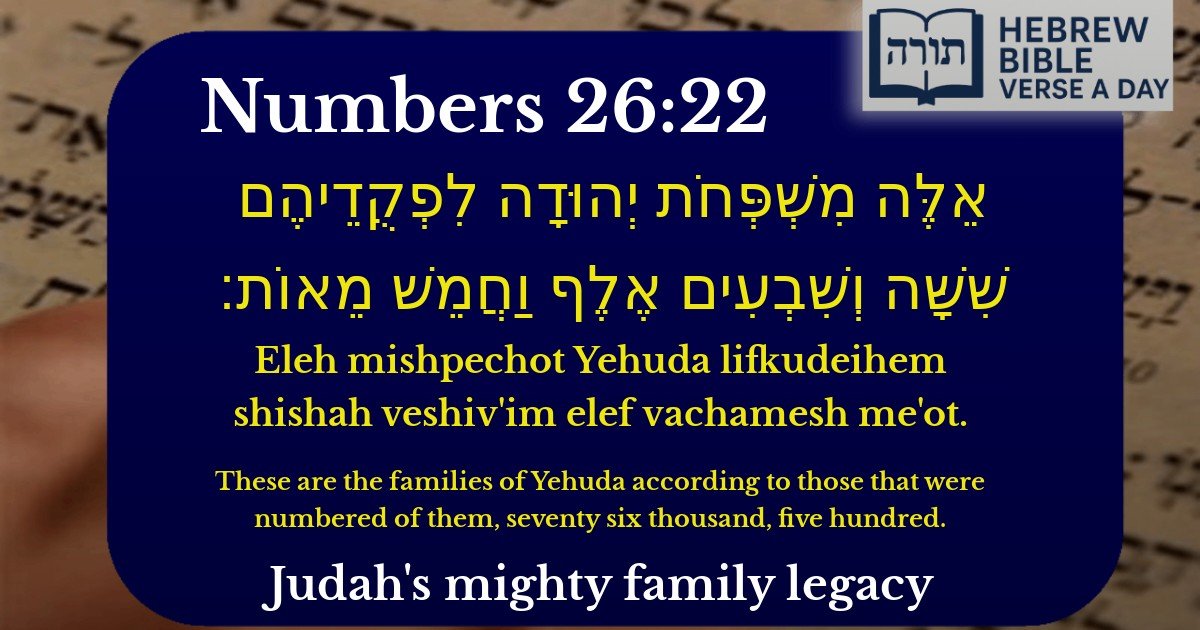
A: Numbers 26:22 records the census count of the tribe of Yehuda (Judah) during the Israelites' journey in the wilderness. It lists their families and totals 76,500 men eligible for military service. This shows the size and strength of Yehuda, which later became the leading tribe in Israel (as seen in the Davidic dynasty). Rashi explains that these counts were important for organizing the camp and distributing the Land of Israel.
Q: Why is the tribe of Yehuda counted separately in the Torah?
A: Yehuda is counted separately because it held a special role among the tribes. According to the Midrash (Bamidbar Rabbah), Yehuda was given prominence because kingship would come from this tribe (as seen with King David). The Rambam also notes that tribal lineage was crucial for inheritance and land division in Israel, making these counts halachically significant.
Q: How does the number 76,500 for Yehuda compare to other tribes?
A: Yehuda was the largest tribe at this time, as seen in Numbers 26. For comparison, Dan had 64,400, and Issachar had 64,300. The Talmud (Bava Batra 121a) discusses why certain tribes grew more—Yehuda's blessing from Yaakov (Genesis 49:8-12) and their strong leadership contributed to their numbers.
Q: What can we learn from the detailed census in Numbers 26?
A: The census teaches that every individual in Klal Yisrael (the Jewish people) matters. The Midrash (Tanchuma) explains that counting shows G-d's love for His people, like a king who repeatedly counts his treasured coins. Additionally, the orderly listing of families emphasizes the importance of preserving lineage and tribal identity in Judaism.
Q: Does the tribe of Yehuda still exist today?
A: Yes, Jewish tradition maintains that tribal identities were preserved through careful genealogical records (see Rambam's Hilchos Melachim 12:3). While the full identification is hidden until Mashiach's time, many Jews today are part of Yehuda (most Ashkenazi/Sephardi Jews) or Levi (Levites and Kohanim). The Vilna Gaon taught that tribal roles will be fully restored in the future redemption.


Context in the Torah
The verse (Bamidbar 26:22) appears in the census of Bnei Yisrael taken in the wilderness, listing the families of Shevet Yehuda and their total count of 76,500 men eligible for military service. This census occurs after the plague following the sin of Ba'al Pe'or and before the entry into Eretz Yisrael.
Rashi's Commentary
Rashi notes that the phrase "אֵלֶּה מִשְׁפְּחֹת יְהוּדָה" ("These are the families of Yehuda") emphasizes the continuity of Yehuda's lineage despite the challenges faced in the wilderness. He connects this to Bereishit 46:12, where Yehuda's sons are first listed, showing how the tribe remained intact through the Egyptian exile and desert wanderings.
Significance of the Number
The count of 76,500 reflects Yehuda's status as the largest tribe, fulfilling Yaakov Avinu's blessing (Bereishit 49:8): "יְהוּדָה אַתָּה יוֹדוּךָ אַחֶיךָ" ("Yehuda, your brothers shall acknowledge you"). The Midrash (Bamidbar Rabbah 2:7) explains that Yehuda's numerical prominence symbolized its future role in leadership, ultimately producing the Davidic dynasty.
Structural Analysis
Halachic Implication
Rambam (Hilchot Melachim 1:7) derives from Yehuda's enduring leadership that monarchy must come specifically from this tribe, as reinforced by its consistent numerical strength in both censuses. This became the basis for the halachic requirement that Mashiach must descend from David and Yehuda.