Frequently Asked Questions
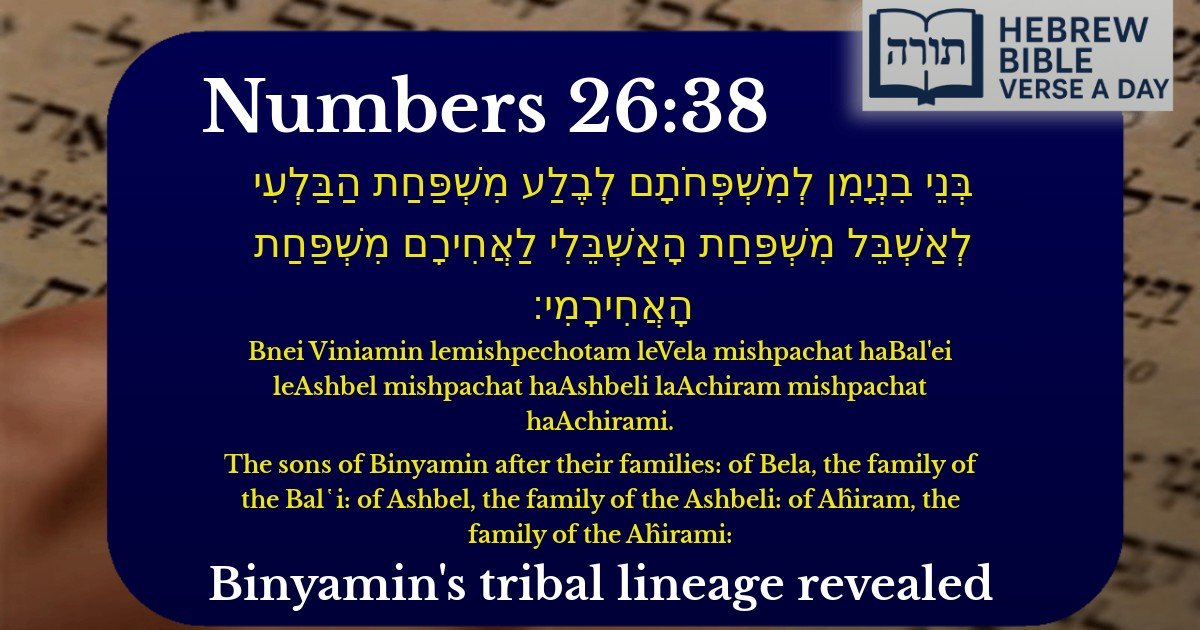
Q: Why does the Torah list the families of Binyamin in Numbers 26:38?
A: The Torah lists the families of Binyamin (Benjamin) to document the tribal lineage of the Israelites, which was important for inheritance, tribal roles, and maintaining Jewish identity. Rashi explains that these genealogies were recorded when the Jews were counted before entering the Land of Israel.
Q: What is the significance of the names Bela, Ashbel, and Achiram in Numbers 26:38?
A: Bela, Ashbel, and Achiram were sons of Binyamin (Benjamin), and their names represent distinct family clans within the tribe. The Midrash teaches that each name carries meaning—for example, 'Bela' may relate to 'devouring' (as Jacob's blessing hinted at Binyamin's fierce nature), showing how traits and destinies were embedded in their names.
Q: How does this verse connect to the rest of the Torah?
A: This verse continues the census in the Book of Numbers, which ensures an orderly division of the Land of Israel among the tribes. Rambam (Maimonides) emphasizes that tribal lineage was essential for assigning portions of the land, as well as for maintaining the structure of Jewish society.
Q: Why is tribal lineage important in Judaism?
A: Tribal lineage (like the families of Binyamin listed here) was crucial for inheritance, marriage laws, and roles such as the priesthood (for Levi) or kingship (for Judah). The Talmud (Kiddushin 70a) discusses how lineage preserves Jewish identity and halachic (legal) distinctions between tribes.
Q: Can we trace modern Jewish families back to these biblical tribes?
A: While most tribal identities were lost after the Assyrian exile (except for Levi and some traces of Judah), Jewish tradition still values lineage (yichus). The Talmud (Pesachim 4a) teaches that knowing one's roots fosters spiritual connection, though today, all Jews are part of Klal Yisrael (the collective Jewish people).


Context in Sefer Bamidbar
This verse appears in Bamidbar (Numbers) 26:38, as part of the census of Bnei Yisrael in the plains of Moav before entering Eretz Yisrael. The Torah lists the families of Shevet Binyamin, detailing their lineage through Bela, Ashbel, and Achiram.
Rashi's Commentary on the Names
Rashi (Bamidbar 26:38) notes that these names correspond to earlier names mentioned in Bereishit (Genesis) 46:21, where Binyamin's sons are listed as Bela, Becher, Ashbel, etc. Rashi explains that some names changed over time due to significant events:
Significance of Family Lineages
The Rambam (Hilchot Shemitta V'Yovel 10:4) emphasizes the importance of preserving tribal lineage, as it affects inheritance, marriage laws, and future redemption. The meticulous recording of families in this census ensured the integrity of Shevet Binyamin's identity.
Midrashic Insights
The Midrash Tanchuma (Bamidbar 12) teaches that Shevet Binyamin was uniquely beloved, as their ancestor Binyamin was the only son born in Eretz Yisrael. The listing of their families highlights their distinction and future role in Jewish history (e.g., the first king, Shaul, descended from Binyamin).
Lessons in Identity
The Sforno (Bamidbar 26:38) notes that the repetition of family names (e.g., "Bal῾i" from Bela) reinforces the idea that each family's unique traits were preserved through generations. This teaches the value of maintaining one's heritage while contributing to Klal Yisrael.