Frequently Asked Questions
Q: What does Numbers 26:48 mean?
A: Numbers 26:48 lists the descendants of the tribe of Naftali, specifically mentioning the families of Yaĥże᾽el and Guni. This verse is part of a larger census taken in the wilderness to count the Israelite men eligible for military service and to allocate portions of the Land of Israel.
Q: Why is the tribe of Naftali mentioned in the Torah?
A: The tribe of Naftali is one of the twelve tribes of Israel, descended from Naftali, the son of Yaakov (Jacob). The Torah mentions them to show their lineage and their role among the tribes, as well as their future inheritance in the Land of Israel (as described in Joshua 19:32-39).
Q: What can we learn from the census of the tribes in Numbers 26?
A: The census teaches us the importance of each individual and family within the nation of Israel. Rashi explains that counting the people showed G-d's love for them, like a shepherd who counts his flock. It also prepared them for entering the Land of Israel by organizing them for inheritance and leadership roles.
Q: How does the division of tribes and families apply today?
A: While we no longer have the tribal structure today, the concept of family lineage remains important in Judaism, especially regarding traditions like the Kohen, Levi, and Yisrael distinctions. The Rambam (Maimonides) discusses how certain mitzvot and customs are tied to family heritage.
Q: What is the significance of family names like 'Yaĥże᾽eli' and 'Guni'?
A: These names represent distinct family clans within the tribe of Naftali. The Midrash teaches that family identities were preserved to maintain the unique spiritual qualities of each tribe and family, ensuring the diversity and unity of the Jewish people.

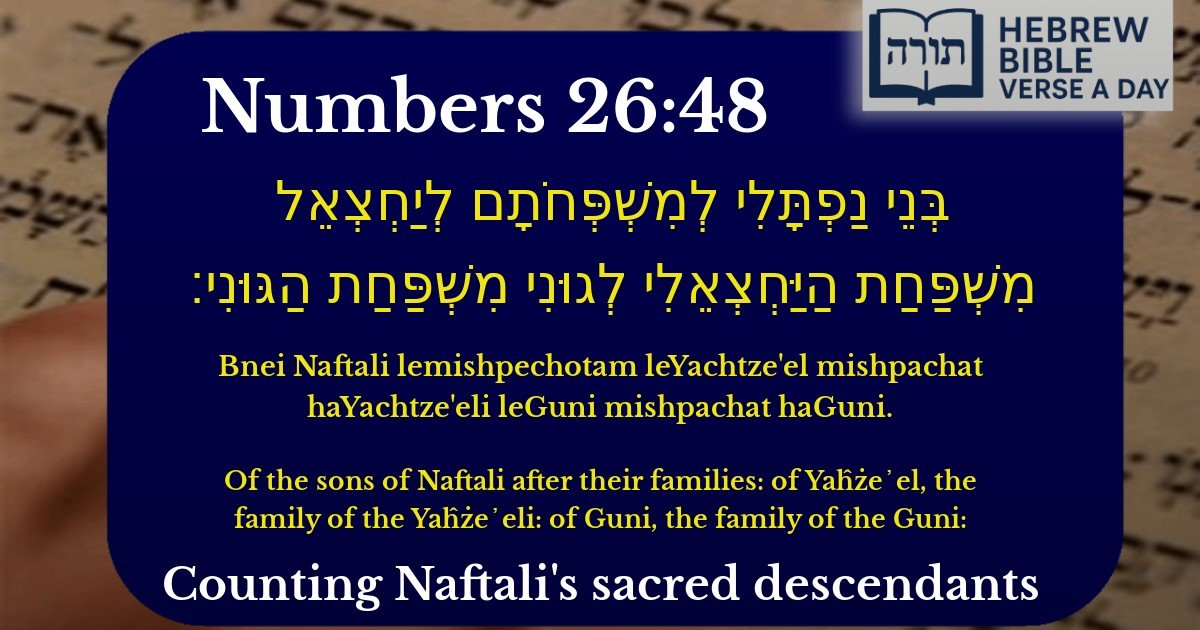

The Sons of Naftali and Their Families
The verse enumerates the descendants of Naftali, the sixth son of Yaakov Avinu, listing their families according to their lineage. This follows the pattern of the Torah's detailed genealogical records, emphasizing the importance of tribal identity and ancestral heritage in Klal Yisrael.
Rashi's Explanation
Rashi (Bamidbar 26:48) notes that the Torah lists the families of Naftali to demonstrate how each tribe maintained its unique identity even after generations. The names Yaĥże᾽el and Guni reflect the characteristics or events associated with their ancestors, as was common in biblical naming conventions.
Significance of Tribal Lineage
The Rambam (Hilchot Shemita v'Yovel 10:5) explains that tribal lineage was crucial for maintaining the division of Eretz Yisrael among the tribes. Each family's inheritance was tied to their ancestral roots, ensuring the fulfillment of the divine promise to Avraham, Yitzchak, and Yaakov.
Midrashic Insights
Halachic Implications
The Talmud (Bava Batra 121b) discusses how these family divisions influenced land apportionment and inheritance laws. The precise recording of lineages ensured that tribal lands remained within their designated boundaries, as commanded in the Torah.