Frequently Asked Questions
Q: What does it mean when the Torah says 'And the Lord spoke to Moshe, saying'?
A: This phrase appears frequently in the Torah to introduce divine commandments or instructions given to Moshe (Moses). According to Rashi and other commentators, it emphasizes that Moshe received these words directly from Hashem (God) to transmit to the Jewish people, ensuring the authenticity of the Torah's teachings.
Q: Why does the Torah repeat 'saying' after 'And the Lord spoke to Moshe'?
A: The word 'saying' (לֵּאמֹר) indicates that Moshe was to relay these words to the Jewish people. The Talmud (Yoma 4b) explains that this teaches us Moshe's role as the faithful transmitter of Hashem's commandments, ensuring the message was delivered accurately to Bnei Yisrael (the Children of Israel).
Q: Is there significance to how the Torah introduces God's words to Moshe?
A: Yes. The Rambam (Maimonides) explains in Moreh Nevuchim that this phrasing highlights the prophecy of Moshe, which was unique in its clarity and directness. Unlike other prophets who received messages through visions or dreams, Moshe spoke with Hashem 'face to face' (Devarim 34:10), making his transmission of the Torah entirely reliable.
Q: How does this verse connect to the broader context of Parshat Pinchas?
A: In Parshat Pinchas (where this verse appears), Hashem instructs Moshe about dividing the Land of Israel among the tribes. The Midrash (Bamidbar Rabbah 21:13) teaches that this introduction reminds us that the allocation of the Land was not human decision-making, but a divine commandment given through Moshe, showing the holiness of Eretz Yisrael (the Land of Israel).
Q: What can we learn from this verse about communication with Hashem?
A: The Sforno explains that this phrasing teaches us the importance of precise transmission of Torah teachings. Just as Moshe carefully relayed Hashem's words, we must strive to learn and teach Torah accurately. The Mishnah in Avot (1:1) also derives from this the principle of 'making a fence around the Torah'—preserving its integrity through proper transmission.


Introduction to Divine Communication
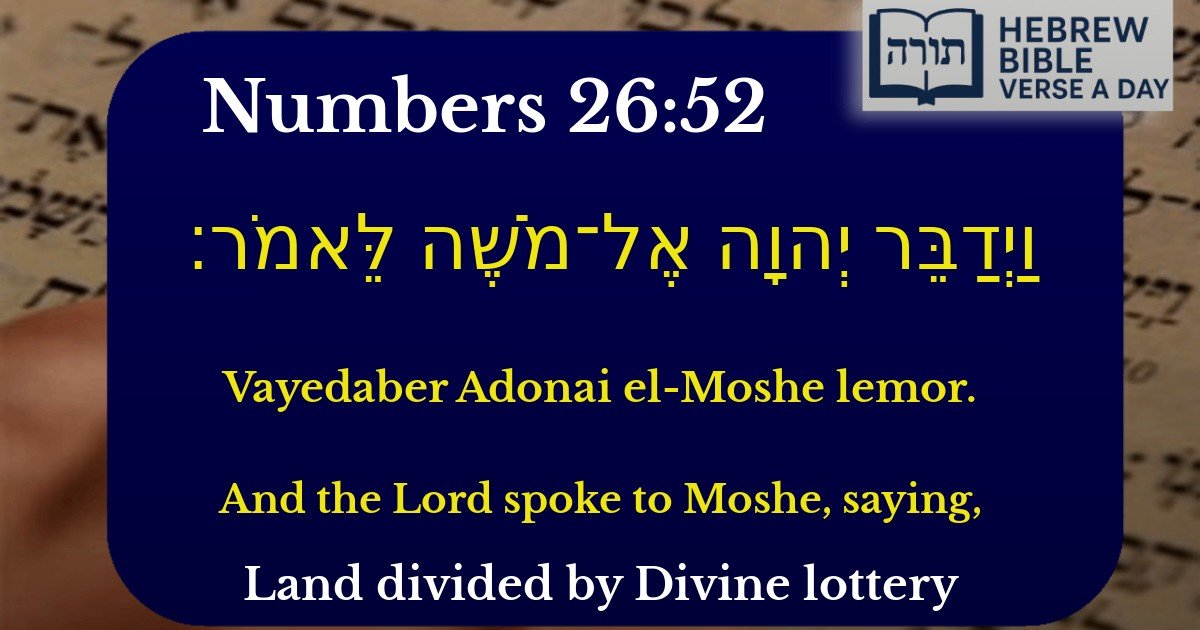
The verse "וַיְדַבֵּר יְהוָה אֶל־מֹשֶׁה לֵּאמֹר" ("And the Lord spoke to Moshe, saying") appears frequently in the Torah, marking the beginning of divine communication. According to Rashi (Shemot 6:2), this phrase emphasizes that Hashem's words were conveyed to Moshe with clarity and precision, ensuring no misunderstanding in transmission. The term "לֵּאמֹר" ("saying") indicates that Moshe was to relay these words to Bnei Yisrael, underscoring his role as the intermediary.
The Nature of Prophecy
The Rambam (Hilchot Yesodei HaTorah 7:6) explains that Moshe's prophecy was unique—unlike other prophets who received visions in dreams or allegories, Moshe heard Hashem's words directly and with absolute clarity. This verse exemplifies the direct and unfiltered communication between Hashem and Moshe, a hallmark of Moshe Rabbeinu's unparalleled prophetic stature.
Midrashic Insights
Theological Implications
The Malbim (commentary on Shemot 6:2) elaborates that the phrasing "אֶל־מֹשֶׁה" ("to Moshe")—rather than "through Moshe"—emphasizes the intimate, personal nature of the communication. This reflects the principle that Torah is not merely a set of laws but a living dialogue between Hashem and His people, mediated by Moshe as the faithful transmitter.