Frequently Asked Questions
Q: What does Numbers 26:53 mean when it says the land will be divided 'according to the number of names'?
A: This verse refers to the division of the Land of Israel among the tribes based on the census taken in Numbers 26. Rashi explains that larger tribes received larger portions of land, while smaller tribes received smaller portions, proportional to their population size. The 'number of names' means counting each individual by name to determine fair distribution.
Q: Why was the land divided according to tribe sizes in Numbers 26:53?
A: The division based on tribe sizes reflects the principle of fairness in Jewish law. The Rambam (Hilchot Terumot 1:5) explains that inheritance laws in the Torah ensure equitable distribution. Larger tribes needed more land to sustain their population, while smaller tribes required less. This system maintained balance and prevented disputes over territory.
Q: How does the inheritance of the Land of Israel in Numbers 26:53 apply to Jews today?
A: While we don't currently divide the Land physically as in biblical times, the principle of equitable distribution remains important in Jewish law (halacha). The Talmud (Bava Batra 122a) discusses how this concept applies to inheritance laws today. Additionally, this verse reminds us of the eternal Jewish connection to the Land of Israel, as promised in the Torah.
Q: What is the significance of counting 'by name' in Numbers 26:53?
A: Counting by name emphasizes the value of each individual. The Midrash (Bamidbar Rabbah 21:10) teaches that when the Torah mentions counting by name, it shows that every Jew matters in building the nation. Even in a large census, each person's unique identity contributes to the whole community's inheritance in the Land.
Q: Which tribes received land according to Numbers 26:53?
A: The verse refers to the twelve tribes of Israel who would inherit portions in the Land. However, as Rashi notes on Numbers 26:55, the tribe of Levi did not receive a territorial portion like the others, as their inheritance was service in the Mishkan (Tabernacle) and later the Temple. The land was divided among the remaining tribes proportionally.


Context in Sefer Bamidbar
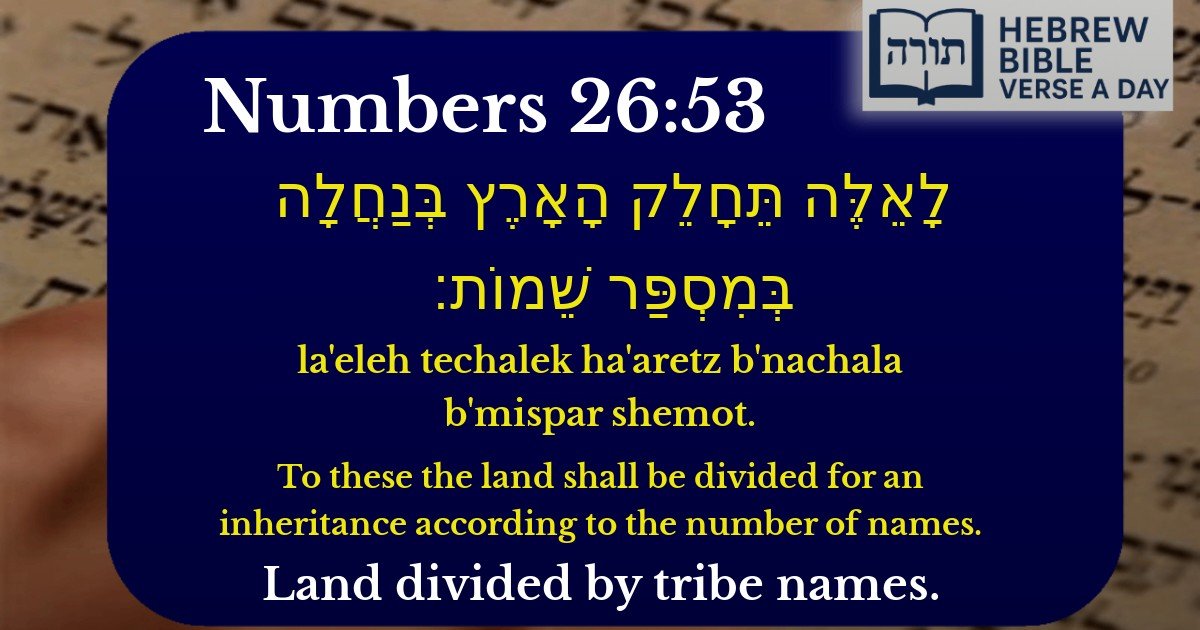
The verse (Bamidbar 26:53) appears in the context of the census taken of Bnei Yisrael in the wilderness before entering Eretz Yisrael. Hashem commands Moshe to divide the land among the tribes based on the number of names counted in this census.
Rashi's Explanation
Rashi explains that the division of the land was to be proportional to the size of each tribe. A larger tribe would receive a larger portion, while a smaller tribe would receive a smaller portion. However, Rashi clarifies that this proportionality applied only to the general tribal territories, not to individual family plots within each tribe's portion.
Ramban's Additional Insight
The Ramban adds that the phrase "בְּמִסְפַּר שֵׁמוֹת" (according to the number of names) emphasizes that the land was to be divided based on the actual count of individuals, not just tribal affiliation. This ensured a just distribution where each person's inheritance was accounted for in the allocation process.
Midrashic Interpretation
The Midrash Tanchuma connects this verse to the concept of zechus avos (merit of the ancestors). It explains that the land was divided not only based on current population numbers, but also in merit of the forefathers whose names are eternally bound to the land of Israel.
Halachic Implications
Spiritual Dimension
The Sforno suggests that the emphasis on "names" teaches that each individual's unique spiritual identity was considered in the land allocation. Just as no two names are identical, each person's portion in Eretz Yisrael reflected their distinct spiritual mission.