

Join Our Newsletter To Be Informed When New Videos Are Posted
Hebrew Text
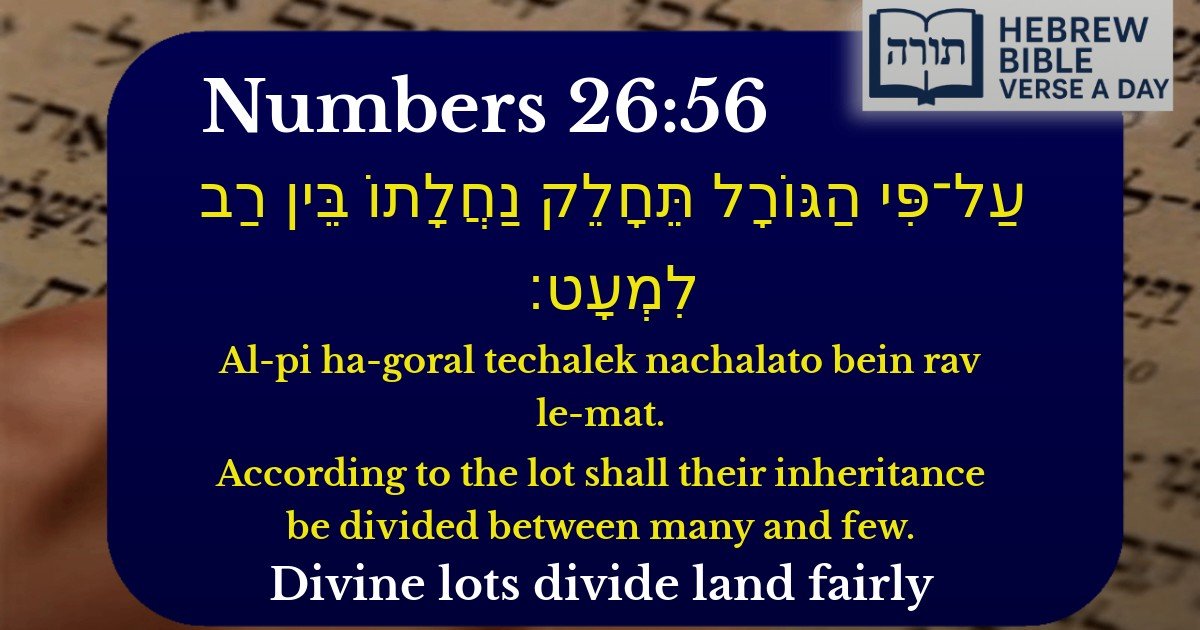
עַל־פִּי הַגּוֹרָל תֵּחָלֵק נַחֲלָתוֹ בֵּין רַב לִמְעָט׃
English Translation
According to the lot shall their inheritance be divided between many and few.
Transliteration
Al-pi ha-goral techalek nachalato bein rav le-mat.
Hebrew Leining Text
עַל־פִּי֙ הַגּוֹרָ֔ל תֵּחָלֵ֖ק נַחֲלָת֑וֹ בֵּ֥ין רַ֖ב לִמְעָֽט׃ {ס}
🎵 Listen to leining
Parasha Commentary
📚 Talmud Citations
This verse is quoted in the Talmud.
📖 Bava Batra 122a
The verse is referenced in the discussion about the division of the Land of Israel among the tribes by lot, emphasizing the divine allocation of land.
Context of the Verse
The verse (Bamidbar 26:55) discusses the division of the Land of Israel among the tribes, emphasizing that the allocation was determined by lot (goral). This method ensured divine involvement in the distribution, as the outcome was seen as directly guided by Hashem's will.
Rashi's Explanation
Rashi (Bamidbar 26:55) explains that the division by lot was a miraculous process. The names of the tribes and the boundaries of the land were inscribed on separate lots, and they miraculously matched perfectly—demonstrating that the allocation was not random but divinely ordained. This ensured fairness, as no human bias could influence the distribution.
Rambam's Perspective
Rambam (Hilchot Terumot 1:5) discusses the principle of equitable distribution in halachah. While the verse refers to land inheritance, Rambam extends the concept to other areas of Jewish law, teaching that fairness and divine providence should govern all communal allocations, whether material or spiritual.
Midrashic Insights
Halachic Implications
The Talmud (Bava Batra 122a) derives from this verse that inheritance in general should follow clear, unbiased rules. The use of the lot (goral) serves as a model for resolving disputes fairly, whether in land division or other legal matters, ensuring that human judgment does not override divine justice.
Spiritual Lesson
The Sforno (Bamidbar 26:55) highlights that this system reinforced the idea that the Land of Israel is a divine gift. By accepting the lot's outcome, the tribes acknowledged that their portion was not merely a human allocation but a sacred trust from Hashem, tailored to their spiritual needs.