Frequently Asked Questions
Q: What does Numbers 27:9 mean?
A: Numbers 27:9 discusses the laws of inheritance in the Torah. It states that if a man dies without having any sons or daughters, his inheritance should be given to his brothers. This is part of the broader Torah laws about passing down property within a family, ensuring that land and possessions stay within the tribe (as explained in Rashi and the Talmud, Bava Batra 109b).
Q: Why is inheritance given to brothers if there are no daughters?
A: The Torah establishes a clear order of inheritance to maintain family and tribal continuity. If a man has no sons or daughters, the next in line are his brothers (as seen in Numbers 27:9). This ensures that property remains within the family and tribe, preserving ancestral land as commanded in the Torah (based on Rambam’s Mishneh Torah, Laws of Inheritance 1:1-3).
Q: What can we learn from this verse about Jewish inheritance laws?
A: This verse teaches us that the Torah provides a structured system for inheritance to prevent disputes and keep property within the family. The order is sons first, then daughters if there are no sons, and then brothers if there are no children (as detailed in Talmud, Bava Batra 115a). This reflects the Torah’s emphasis on family responsibility and tribal continuity.
Q: How do Jewish inheritance laws apply today?
A: While modern civil laws may differ, traditional Jewish law (halacha) still follows the Torah’s inheritance principles. If a Jewish person passes away without children, their brothers would have a claim to the inheritance according to halacha (as ruled by Rambam and Shulchan Aruch, Choshen Mishpat 276). However, today, many people also write a halachic will (tzava’ah) to clarify their wishes within Torah guidelines.

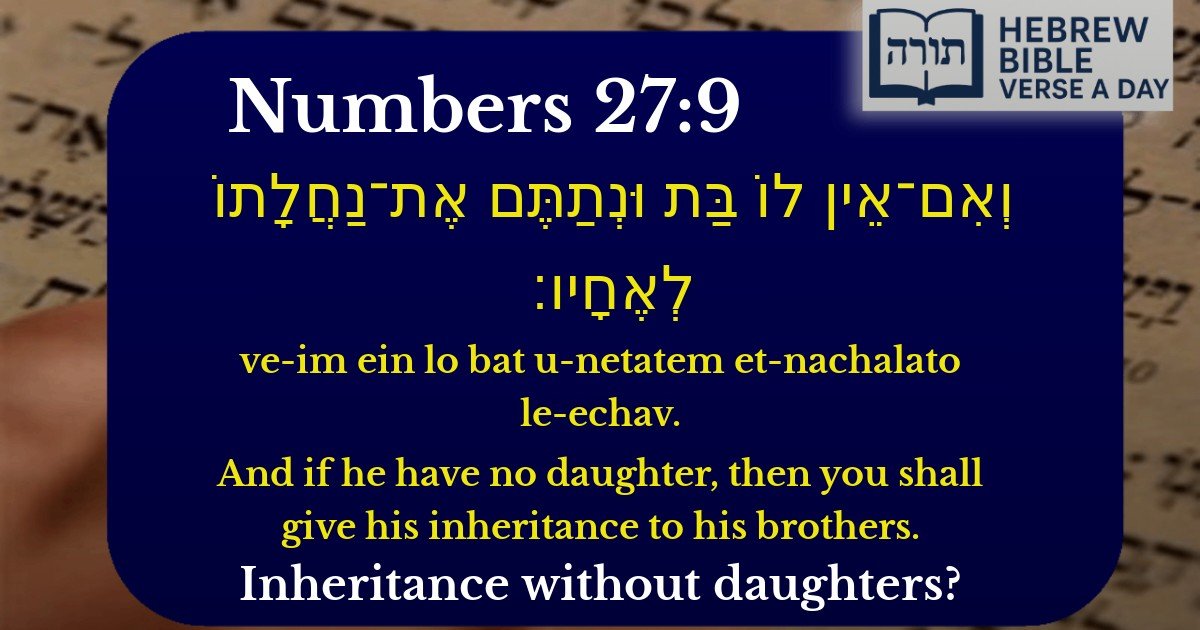

Inheritance Laws in the Torah
The verse (Numbers 27:9) discusses the order of inheritance when a man dies without a son, continuing the earlier discussion in the parsha about the daughters of Tzelofchad. Here, the Torah states that if the deceased has no daughter, the inheritance passes to his brothers. This is part of the broader system of inheritance laws outlined in the Torah.
Rashi's Explanation
Rashi (Rabbi Shlomo Yitzchaki) comments on this verse by connecting it to the previous verses about inheritance. He explains that the order of inheritance is as follows:
Rashi emphasizes that this structured order ensures the property remains within the family lineage.
Rambam's Legal Perspective
In Mishneh Torah (Hilchot Nachalot 1:3), the Rambam (Maimonides) codifies this law, stating that brothers inherit when there are no sons or daughters. He further explains in chapter 2 that this refers specifically to brothers from the same father, as paternal brothers inherit before more distant relatives, even if the mothers are different.
Talmudic Discussion
The Talmud (Bava Batra 115b) analyzes this verse in detail, deriving several principles:
Midrashic Insight
The Midrash (Bamidbar Rabbah 21:9) connects this law to the broader theme of family continuity in the Torah. It notes how the Torah carefully preserves family lineages and properties, seeing this as part of God's plan for maintaining the structure of the Israelite nation.
Halachic Implications
Later halachic authorities, including the Shulchan Aruch (Choshen Mishpat 276), elaborate on practical applications: