Frequently Asked Questions
Q: What does Numbers 28:13 mean?
A: Numbers 28:13 describes part of the daily and holiday offerings brought in the Mishkan (Tabernacle) and later the Beit HaMikdash (Temple). It specifies that for each lamb offered as an olah (burnt offering), there must also be a minchah (meal offering) consisting of a tenth of an ephah of fine flour mixed with oil. This offering is described as a 'sweet savor' to Hashem, meaning it is pleasing and accepted when brought with proper intent.
Q: Why is the flour offering mixed with oil?
A: Rashi explains that mixing the fine flour with oil represents richness and quality, showing that we offer our best to Hashem. The oil also makes the offering more substantial and dignified, fitting for a sacred offering. The Talmud (Menachot 76a) discusses the precise measurements and mixing process to fulfill the mitzvah properly.
Q: What is the significance of the 'tenth measure' mentioned in this verse?
A: The 'tenth measure' (עִשָּׂרוֹן) refers to one-tenth of an ephah of flour, which was the standard measurement for meal offerings accompanying animal sacrifices. The Rambam (Hilchos Maaseh HaKorbanos 9:4) explains that this measurement teaches precision in serving Hashem - we must be exact and careful in fulfilling mitzvos, especially in the Beit HaMikdash service.
Q: What does 'reiach nichoach' (sweet savor) mean in this context?
A: The term 'reiach nichoach' (רֵיחַ נִיחֹחַ) means that the offering is pleasing and acceptable to Hashem when brought with the right intentions. The Midrash (Vayikra Rabbah 3:2) explains that it's not the physical smell that matters, but rather the devotion and obedience behind the offering that makes it 'sweet' before Hashem.
Q: How does this verse apply to Jews today without the Temple?
A: While we cannot bring sacrifices today, the Talmud (Berachos 26b) teaches that prayer was established corresponding to the daily offerings. The Rambam (Hilchos Tefillah 1:5) explains that we maintain the times of prayer that correspond to these offerings. Additionally, studying the laws of sacrifices (as in this verse) is considered a partial substitute (Menachot 110a). The verse also teaches us about bringing our best efforts in serving Hashem in all aspects of life.

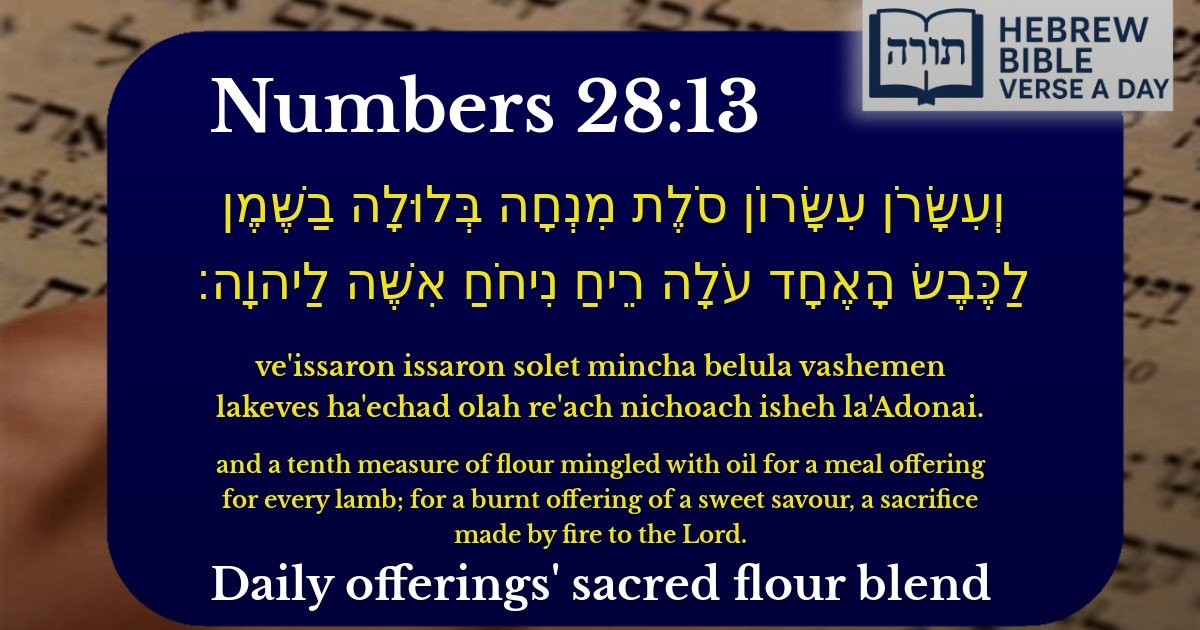

Explanation of the Verse
The verse (Numbers 28:13) describes the additional offerings brought on Shabbat, specifying the mincha (meal offering) accompanying the olah (burnt offering). The isaron (tenth measure) of fine flour mixed with oil represents a standard measurement for such offerings, as detailed in the Torah.
Rashi's Commentary
Rashi (Rabbi Shlomo Yitzchaki) explains that the phrase "עִשָּׂרֹן עִשָּׂרוֹן" ("a tenth measure for every lamb") emphasizes that each lamb requires its own separate tenth of flour, not a shared portion. This teaches precision in mitzvah observance, particularly in the Temple service.
Rambam's Perspective
In Hilchos Temidin u'Musafin (Laws of Constant and Additional Offerings), the Rambam (Maimonides) elaborates that the mincha must be thoroughly mixed ("בְּלוּלָה בַשֶּׁמֶן") to ensure uniformity, symbolizing the complete devotion required in divine service.
Symbolism of the Offering
Halachic Significance
The Talmud (Menachos 104a) derives from this verse that the mincha must be mixed with oil before being offered, reinforcing the principle that Temple rituals require meticulous adherence to Torah law. The phrase "אִשֶּׁה לַיהוָה" ("a sacrifice made by fire to the Lord") underscores that the offering must be burned completely on the altar, reflecting total dedication to Hashem.