Frequently Asked Questions
Q: What does Numbers 28:16 mean?
A: Numbers 28:16 establishes the date for observing Passover (Pesach) as the 14th day of the first month (Nisan) in the Hebrew calendar. This verse reminds us of the mitzvah (commandment) to bring the Passover offering in the Temple era, commemorating the Exodus from Egypt.
Q: Why is Passover on the 14th of Nisan?
A: The 14th of Nisan marks the day before the Exodus from Egypt began (on 15th Nisan). On this day in ancient times, the Passover lamb was brought as an offering in the afternoon (Rashi on Exodus 12:6). This date was divinely commanded to forever remember our redemption from slavery.
Q: How do we observe this verse today without the Temple?
A: While we no longer bring the Passover offering without the Temple, we still observe the 14th of Nisan by preparing for Passover - removing chametz (leaven) and conducting the Bedikat Chametz (search for leaven) ceremony at night. The Seder on 15th Nisan fulfills the Torah's commandment to retell the Exodus story (Rambam, Hilchot Chametz U'Matzah 1:1-3).
Q: Why does the verse call it 'Passover to the Lord'?
A: The phrase 'Passover to the Lord' emphasizes that this observance is a divine commandment, not merely a historical commemoration. The Passover offering was brought specifically for Hashem, demonstrating our commitment to fulfill His will (Sforno on Numbers 28:16).
Q: What's the significance of the 'first month' mentioned?
A: Nisan is called the 'first month' because it marks the beginning of our national identity as Jews after the Exodus. The Torah considers Nisan as the primary month for counting festivals, teaching us that our spiritual calendar revolves around our redemption (Rashi on Exodus 12:2, Talmud Rosh Hashanah 7a).

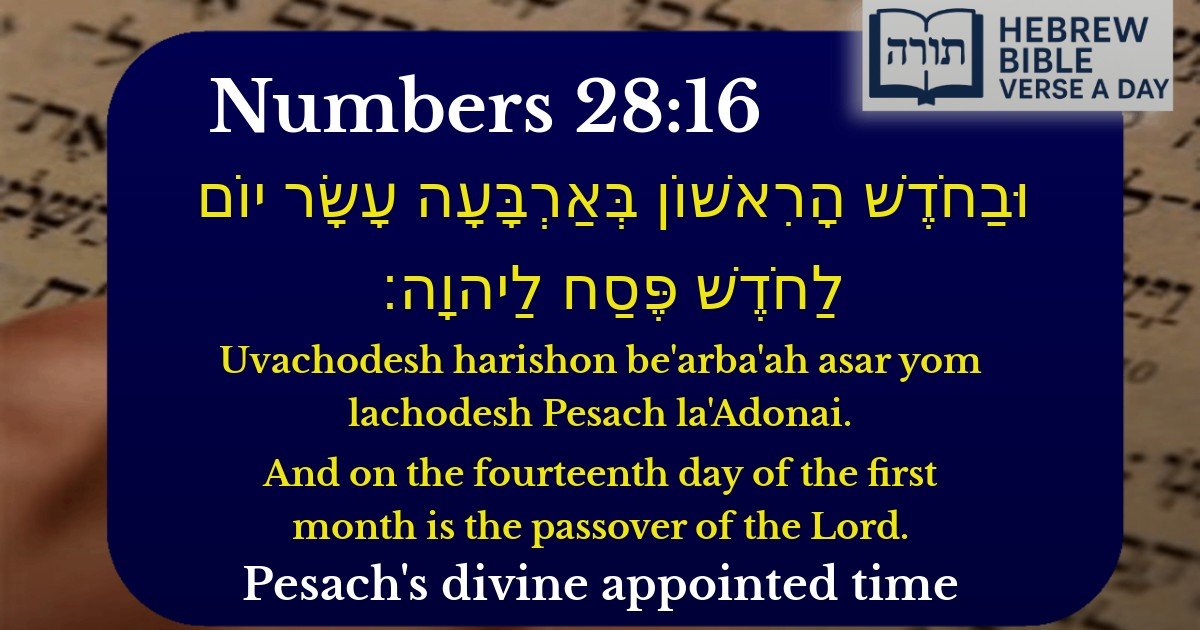

The Timing of Pesach
The verse states that Pesach occurs on the 14th day of the first month (Nisan). Rashi (Exodus 12:18) explains that this date marks the preparation for the Korban Pesach (Paschal sacrifice), which was to be slaughtered in the afternoon of the 14th of Nisan in preparation for the Seder night on the 15th. The Torah emphasizes that this is "Pesach laHashem" (a Passover to the Lord), indicating its sacred nature as a divine commandment.
The Significance of Nisan as the First Month
Rambam (Hilchot Kiddush HaChodesh 1:2) notes that Nisan is called the "first month" because it marks the beginning of the Jewish people's national identity through the Exodus. The Sforno adds that this designation teaches that all months are counted from Nisan to commemorate our redemption. The Talmud (Rosh Hashanah 7a) derives from this verse that the year begins in Nisan for the purpose of counting festivals.
The Meaning of "Pesach laHashem"
The phrase "Pesach laHashem" is interpreted in several ways by our sages:
The Preparation for Redemption
The Midrash (Shemot Rabbah 15:11) teaches that the 14th of Nisan represents the final day of preparation before redemption. Just as the Israelites had to demonstrate their faith by preparing the lamb (an Egyptian deity) for sacrifice, we must actively prepare ourselves spiritually for redemption. The Sefer HaChinuch (Mitzvah 16) connects this to the modern practice of searching for chametz on the night of the 14th, symbolizing our ongoing battle against spiritual impurity.