Frequently Asked Questions
Q: What does Numbers 28:28 teach about the meal offerings?
A: Numbers 28:28 specifies the amounts of flour and oil required for the meal offerings (mincha) brought with the sacrifices during festivals. For a bull, three tenths of an ephah of fine flour mixed with oil was required, and for a ram, two tenths. This teaches the importance of precision and devotion in serving Hashem, as every detail in the Torah has significance (Rashi on Numbers 28:28).
Q: Why are different amounts of flour required for a bull and a ram in Numbers 28:28?
A: The Torah assigns different amounts of flour based on the size and significance of the animal being offered. A bull, being larger and more valuable, requires a greater meal offering (three tenths of an ephah) than a ram (two tenths). This reflects the principle that our service to Hashem should correspond to the importance of the occasion (Rambam, Hilchot Maaseh HaKorbanot).
Q: What is the significance of mixing flour with oil in the meal offering?
A: The flour mixed with oil symbolizes richness and dedication in serving Hashem. Oil represents wisdom and refinement (as in the anointing of kings and priests), teaching that our offerings—whether physical or spiritual—should be given with sincerity and a desire for spiritual elevation (Midrash Tanchuma, Emor 13).
Q: How does Numbers 28:28 apply to us today without the Temple?
A: Although we no longer bring physical sacrifices, the lesson of Numbers 28:28 still applies. Our prayers, Torah study, and acts of kindness are considered 'spiritual offerings.' Just as the meal offering required precise measures, we should approach our service to Hashem with care, consistency, and a generous spirit (Talmud, Menachot 110a).
Q: What is an 'esron' (tenth measure) mentioned in Numbers 28:28?
A: An 'esron' (עִשָּׂרוֹן) is a unit of measurement equal to one-tenth of an ephah (approx. 2.2 liters). The Torah specifies exact amounts to emphasize that serving Hashem requires attention to detail. The precision in measurements teaches us that every mitzvah, no matter how small, has great value in the eyes of Hashem (Rashi on Vayikra 23:13).

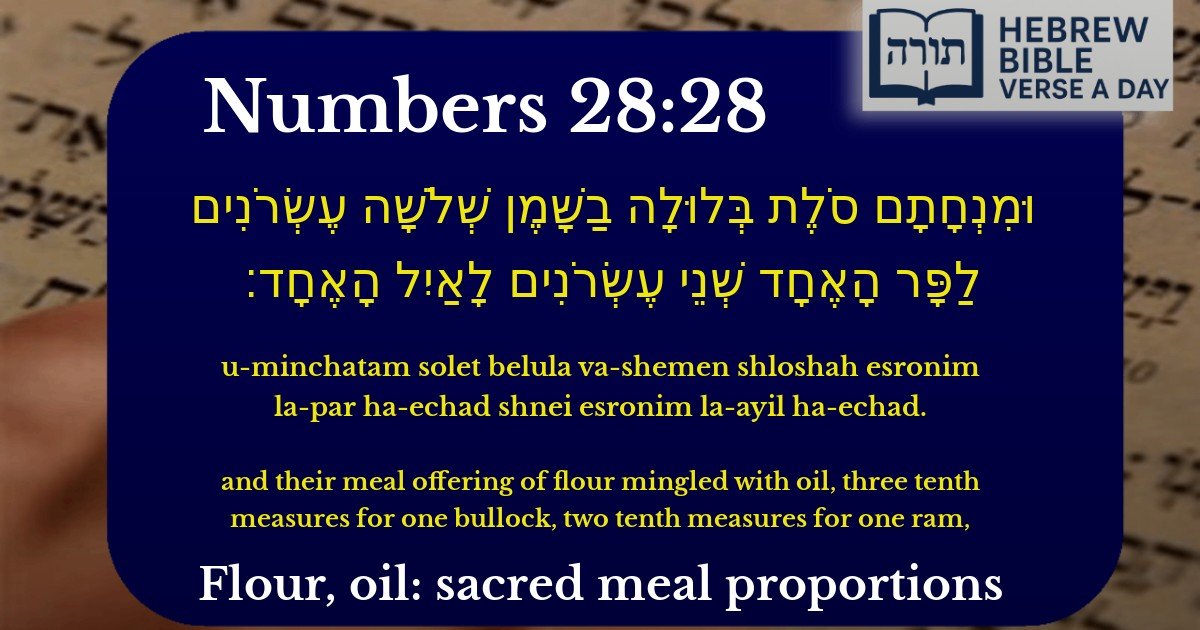

Verse Context and Overview
The verse (Numbers 28:12) details the meal offering (mincha) accompanying the communal sacrifices brought on Rosh Chodesh (the New Moon). The offering consists of fine flour (solet) mixed with oil, measured in specific quantities for the bull (par) and ram (ayil).
Explanation of the Measurements
Rashi (on Numbers 28:12) explains that the measurements are given in esronim (tenths of an ephah), with:
The Rambam (Hilchot Temidin uMusafin 7:4) elaborates that these measurements are fixed by Torah law and cannot be altered.
Symbolism of the Ingredients
The mincha consists of solet (fine flour) and oil, which the Midrash (Vayikra Rabbah 3:1) interprets as representing:
Connection to Rosh Chodesh
The Kli Yakar (Numbers 28:12) notes that the additional sacrifices on Rosh Chodesh signify renewal. The meal offering, specifically, reflects the Jewish people's continuous dedication to Torah and mitzvot, just as the moon renews itself monthly.