
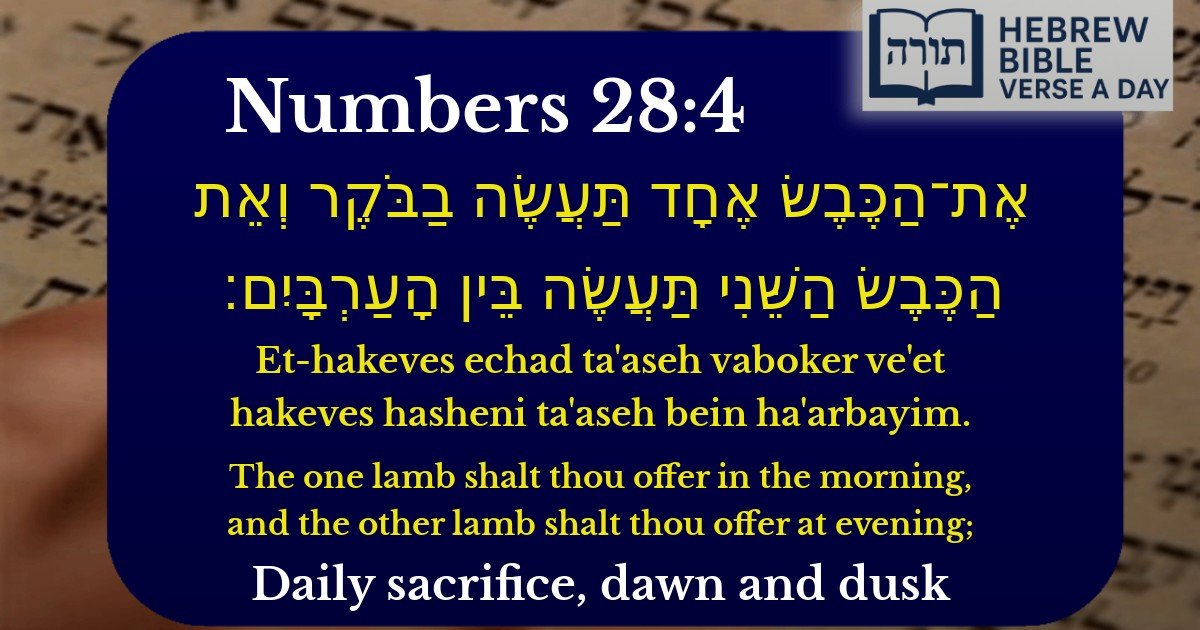

Numbers 28:4 - Daily sacrifice, dawn and dusk

Numbers 28:4 - במדבר 28:4

Hebrew Text

אֶת־הַכֶּבֶשׂ אֶחָד תַּעֲשֶׂה בַבֹּקֶר וְאֵת הַכֶּבֶשׂ הַשֵּׁנִי תַּעֲשֶׂה בֵּין הָעַרְבָּיִם׃

English Translation

The one lamb shalt thou offer in the morning, and the other lamb shalt thou offer at evening;

Transliteration

Et-hakeves echad ta'aseh vaboker ve'et hakeves hasheni ta'aseh bein ha'arbayim.

Hebrew Leining Text

אֶת־הַכֶּ֥בֶשׂ אֶחָ֖ד תַּעֲשֶׂ֣ה בַבֹּ֑קֶר וְאֵת֙ הַכֶּ֣בֶשׂ הַשֵּׁנִ֔י תַּעֲשֶׂ֖ה בֵּ֥ין הָֽעַרְבָּֽיִם׃

🎵 Listen to leining

Parasha Commentary

Context in the Torah

The verse (Shemot 29:39) appears in the context of the daily Korban Tamid (continual offering) in the Mishkan (Tabernacle) and later in the Beit HaMikdash (Temple). This offering was brought twice daily—once in the morning and once in the afternoon—as a constant service before Hashem.

Rashi's Explanation

Rashi (Shemot 29:39) explains that the phrase "בַבֹּקֶר" (in the morning) refers to the time after sunrise, while "בֵּין הָעַרְבָּיִם" (at evening) refers to the time after midday, specifically from the sixth hour (noon) onward. He emphasizes that this mitzvah is perpetual, binding for all generations.

Rambam's Halachic Perspective

In Hilchot Temidin uMusafin (1:1-3), the Rambam codifies the laws of the Korban Tamid, stating that it is a positive commandment to offer two lambs daily—one in the morning and one in the afternoon. He notes that this offering takes precedence over other sacrifices, as it symbolizes the constant connection between Klal Yisrael and Hashem.

Symbolism and Midrashic Insights

  • The Midrash Tanchuma (Tetzaveh 14) teaches that the morning lamb atones for sins committed at night, while the afternoon lamb atones for sins committed during the day, illustrating Hashem's continuous mercy.
  • The Zohar (Parashat Terumah) connects the two offerings to the balance of chesed (kindness) and din (judgment) in the world, with the morning representing divine kindness and the evening representing divine judgment.

Practical Halachic Implications

The Shulchan Aruch (Orach Chaim 58:1) derives from this verse the times for Shacharit (morning prayers) and Mincha (afternoon prayers), as prayer was instituted to parallel the Korban Tamid. Thus, the structure of daily tefillah mirrors the Temple service, reinforcing the idea that Torah and avodah (service) are inseparable.

📚 Talmud Citations

This verse is quoted in the Talmud.

📖 Yoma 33b
The verse is cited in the discussion about the daily sacrifices (Tamid) and their timing, emphasizing the requirement to offer one lamb in the morning and another in the evening.
📖 Menachot 49b
Referenced in the context of discussing the proper times for offering sacrifices, particularly the daily offerings.

Frequently Asked Questions

Q: What does Numbers 28:4 mean?
A: Numbers 28:4 instructs the Jewish people to bring two daily offerings (korbanot) in the Beit HaMikdash (Holy Temple): one lamb in the morning (Shacharit) and one in the afternoon (Mincha). This is known as the 'Korban Tamid' (constant offering). Rashi explains that this verse emphasizes the consistency and dedication required in serving Hashem, as these offerings were brought every single day without interruption.
Q: Why is the Korban Tamid important in Judaism?
A: The Korban Tamid is fundamental because it represents the ongoing relationship between the Jewish people and Hashem. The Rambam (Hilchot Temidim uMusafim 1:1-2) teaches that these daily offerings atone for sins and maintain spiritual connection. Even though we no longer have the Beit HaMikdash, our daily prayers (Shacharit and Mincha) correspond to these offerings, keeping the same structure of devotion.
Q: What can we learn from the two daily offerings in Numbers 28:4?
A: The Talmud (Berachot 26b) derives from this verse that our daily prayers (Shacharit and Mincha) were established to parallel the Tamid offerings. This teaches us the importance of starting and ending our day with connection to Hashem. The Midrash (Bamidbar Rabbah 21:9) also highlights that consistency in small daily acts of service builds a strong spiritual foundation.
Q: How does Numbers 28:4 apply to Jewish life today?
A: Although we cannot bring physical offerings today, the structure of Jewish prayer mirrors the Tamid service. The Shulchan Aruch (Orach Chaim 89:1) rules that we should pray Shacharit in the morning and Mincha in the afternoon, just as the lambs were offered. This reminds us to dedicate time to Hashem both when we begin our day and as we conclude our work.
Q: Why were the offerings brought specifically in the morning and evening?
A: Rashi (on Numbers 28:4) explains that the morning offering atones for sins committed at night, while the evening offering atones for daytime sins. The Ramban adds that these times represent transitions—day to night and night to day—teaching us to sanctify all phases of life. The Talmud (Pesachim 58a) also notes that these were times when people gathered, making the offerings a communal experience.