

Join Our Newsletter To Be Informed When New Videos Are Posted
Hebrew Text
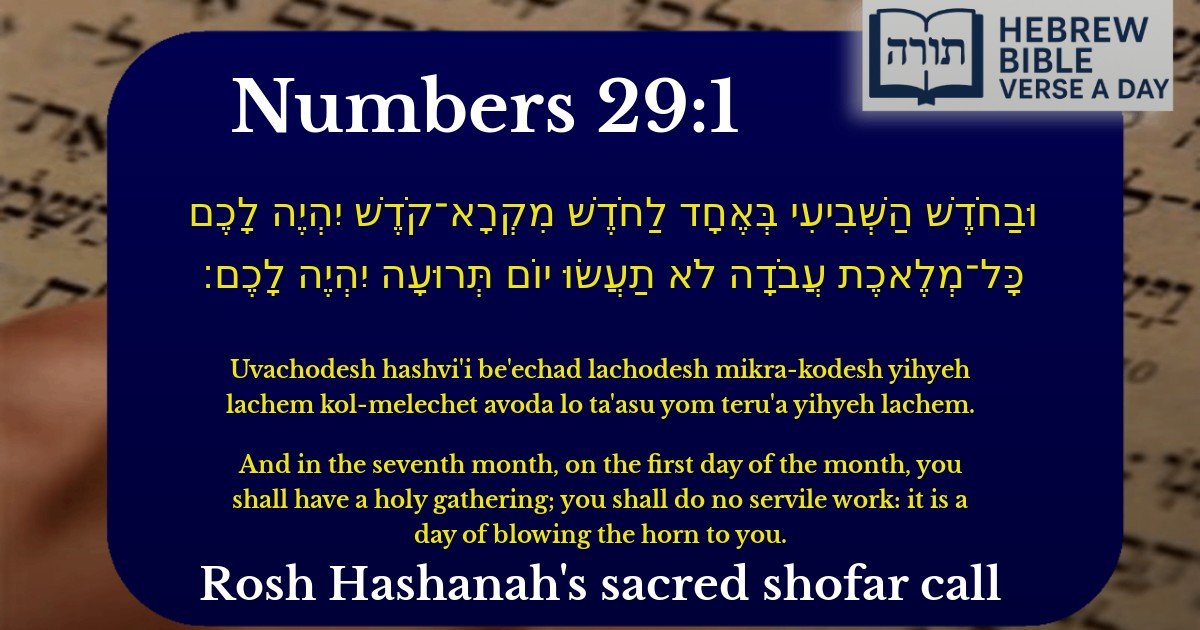
וּבַחֹדֶשׁ הַשְּׁבִיעִי בְּאֶחָד לַחֹדֶשׁ מִקְרָא־קֹדֶשׁ יִהְיֶה לָכֶם כָּל־מְלֶאכֶת עֲבֹדָה לֹא תַעֲשׂוּ יוֹם תְּרוּעָה יִהְיֶה לָכֶם׃
English Translation
And in the seventh month, on the first day of the month, you shall have a holy gathering; you shall do no servile work: it is a day of blowing the horn to you.
Transliteration
Uvachodesh hashvi'i be'echad lachodesh mikra-kodesh yihyeh lachem kol-melechet avoda lo ta'asu yom teru'a yihyeh lachem.
Hebrew Leining Text
וּבַחֹ֨דֶשׁ הַשְּׁבִיעִ֜י בְּאֶחָ֣ד לַחֹ֗דֶשׁ מִֽקְרָא־קֹ֙דֶשׁ֙ יִהְיֶ֣ה לָכֶ֔ם כׇּל־מְלֶ֥אכֶת עֲבֹדָ֖ה לֹ֣א תַעֲשׂ֑וּ י֥וֹם תְּרוּעָ֖ה יִהְיֶ֥ה לָכֶֽם׃
🎵 Listen to leining
Parasha Commentary
📚 Talmud Citations
This verse is quoted in the Talmud.
📖 Rosh Hashanah 29b
The verse is discussed in the context of the mitzvah of blowing the shofar on Rosh Hashanah, which is the first day of the seventh month.
📖 Megillah 31a
The verse is referenced in the discussion of the Torah readings for the festivals, including Rosh Hashanah.
The Seventh Month and Rosh Hashanah
The verse refers to the first day of the seventh month (Tishrei), which is Rosh Hashanah, the Jewish New Year. Although it is called the "seventh month" in the Torah, it is considered the beginning of the year in terms of the counting of years and the judgment of mankind (Rosh Hashanah 1:1). This duality reflects its dual nature as both a continuation of the calendar and a new beginning.
The Prohibition of Melachah (Servile Work)
The Torah prohibits melachah (servile work) on this day, similar to Shabbat (Rashi, Bamidbar 29:1). However, unlike Shabbat, certain food preparations (ochel nefesh) are permitted when necessary (Rambam, Hilchot Yom Tov 1:5). This distinction highlights that while Rosh Hashanah is a day of rest, it also allows for basic needs to sustain the joy of the holiday.
Yom Teruah: The Day of Blowing the Shofar
The verse calls this day Yom Teruah (a day of blowing the horn), emphasizing the mitzvah of sounding the shofar. The shofar serves multiple purposes:
The Hidden Nature of Rosh Hashanah
Interestingly, the verse does not explicitly call this day "Rosh Hashanah" or mention its themes of judgment and kingship. The Talmud (Rosh Hashanah 16a) explains that these concepts are deliberately concealed in the written Torah but revealed in the oral tradition. This teaches that some aspects of divine service require deeper study and transmission through mesorah (tradition).