Frequently Asked Questions
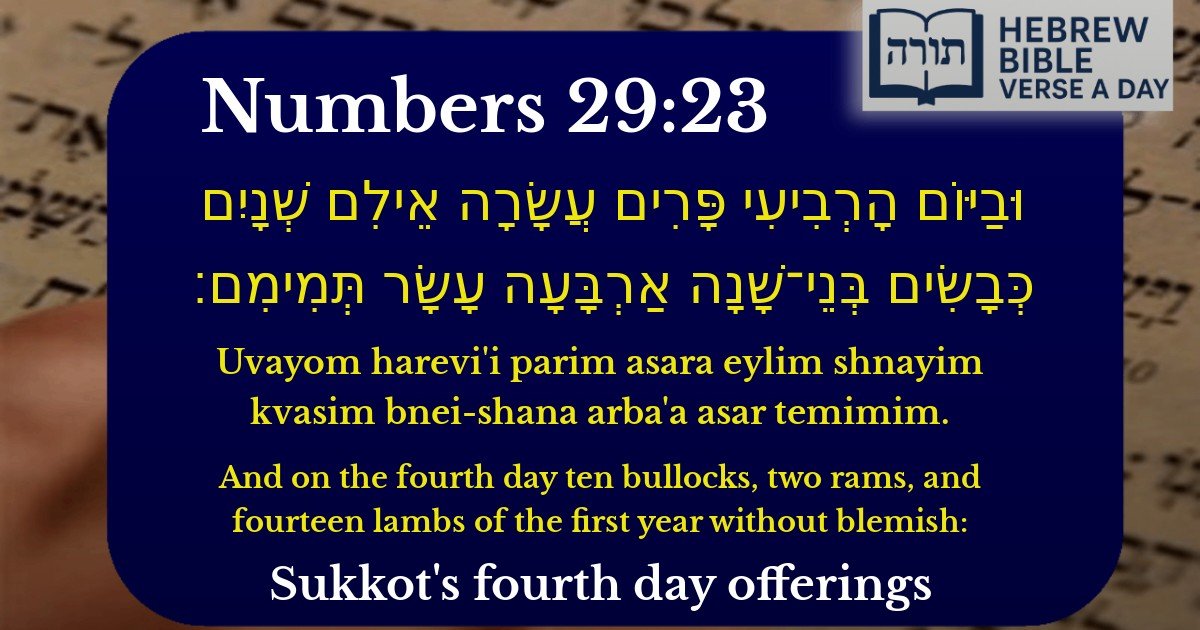
Q: What is the significance of the sacrifices mentioned in Numbers 29:23?
A: The sacrifices listed in Numbers 29:23 were part of the additional offerings (Musaf) brought during the festival of Sukkot. According to Rashi, the number of sacrifices decreased each day of Sukkot, symbolizing the gradual reduction of Israel's merit. The Talmud (Sukkah 55b) teaches that these offerings atoned for the sins of the nations, showing that the Jewish people pray for the welfare of the entire world.
Q: Why were the animals required to be 'without blemish' (temimim)?
A: The Torah requires sacrifices to be 'without blemish' (temimim) to teach us that offerings to Hashem must be of the highest quality, as explained by Rambam in Hilchot Ma'aseh HaKorbanot. This reflects the idea that we should give our best in serving G-d, whether in physical offerings or in our spiritual devotion.
Q: Why does the number of bulls decrease each day of Sukkot?
A: The decreasing number of bulls (from 13 on the first day to 7 on the seventh day) symbolizes the diminishing of worldly influences, as explained by the Midrash (Bamidbar Rabbah 21:24). The Sages teach that this represents the temporary nature of material success, while our spiritual connection to Hashem remains constant.
Q: What lesson can we learn today from the Sukkot sacrifices?
A: The Sukkot sacrifices teach us about the importance of consistency in serving Hashem. Even though the number of bulls decreased each day, the number of lambs (14) remained constant, showing that while some aspects of life change, our basic commitment to Torah and mitzvot must remain steadfast, as emphasized in the teachings of the Chofetz Chaim.
Q: Why were these sacrifices specifically brought during Sukkot?
A: Sukkot is the festival when we celebrate Hashem's protection during our journey in the wilderness and express gratitude for the harvest. The large number of sacrifices, as explained in the Talmud (Sukkah 55b), reflects our joy and thankfulness to Hashem for His constant care, both in the desert and in our agricultural blessings.


Explanation of the Verse (Bamidbar 7:30)
This verse describes the offerings brought by the tribal leader on the fourth day of the dedication of the Mishkan (Tabernacle). The offerings consisted of:
Symbolism of the Offerings
The unblemished (תְּמִימִם) nature of the animals, as emphasized in the verse, teaches that offerings must be perfect—both physically and spiritually. The Talmud (Menachot 27a) derives from this that one’s service to G-d must be wholehearted and without defect.
Fourth Day Significance
The fact that these offerings were brought on the fourth day may hint at the fourth day of Creation, when the sun and moon were placed in the heavens (Bereishit 1:14-19). The Midrash Tanchuma (Naso 14) connects this to the idea that the Mishkan, like the celestial bodies, serves as a focal point of divine light in the world.
Practical Halachic Insight
The Rambam (Hilchot Ma’aseh HaKorbanot 1:14) notes that the detailed listing of each day’s offerings underscores the importance of precision in avodah (Temple service), teaching that every mitzvah must be performed with exactness and devotion.