Frequently Asked Questions
Q: What does Numbers 29:33 mean?
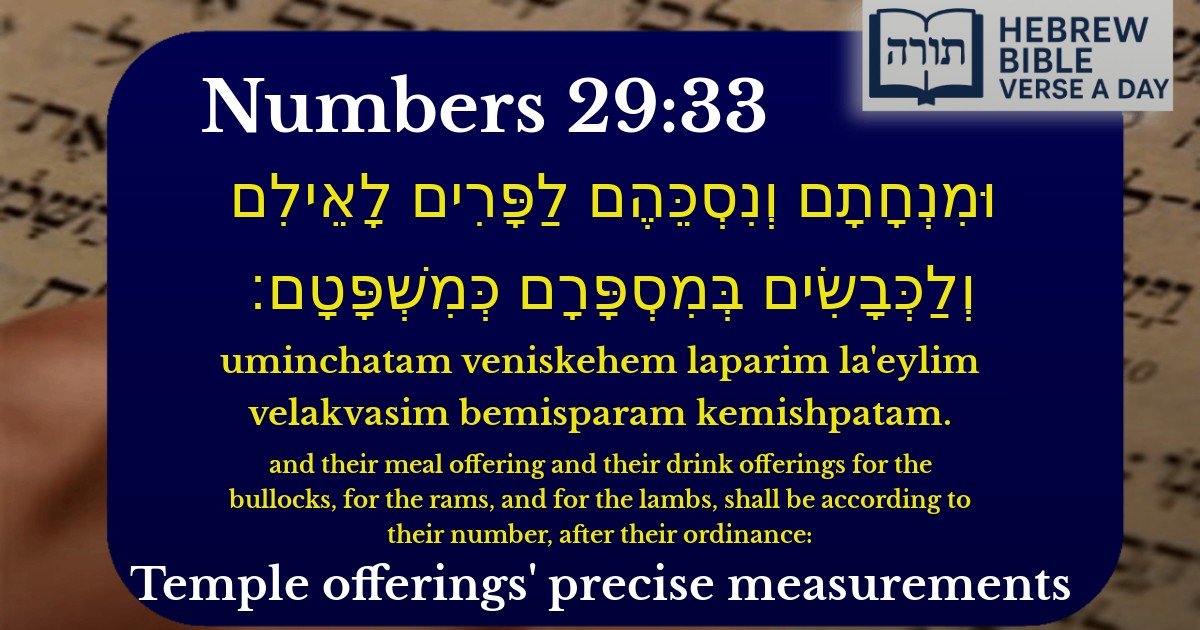
A: Numbers 29:33 discusses the meal offerings (mincha) and drink offerings (nesachim) brought in the Temple along with animal sacrifices (bullocks, rams, and lambs) during the festival of Sukkot. The verse emphasizes that these offerings must be given in precise quantities 'according to their number' and 'after their ordinance,' meaning they follow strict Torah guidelines (Rashi, Rambam).
Q: Why is this verse important?
A: This verse is important because it highlights the detailed laws of sacrifices during Sukkot, teaching us the value of precision and devotion in serving Hashem. The Talmud (Menachot 103b) explains that every detail in Temple service reflects our commitment to fulfilling mitzvot properly.
Q: What can we learn from Numbers 29:33 today?
A: Though we no longer bring sacrifices, this verse teaches us that serving Hashem requires attention to detail and consistency. Just as the offerings had specific measurements, our prayers and mitzvot today should be performed with care and sincerity (Midrash Tanchuma, Tzav 14).
Q: How were the meal and drink offerings prepared?
A: The meal offering (mincha) was made from fine flour mixed with oil, and the drink offering (nesach) was wine. The Torah specifies exact amounts for each animal: for example, a bullock required a larger offering than a lamb (Rashi on Numbers 15:4-10, Mishnah Menachot 9:3).
Q: Why does the Torah specify 'after their ordinance'?
A: The phrase 'after their ordinance' (כְּמִשְׁפָּטָם) means these offerings follow fixed rules given earlier in the Torah (e.g., Numbers 15:1-16). The Sages teach that this repetition reinforces the importance of following halacha (Jewish law) without deviation (Rambam, Hilchot Maaseh HaKorbanot 2:1).


Overview of the Verse
The verse (Numbers 29:18) discusses the meal offerings (mincha) and drink offerings (nesech) that accompany the sacrifices brought during the festival of Sukkot. These offerings are specified for the bullocks, rams, and lambs, each according to their prescribed number and ordinance.
Explanation of the Sacrificial Details
Rashi explains that the phrase "בְּמִסְפָּרָם כְּמִשְׁפָּטָם" ("according to their number, after their ordinance") refers to the fixed quantities of flour, oil, and wine that must accompany each animal sacrifice. The Torah provides exact measurements for these offerings elsewhere (e.g., Numbers 15:1-16), and this verse reiterates that these laws apply to the Sukkot sacrifices as well.
Significance of the Meal and Drink Offerings
The Rambam (Hilchos Maaseh HaKorbanos 2:1) teaches that the meal and drink offerings serve to complete the sacrificial service. They symbolize gratitude and submission to Hashem, as flour and wine represent sustenance and joy. The mincha (meal offering) is a reminder of human labor and dependence on divine providence, while the nesech (drink offering) signifies celebration and dedication.
Connection to Sukkot
The Talmud (Sukkah 55b) notes that the seventy bullocks offered during Sukkot correspond to the seventy nations of the world, emphasizing the universal aspect of the festival. The meal and drink offerings accompanying these sacrifices highlight the spiritual elevation intended for all humanity through the service of the Jewish people.
Halachic Precision in Offerings
These precise measurements, as emphasized in the verse, teach the importance of meticulousness in divine service, reflecting the principle of "הַכֹּל לְפִי הַמִּנְיָן וְהַמִּשְׁקָל" ("everything according to count and measure") in avodas Hashem.