Frequently Asked Questions
Q: What does Numbers 30:11 mean in simple terms?
A: Numbers 30:11 discusses the laws of vows (nedarim) made by a married woman. According to Orthodox Jewish interpretation, this verse teaches that if a woman makes a vow or oath while under her husband's authority, her husband has the ability to affirm or nullify that vow on the same day he hears about it (as explained in the following verses). This is part of the Torah's detailed laws about personal commitments and their validity within family relationships.
Q: Why is the concept of vows (nedarim) important in Judaism?
A: Vows (nedarim) are taken very seriously in Judaism because they involve making a binding commitment to Hashem. The Talmud (Nedarim) and Rambam (Hilchot Nedarim) explain that once a person makes a vow, they must fulfill it, as it's considered as weighty as other Torah commandments. This verse in Numbers 30 shows the Torah's careful balance between personal spiritual expression (through vows) and maintaining harmony in family relationships.
Q: How does this verse about vows apply to Jewish life today?
A: While the specific husband-wife dynamic described in this verse doesn't apply in the same way today (as explained by later halachic authorities), the underlying principles remain important: 1) We must be careful before making vows or oaths (as per Kohelet 5:4-5), 2) Family relationships affect our spiritual commitments, and 3) There are proper Torah procedures for annulling vows when necessary (highlighted in the Kol Nidrei service before Yom Kippur).
Q: What does Rashi say about Numbers 30:11?
A: Rashi explains this verse by noting that it refers specifically to vows a wife makes while 'in her husband's house' - meaning while she is under his authority through marriage. He clarifies that this shows the husband's ability to affirm or nullify her vow applies specifically to vows that affect their marital relationship or his rights (based on Talmud Nedarim 70b). Rashi emphasizes this is part of the Torah's system maintaining proper family dynamics.
Q: Are women's vows treated differently than men's in Jewish law?
A: Yes, there are differences based on this and other verses in Numbers 30. Traditional Jewish sources (Talmud, Rambam) explain that while all adults are responsible for their own vows, the Torah gives certain family members (fathers for unmarried daughters, husbands for wives) the ability to annul vows that affect family relationships, provided they do so on the same day they hear about them. This reflects the Torah's view of family as an interconnected unit where certain commitments can impact others.


Context in the Torah
The verse (Bamidbar 30:11) is part of the Torah's discussion of vows (nedarim) and oaths (shevuot), specifically addressing the laws concerning a married woman's vows and her husband's ability to affirm or nullify them. This falls under the broader category of parashat Matot, which details the halachot of nedarim.
Explanation of the Verse
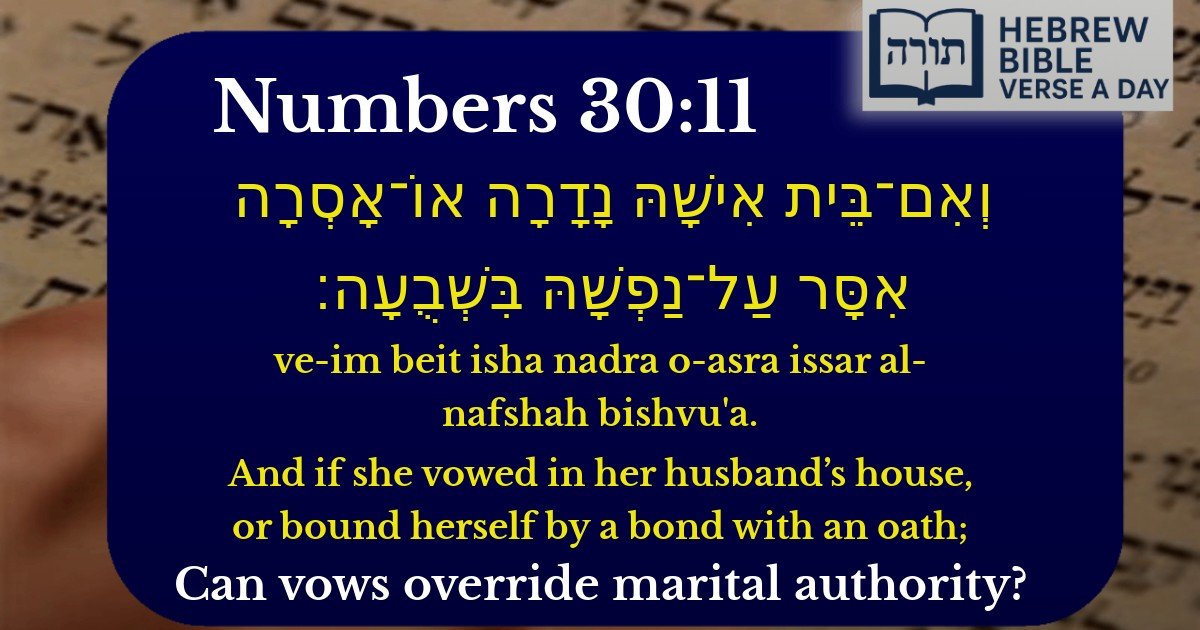
The phrase "וְאִם־בֵּית אִישָׁהּ נָדָרָה" ("And if she vowed in her husband’s house") refers to a married woman who makes a vow while under her husband's authority. The Torah establishes that a husband has the power to uphold or annul his wife's vows under certain conditions (as detailed in the subsequent verses).
The term "אָסְרָה אִסָּר עַל־נַפְשָׁהּ" ("or bound herself by a bond with an oath") indicates that the vow is a binding obligation upon herself, whether it involves abstaining from permitted pleasures (issur) or committing to a specific act. Rashi explains that "אִסָּר" refers to prohibitive vows (e.g., abstaining from something), while "נֶדֶר" refers to positive commitments (e.g., donating to the Temple).
Halachic Implications
Spiritual and Ethical Lessons
The verse underscores the Torah's balance between personal spiritual expression and familial harmony. While a woman may seek to elevate herself through vows, the Torah grants her husband a role in ensuring these commitments do not disrupt the marital relationship. This reflects the principle of shalom bayit (domestic harmony) as a foundational Jewish value.