

Join Our Newsletter To Be Informed When New Videos Are Posted
Hebrew Text
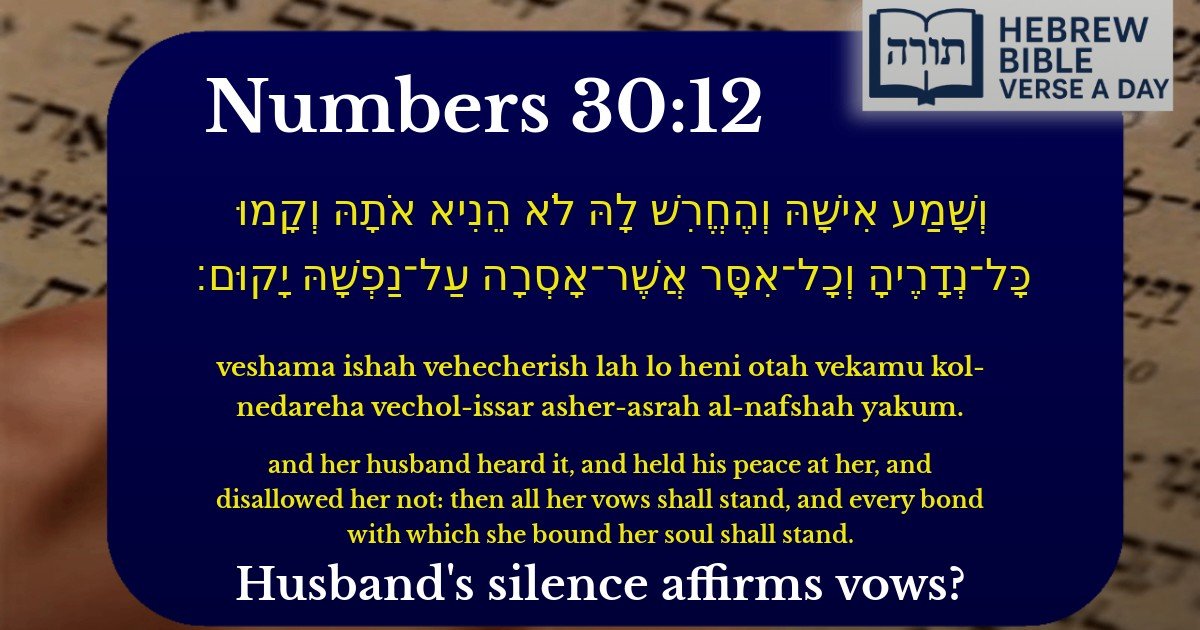
וְשָׁמַע אִישָׁהּ וְהֶחֱרִשׁ לָהּ לֹא הֵנִיא אֹתָהּ וְקָמוּ כָּל־נְדָרֶיהָ וְכָל־אִסָּר אֲשֶׁר־אָסְרָה עַל־נַפְשָׁהּ יָקוּם׃
English Translation
and her husband heard it, and held his peace at her, and disallowed her not: then all her vows shall stand, and every bond with which she bound her soul shall stand.
Transliteration
Veshama ishah vehecherish lah lo heni otah vekamu kol-nedareha vechol-issar asher-asrah al-nafshah yakum.
Hebrew Leining Text
וְשָׁמַ֤ע אִישָׁהּ֙ וְהֶחֱרִ֣שׁ לָ֔הּ לֹ֥א הֵנִ֖יא אֹתָ֑הּ וְקָ֙מוּ֙ כׇּל־נְדָרֶ֔יהָ וְכׇל־אִסָּ֛ר אֲשֶׁר־אָסְרָ֥ה עַל־נַפְשָׁ֖הּ יָקֽוּם׃
🎵 Listen to leining
Parasha Commentary
📚 Talmud Citations
This verse is quoted in the Talmud.
📖 Nedarim 72a
The verse is discussed in the context of the laws regarding vows and the role of a husband in annulling his wife's vows.
📖 Nazir 12a
The verse is referenced in a discussion about the conditions under which a husband can annul his wife's vows, particularly in relation to the Nazirite vow.
Context in the Torah
This verse (Bamidbar 30:8) is part of the Torah's discussion of nedarim (vows) and the laws concerning a husband's ability to nullify his wife's vows. The passage outlines the conditions under which a husband may affirm or annul his wife's vows, emphasizing the importance of timely response.
Rashi's Explanation
Rashi (Bamidbar 30:8) explains that the phrase "וְהֶחֱרִשׁ לָהּ" ("and held his peace at her") means the husband remained silent upon hearing his wife's vow. His silence is interpreted as implicit consent, causing the vow to remain binding. Rashi further clarifies that the husband must nullify the vow on the same day he hears it (based on the principle of ביום שמעו—"on the day he hears it"), otherwise, the vow stands.
Rambam's Halachic Perspective
In Hilchot Nedarim (11:6), the Rambam codifies this law, stating that if a husband hears his wife's vow and does not annul it on that day, he loses the ability to nullify it afterward. The silence (החרש) is considered an affirmation, and the vow becomes irrevocable.
Talmudic Discussion (Nedarim 72a)
The Talmud elaborates on the concept of החרש (silence), teaching that if a husband remains silent when he could have objected, his inaction is equivalent to agreement. The Gemara also discusses whether partial silence (e.g., acknowledging the vow without explicitly affirming or negating it) suffices, concluding that complete silence is required for the vow to stand.
Midrashic Insight (Bamidbar Rabbah)
The Midrash (Bamidbar Rabbah 21:3) connects this law to the broader theme of speech and responsibility in marital relationships. It emphasizes that a husband’s silence is not passive but an active decision with legal consequences, reinforcing the Torah’s expectation of mindful communication between spouses.
Practical Halachic Implications