Frequently Asked Questions
Q: What does Numbers 30:6 mean?
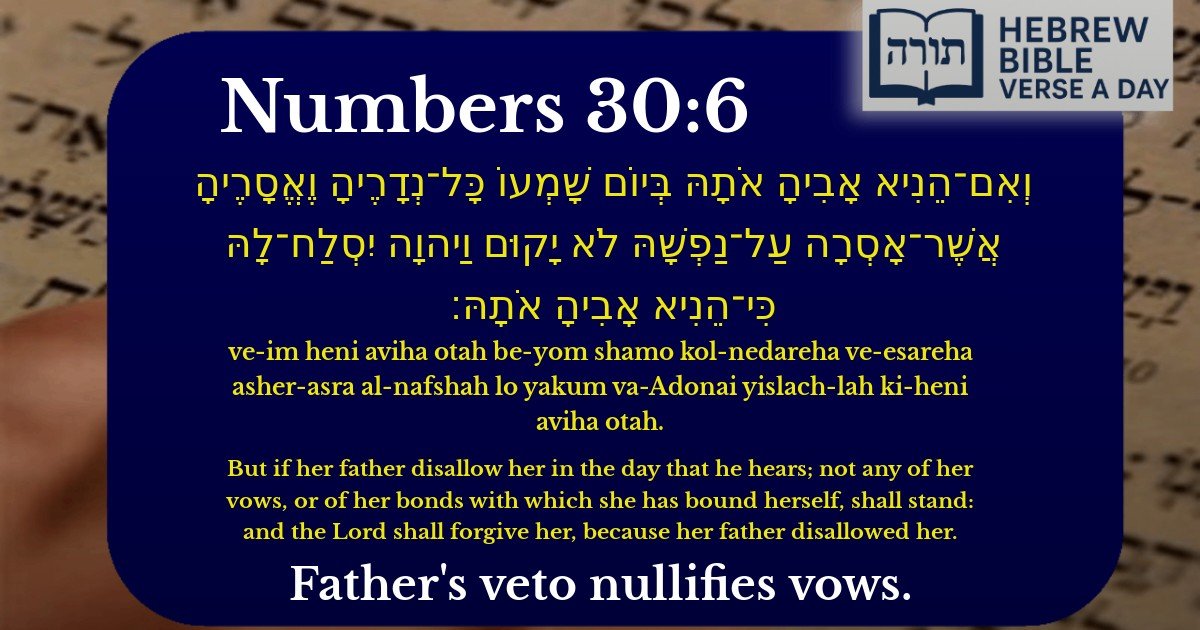
A: Numbers 30:6 discusses the laws of vows (nedarim) made by an unmarried woman living in her father's home. If her father hears her vow and disapproves of it on the same day, the vow becomes invalid (lo yakum—'it shall not stand'). Hashem forgives her because her father nullified it. This teaches that under certain conditions, a father has the authority to annul his daughter's vows to protect her from unintended consequences.
Q: Why is a father allowed to cancel his daughter's vow?
A: According to Jewish tradition (Rashi on Numbers 30:6, Talmud Nedarim 70a), a father (or later, a husband) can annul certain vows to prevent harm or impractical commitments. This reflects the Torah’s concern for fairness and family harmony. The father’s role is not arbitrary—he must act on the same day he hears the vow, showing that the Torah balances personal spiritual commitments with responsible family oversight.
Q: Does this law still apply today?
A: In Orthodox Jewish practice, the laws of vow nullification (hafarat nedarim) still apply in certain cases, primarily through the formal process before a beit din (rabbinical court) or by a husband before Rosh Hashanah (as per Mishnah Nedarim 10:2). However, the specific father-daughter dynamic in this verse applies only while the daughter is unmarried and living in her father’s home (Rambam, Hilchot Nedarim 12:1-2).
Q: What is the significance of 'Hashem will forgive her' in this verse?
A: The phrase 'Hashem will forgive her' (וַיהוָה יִסְלַח־לָהּ) teaches that when a vow is properly nullified, the woman is not held spiritually accountable for breaking it. The Talmud (Chagigah 10a) explains that this forgiveness emphasizes that the vow was never valid to begin with—it’s as if she never made it. This highlights the Torah’s compassion in preventing unnecessary guilt over unintended obligations.
Q: Can a mother or other relatives cancel a vow like a father does in this verse?
A: No, traditional Jewish law (based on Numbers 30:6 and Rambam, Hilchot Nedarim 12:1) grants this authority only to a father for his unmarried daughter or a husband for his wife (with limitations). A mother or other relatives do not have this power. The Talmud (Nedarim 70b) derives this from the precise wording of the verse, which specifies 'her father' (אָבִיהָ).


Context of the Verse
This verse (Numbers 30:6) is part of the Torah's discussion about vows (nedarim) and the conditions under which they may be annulled. Specifically, it addresses the case of a young woman still living in her father's household whose vows can be nullified by her father if he expresses his disapproval on the day he hears of them.
Rashi's Explanation
Rashi (Rabbi Shlomo Yitzchaki) explains that the term "הֵנִיא" (heini) means "to restrain" or "to prevent." He emphasizes that the father's annulment must occur on the very day he hears the vow, as the verse states "בְּיוֹם שָׁמְעוֹ" (on the day he hears). If he does not object on that day, the vow stands. Rashi also notes that the phrase "וַיהוָה יִסְלַח־לָהּ" (and the Lord shall forgive her) indicates that even though she made a vow, she is not held accountable for breaking it because her father rightfully annulled it.
Rambam's Legal Perspective
In Hilchot Nedarim (Laws of Vows 12:1-2), the Rambam (Maimonides) codifies this law, stating that a father has the authority to annul his daughter's vows only while she is in his domain (a נערה, a young woman still under his guardianship). The annulment must be verbalized explicitly—either by saying, "It is annulled" or "It is not binding." The Rambam also clarifies that if the father remains silent, the vow remains valid.
Talmudic Discussion (Nedarim 70b-71a)
The Talmud elaborates on the conditions for annulment:
Midrashic Insight (Sifrei Bamidbar 153)
The Sifrei highlights the ethical dimension: the verse concludes with "וַיהוָה יִסְלַח־לָהּ" (and the Lord shall forgive her) to teach that Hashem shows compassion. Even though the daughter initially took a vow seriously, her father's intervention is a protective measure, and she is not punished for retracting it.
Practical Halachic Implications
This verse establishes key principles in Jewish law regarding vows: