
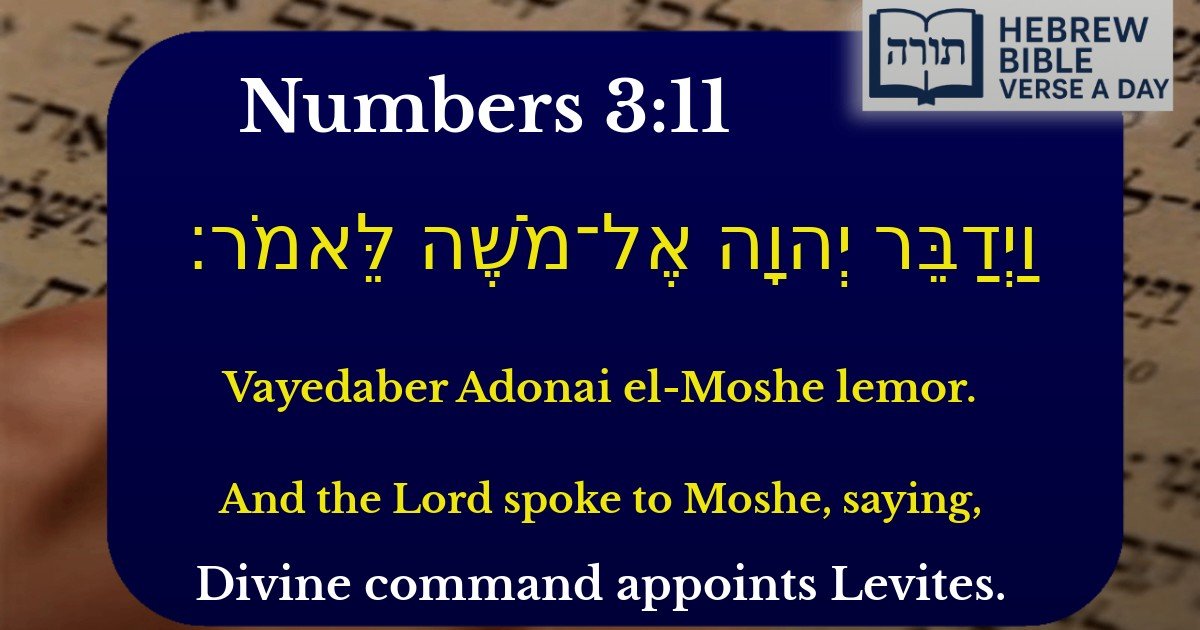

Numbers 3:11 - Divine command appoints Levites.

Numbers 3:11 - במדבר 3:11

Hebrew Text

וַיְדַבֵּר יְהוָה אֶל־מֹשֶׁה לֵּאמֹר׃

English Translation

And the Lord spoke to Moshe, saying,

Transliteration

Vayedaber Adonai el-Moshe lemor.

Hebrew Leining Text

וַיְדַבֵּ֥ר יְהֹוָ֖ה אֶל־מֹשֶׁ֥ה לֵּאמֹֽר׃

🎵 Listen to leining

Parasha Commentary

Introduction to Divine Communication

The phrase "וַיְדַבֵּר יְהוָה אֶל־מֹשֶׁה לֵּאמֹר" ("And the Lord spoke to Moshe, saying") is a recurring formula in the Torah, introducing direct communication from Hashem to Moshe Rabbeinu. Rashi (on Shemot 6:2) notes that this expression signifies a clear and direct transmission of divine will, often marking the beginning of a significant commandment or revelation.

The Nature of Divine Speech

Rambam (Maimonides) in Moreh Nevuchim (1:65) explains that when the Torah describes Hashem as "speaking," it is an anthropomorphism to help human beings comprehend divine communication. In truth, Hashem's "speech" transcends human language and is a pure transmission of divine wisdom to Moshe, the most elevated of prophets.

  • Rashi (Shemot 19:19): Emphasizes that Moshe alone merited this level of direct communication ("panim el panim"), unlike other prophets who received visions or dreams.
  • Ramban (Nachmanides on Shemot 20:1): Highlights that this phrase underscores the authenticity and authority of Moshe's prophecy, distinguishing it from all other forms of divine revelation.

The Significance of "Lemor" (לֵּאמֹר)

The word "לֵּאמֹר" ("saying") indicates that Moshe was commanded to transmit the divine message to Bnei Yisrael. The Talmud (Yoma 4b) explains that this term implies an obligation to relay the words precisely as received, without addition or omission.

Contextual Meaning in the Torah

This phrase appears frequently at the outset of mitzvot, as noted by the Ohr HaChaim (Shemot 25:1), who explains that it serves as a reminder that all commandments originate from Hashem's direct will, not Moshe's own authority. The Kli Yakar adds that the repetition of this formula throughout the Torah reinforces the eternal nature of these commandments.

📚 Talmud Citations

This verse is not quoted in the Talmud.

Frequently Asked Questions

Q: What does it mean when the verse says 'And the Lord spoke to Moshe, saying'?
A: This phrase is a common introduction in the Torah indicating that Hashem (G-d) is conveying a commandment or message to Moshe (Moses) to transmit to the Jewish people. Rashi explains that this wording emphasizes the direct and clear communication between Hashem and Moshe.
Q: Why does the Torah repeat 'saying' after 'And the Lord spoke to Moshe'?
A: The word 'saying' (לֵּאמֹר) teaches that Moshe was commanded to repeat Hashem's words exactly to the Jewish people. The Talmud (Yoma 4b) explains that this term implies Moshe was to transmit the message faithfully, without adding or omitting anything.
Q: How is this verse relevant to us today?
A: This verse reminds us of the importance of faithfully transmitting Torah teachings from generation to generation. Just as Moshe conveyed Hashem's words accurately, we must ensure the Torah's integrity is preserved in our learning and teaching, as emphasized by Rambam in his principles of Torah transmission.
Q: Why is Moshe referred to by name here instead of as 'Moshe Rabbeinu' (Moses our teacher)?
A: The Torah often refers to Moshe simply by his name to show his humility and his role as a faithful messenger of Hashem. The Midrash (Shemos Rabbah 3:15) highlights that Moshe's greatness lay in his willingness to be a pure conduit for Hashem's word without seeking honor for himself.
Q: What can we learn from the way Hashem spoke to Moshe?
A: We learn that prophecy requires clarity and direct communication. Rambam (Hilchos Yesodei HaTorah 7:1) explains that Moshe's prophecy was unique in that he heard Hashem's words with perfect clarity, unlike other prophets who received messages through visions or parables.