Frequently Asked Questions
Q: What is the context of Numbers 31:12?
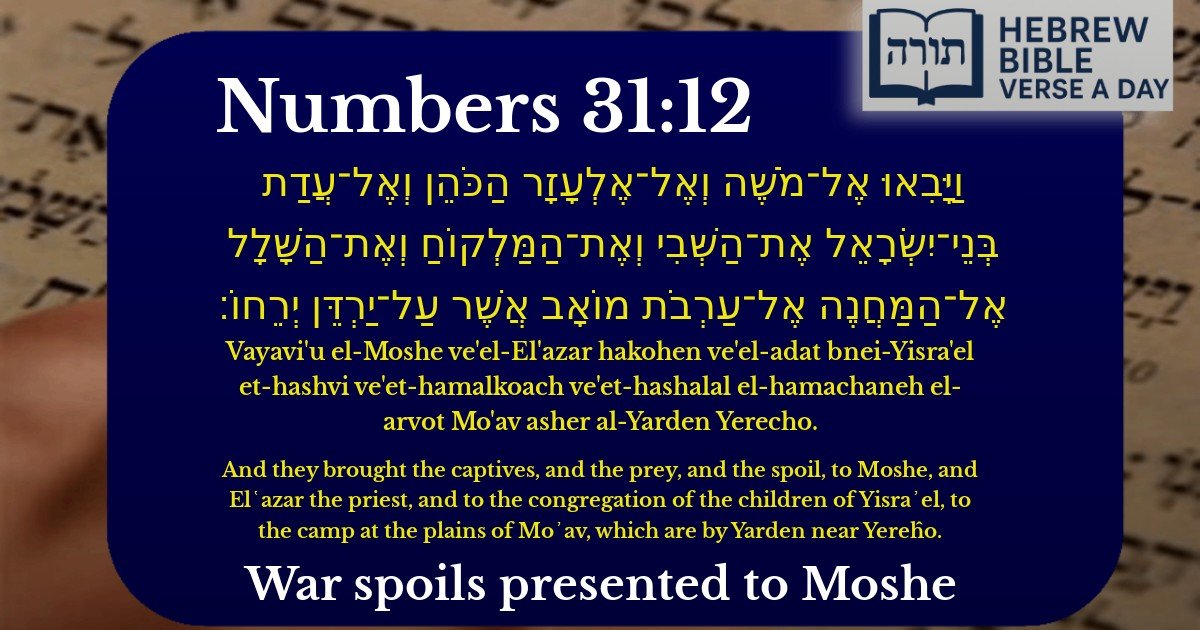
A: Numbers 31:12 describes the aftermath of the battle against Midian, where the Israelites, following Hashem's command, fought and defeated them. The verse explains how the soldiers brought the captives, spoils of war, and other plunder to Moshe, Elazar the Kohen, and the entire congregation of Israel at their camp in the plains of Moav near the Jordan River by Jericho. This event is part of the Torah's account of the Israelites' journey before entering the Land of Israel.
Q: Why did they bring the spoils to Moshe and Elazar?
A: According to Rashi and other commentaries, the spoils were brought to Moshe and Elazar the Kohen to ensure proper distribution and purification. The Torah requires that spoils of war be divided between the warriors, the Levites, and the rest of the nation (Numbers 31:27-30). Additionally, certain items needed purification (such as metal utensils through kashering) before they could be used, as explained in the following verses (Numbers 31:21-24).
Q: What lesson can we learn from this verse today?
A: This verse teaches the importance of accountability and following proper procedures, even in times of success. The soldiers did not keep the spoils for themselves but brought them to Moshe and Elazar for proper distribution and sanctification. This reflects the Jewish value of honesty, fairness, and recognizing that material gains must be handled with integrity and in accordance with Torah law.
Q: Where exactly was the camp located in this verse?
A: The verse specifies that the camp was in the 'plains of Moav, which are by the Jordan near Jericho.' According to Rashi and other commentaries, this was the final encampment of the Israelites before entering Eretz Yisrael (the Land of Israel). It was a significant location where Moshe delivered many of his final teachings to the nation, as recorded in the book of Devarim (Deuteronomy).
Q: What is the significance of mentioning the captives and spoils?
A: The mention of captives and spoils highlights the fulfillment of Hashem's command to wage war against Midian (Numbers 31:1-2). The Torah emphasizes that the spoils were handled properly, teaching that even in war, ethical conduct and adherence to Torah law are essential. The Midrash also notes that the spoils included wealth that would later be used for the Mishkan (Tabernacle) and other holy purposes, showing that material success should be directed toward spiritual elevation.


Context of the Verse
This verse (Bamidbar 31:12) describes the return of Bnei Yisrael from the battle against Midian, where they brought the spoils of war to Moshe, Elazar the Kohen, and the entire congregation. The location is specified as the plains of Moav near the Jordan River by Yericho, emphasizing the final stages of their journey before entering Eretz Yisrael.
Rashi's Commentary
Rashi explains that the captives, prey, and spoil were brought to Moshe and Elazar to ensure proper distribution according to Hashem's command. He notes that this was a test for Bnei Yisrael—whether they would follow the Torah's laws regarding the division of spoils (Bamidbar 31:27-30). Rashi also highlights that Elazar's presence was crucial because the spoils required purification (as mentioned later in the parsha), and only a Kohen could oversee this process.
Rambam's Perspective
Rambam (Hilchot Melachim 8:1-2) discusses the laws of wartime spoils, emphasizing that all acquisitions in war must be handled with kedushah (sanctity). The spoils were not to be taken arbitrarily but were to be distributed under the guidance of Moshe and the Kohen, ensuring fairness and adherence to halachah.
Midrashic Insights
The Midrash Tanchuma (Matot 3) elaborates that the spoils were brought to the "camp" (הַמַּחֲנֶה) to teach that even in times of war and victory, Bnei Yisrael must remain connected to their spiritual center—the Mishkan and the leadership of Moshe and the Kohanim. The Midrash also notes that the mention of the plains of Moav near Yericho hints at the imminent conquest of Eretz Yisrael, framing this event as a prelude to Yehoshua's leadership.
Halachic Implications
Symbolism of the Location
The plains of Moav represent a transitional space—between the wilderness and Eretz Yisrael. Bringing the spoils here symbolizes that Bnei Yisrael were to carry the lessons of midbar (humility, reliance on Hashem) into their future as a nation in their land. The proximity to Yericho, the first city to be conquered, further ties this event to the fulfillment of Hashem's promise to Avraham.