

Join Our Newsletter To Be Informed When New Videos Are Posted
Hebrew Text
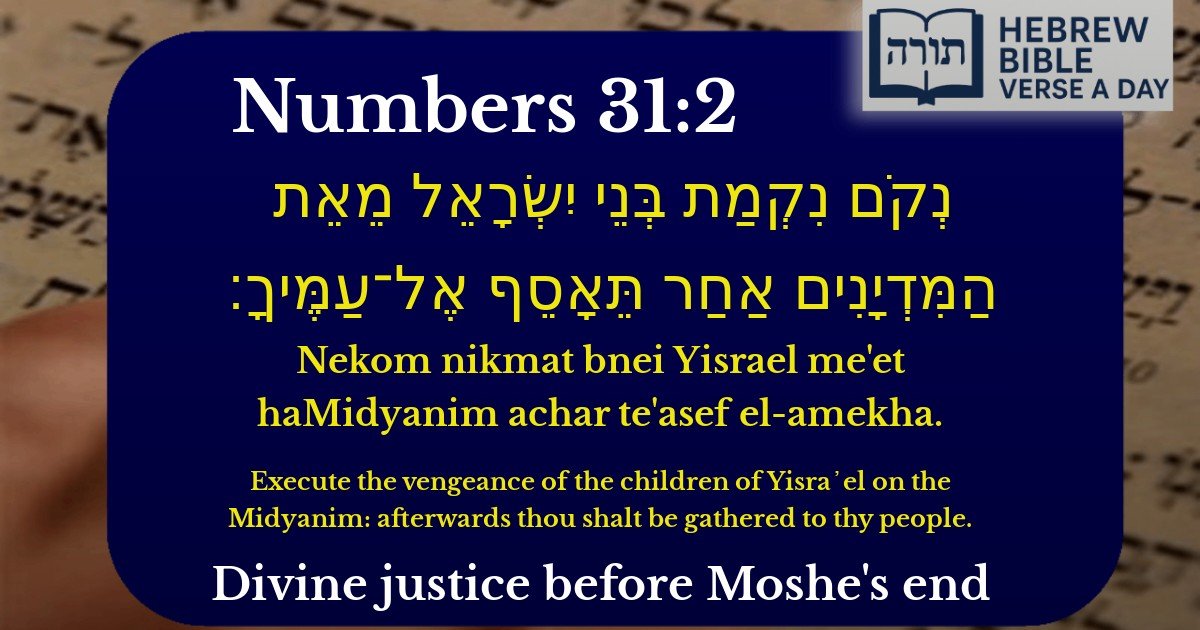
נְקֹם נִקְמַת בְּנֵי יִשְׂרָאֵל מֵאֵת הַמִּדְיָנִים אַחַר תֵּאָסֵף אֶל־עַמֶּיךָ׃
English Translation
Execute the vengeance of the children of Yisra᾽el on the Midyanim: afterwards thou shalt be gathered to thy people.
Transliteration
Nekom nikmat bnei Yisrael me'et haMidyanim achar te'asef el-amekha.
Hebrew Leining Text
נְקֹ֗ם נִקְמַת֙ בְּנֵ֣י יִשְׂרָאֵ֔ל מֵאֵ֖ת הַמִּדְיָנִ֑ים אַחַ֖ר תֵּאָסֵ֥ף אֶל־עַמֶּֽיךָ׃
🎵 Listen to leining
Parasha Commentary
📚 Talmud Citations
This verse is quoted in the Talmud.
📖 Sotah 43a
The verse is referenced in the context of discussing the commandment to wage war against Midian and the subsequent death of Moses.
📖 Yoma 76a
Mentioned in a discussion about the timing of Moses' death in relation to the command to take vengeance on Midian.
Context of the Verse
The verse (Bamidbar 31:2) commands Moshe to wage war against Midyan as retribution for their role in leading Bnei Yisrael astray through the incident of Ba'al Pe'or (Bamidbar 25). This is one of Moshe's final missions before his passing, as the verse states, "afterwards thou shalt be gathered to thy people."
Rashi's Explanation
Rashi (31:2) explains that this vengeance was specifically for the harm Midyan caused Bnei Yisrael, despite not being attacked by them first. He notes that while Moav also participated in the sin of Ba'al Pe'or, the Torah focuses on Midyan because they initiated the plot (based on Sanhedrin 106a). Rashi further comments that the phrase "afterwards thou shalt be gathered" implies this was Moshe's final mission before his death.
Rambam's Perspective
Rambam (Hilchot Melachim 5:1) discusses this war as an example of a milchemet mitzvah (obligatory war), required to punish those who seek to spiritually harm Klal Yisrael. He emphasizes that such wars are not for territorial expansion but for defending the spiritual integrity of the nation.
Talmudic Insights
Midrashic Interpretation
Bamidbar Rabbah (22:4) states that this command came specifically before Moshe's death to complete his mission of defending Yisrael's honor. The Midrash compares this to a faithful shepherd who protects his flock until his last moment.
Later Commentators
The Kli Yakar (31:2) notes the double language of "נְקֹם נִקְמַת" (literally "avenge the vengeance") to teach that this was both vengeance for the past sin at Ba'al Pe'or and a preventive measure against future harm from Midyan.