

Join Our Newsletter To Be Informed When New Videos Are Posted
Hebrew Text
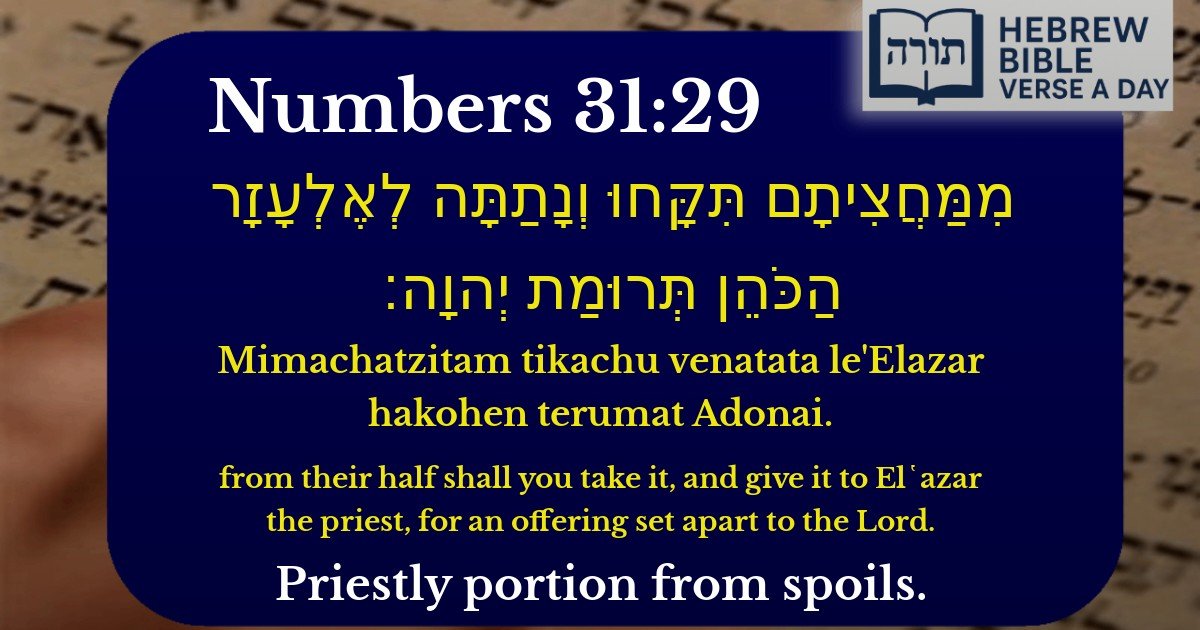
מִמַּחֲצִיתָם תִּקָּחוּ וְנָתַתָּה לְאֶלְעָזָר הַכֹּהֵן תְּרוּמַת יְהוָה׃
English Translation
from their half shall you take it, and give it to El῾azar the priest, for an offering set apart to the Lord.
Transliteration
Mimachatzitam tikachu venatata le'Elazar hakohen terumat Adonai.
Hebrew Leining Text
מִמַּֽחֲצִיתָ֖ם תִּקָּ֑חוּ וְנָתַתָּ֛ה לְאֶלְעָזָ֥ר הַכֹּהֵ֖ן תְּרוּמַ֥ת יְהֹוָֽה׃
🎵 Listen to leining
Parasha Commentary
📚 Talmud Citations
This verse is not quoted in the Talmud.
Context of the Verse
This verse (Bamidbar 31:41) appears in the context of the distribution of spoils from the war against Midian. The Torah instructs that half of the spoils taken by the soldiers should be given to the community, and from that half, a portion is to be given to Elazar the Kohen as a terumat Hashem (offering to the Lord).
Rashi's Explanation
Rashi (Bamidbar 31:41) clarifies that this portion given to Elazar the Kohen is terumah, akin to the terumat ma'aser (the tithe of the tithe) given to the Kohanim from agricultural produce. Just as terumah is sanctified and reserved for Kohanim, so too here, a portion of the spoils is designated for the Kohen as a sacred offering.
Rambam's Perspective
In Hilchot Melachim (8:1), Rambam discusses the laws of war spoils and explains that this portion given to the Kohen is a mitzvah derived from this verse. It emphasizes the Kohen's role in representing the Divine presence during military campaigns, ensuring that even in war, the sanctity of Hashem's portion is upheld.
Midrashic Insight
The Midrash (Bamidbar Rabbah 22:4) connects this verse to the broader theme of recognizing Hashem's hand in victory. By giving a portion to the Kohen, the soldiers acknowledge that their success in battle was not due to their own strength but through Divine assistance. This act of giving reinforces the principle of hakarat hatov (gratitude) to Hashem.
Halachic Implications