Frequently Asked Questions
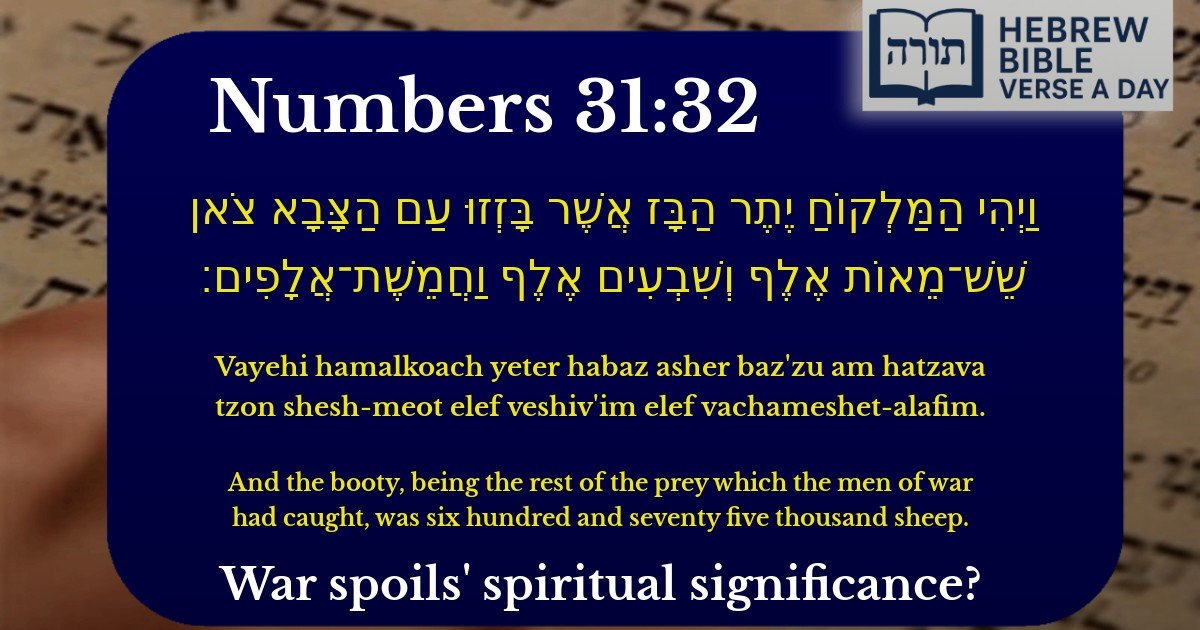
Q: What does Numbers 31:32 mean when it mentions the spoils of war?
A: Numbers 31:32 describes the spoils of war taken by the Israelites after their battle with Midian. The verse specifies that among the captured goods were 675,000 sheep. According to Rashi, this immense number highlights the great wealth of Midian and the extent of the victory granted to the Israelites by Hashem.
Q: Why is the large number of sheep significant in Numbers 31:32?
A: The large number of sheep (675,000) emphasizes the magnitude of the victory and the bounty Hashem provided. The Talmud (Chullin 11a) discusses the laws of kosher slaughter, and such vast numbers remind us of the importance of properly handling and sanctifying even material gains from war, as they ultimately belong to Hashem.
Q: How does Numbers 31:32 apply to us today?
A: While we are not at war today, this verse teaches us about gratitude and recognizing Hashem's hand in our successes. The Rambam (Hilchot Melachim 8:1) explains that even in times of victory, we must remember ethical conduct and proper distribution of resources, as the spoils were divided among the people, Levites, and the Mishkan (Tabernacle).
Q: What can we learn from the spoils of war in Numbers 31:32?
A: This verse teaches us that material success comes from Hashem and must be used responsibly. The Midrash (Bamidbar Rabbah 22:4) explains that the spoils were carefully counted and allocated, showing that even in times of abundance, we must act with fairness and holiness.
Q: Why does the Torah specify the exact number of sheep in Numbers 31:32?
A: The Torah provides precise numbers to emphasize the fulfillment of Hashem's promise and the accountability in handling war spoils. Rashi notes that exact counts were necessary for proper distribution—teaching us that honesty and transparency are essential, especially with communal property.


Context of the Verse
The verse (Numbers 31:32) describes the spoils of war taken by Bnei Yisrael after their battle with Midian. This was part of the divine command to avenge the harm Midian had caused Israel through the incident of Baal Peor (Numbers 25:17-18). The enormous quantity of sheep—675,000—reflects the vastness of Midian's wealth and the scale of their defeat.
Rashi's Commentary
Rashi (Rabbi Shlomo Yitzchaki) notes that the phrase "וְשִׁבְעִים אֶלֶף" (and seventy thousand) is written in an unusual, abbreviated form (without the letter vav in "שִׁבְעִים"). He explains that this hints at a reduction in the spoils: the number of sheep was originally destined to be greater, but due to the sin of some soldiers who kept Midianite women alive (against Moshe's command), the total was diminished (Rashi on Numbers 31:32, based on Midrash Tanchuma).
Midrashic Insights
Halachic Implications
The Rambam (Maimonides) discusses the laws of spoils of war in Hilchot Melachim (Laws of Kings 8:1-2), noting that the division of spoils follows a Torah-mandated formula: half to the soldiers and half to the community, with a portion set aside for the Kohen (priest). The vast number of sheep here underscores the importance of equitable distribution, as taught in the Talmud (Bava Kama 38a).
Symbolism of Sheep
Sheep were central to Midian's economy, and their capture signified the dismantling of Midian's power. The Kli Yakar (Rabbi Shlomo Ephraim Luntschitz) suggests that sheep also represent docility; their seizure symbolized the subduing of Midian's corrupting influence, which had led Israel to immorality at Baal Peor.