
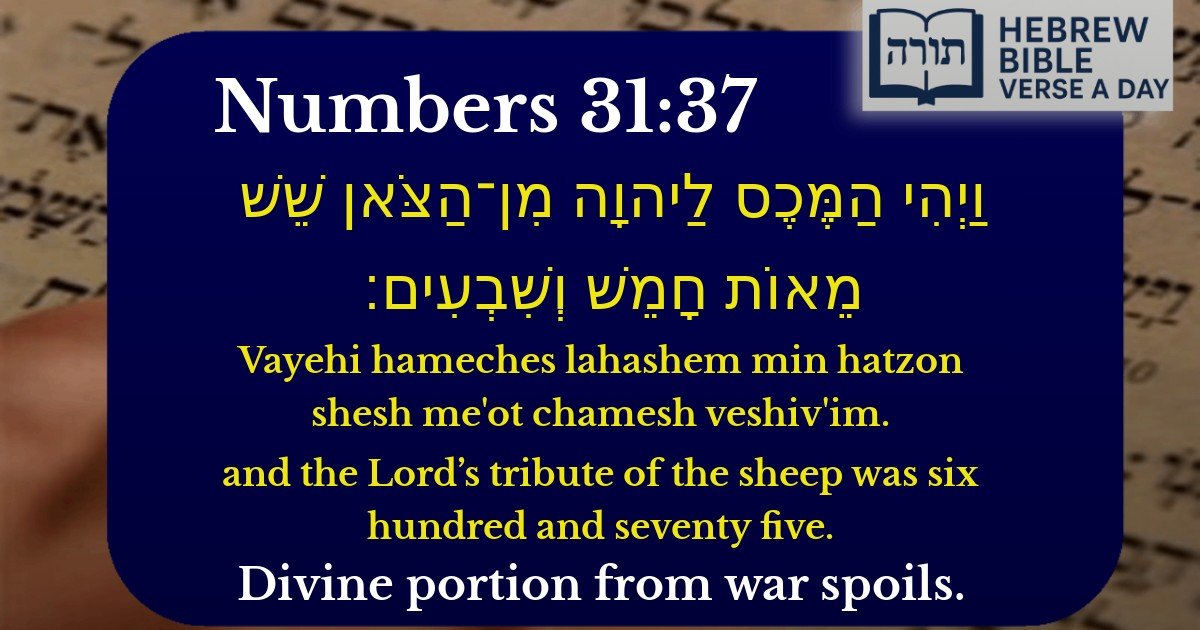

Numbers 31:37 - Divine portion from war spoils.

Numbers 31:37 - במדבר 31:37

Hebrew Text

וַיְהִי הַמֶּכֶס לַיהוָה מִן־הַצֹּאן שֵׁשׁ מֵאוֹת חָמֵשׁ וְשִׁבְעִים׃

English Translation

and the Lord’s tribute of the sheep was six hundred and seventy five.

Transliteration

Vayehi hameches lahashem min hatzon shesh me'ot chamesh veshiv'im.

Hebrew Leining Text

וַיְהִ֛י הַמֶּ֥כֶס לַֽיהֹוָ֖ה מִן־הַצֹּ֑אן שֵׁ֥שׁ מֵא֖וֹת חָמֵ֥שׁ וְשִׁבְעִֽים׃

🎵 Listen to leining

Parasha Commentary

Context in the Torah

The verse (Numbers 31:37) appears in the context of the spoils taken from the war against Midian. After the battle, Moshe and Elazar the Kohen were commanded to divide the spoils between the soldiers and the rest of the congregation, with a portion designated as a tribute to Hashem.

Rashi's Explanation

Rashi (Rabbi Shlomo Yitzchaki) explains that this "tribute to Hashem" refers to the portion given to the Kohanim, as derived from the earlier verse (Numbers 31:28-29). The calculation of 675 sheep was one out of every 500 taken as spoils, which was then given to the Kohanim as their share (תרומה).

Rambam's Perspective

In Hilchot Melachim (8:1), the Rambam (Maimonides) discusses the laws of spoils of war and confirms that a portion must be separated for the Kohen, as this verse demonstrates. This halacha applies even in future wars when the Beit HaMikdash is rebuilt.

Numerical Significance

The number 675 has been examined by commentators:

  • The Baal HaTurim notes that 675 is numerically equivalent to the phrase "זֶה קָרְבַּן" (this is the offering), hinting at the sacrificial nature of this tribute.
  • The Sifrei (a halachic Midrash) emphasizes that this precise accounting demonstrates the Israelites' meticulousness in fulfilling Hashem's commandments regarding sacred matters.

Spiritual Lesson

The Kli Yakar (Rabbi Shlomo Ephraim Luntschitz) teaches that separating this tribute immediately after battle - before any personal benefit was taken - reflects the principle of prioritizing our obligations to Hashem even amidst material success. This models the proper attitude toward wealth and Divine service.

📚 Talmud Citations

This verse is not quoted in the Talmud.

Frequently Asked Questions

Q: What does Numbers 31:37 mean when it mentions 'the Lord’s tribute of the sheep'?
A: Numbers 31:37 refers to the portion of spoils from the war against Midian that was designated as a tribute to Hashem. According to Rashi, this was a mandatory gift given to the Kohanim (priests) and Levites as part of the mitzvah to sanctify a portion of war spoils to Hashem (Numbers 31:28-30).
Q: Why was the number of sheep (675) significant in Numbers 31:37?
A: The number 675 represents one out of every 500 sheep taken as spoils from the war with Midian, as commanded in Numbers 31:28-30. This was a fixed proportion set by the Torah to acknowledge Hashem’s role in their victory. The Talmud (Chullin 11a) discusses the laws of separating these portions as holy.
Q: How does the concept of 'tribute to Hashem' in Numbers 31:37 apply today?
A: While we no longer bring war spoils as tribute, the principle of acknowledging Hashem’s blessings remains. Today, we fulfill this through mitzvot like giving tzedakah (charity), separating challah from dough, and reciting blessings over food—all ways of recognizing that what we have comes from Hashem (Rambam, Hilchot Matnot Aniyim 8:1).
Q: Who received the tribute mentioned in Numbers 31:37?
A: The tribute of 675 sheep was given to Elazar the Kohen Gadol (High Priest) and the Kohanim, as stated in Numbers 31:41. Rashi explains that this was their share for their service in the Mishkan (Tabernacle), similar to other priestly gifts like terumah and ma'aser.