Frequently Asked Questions
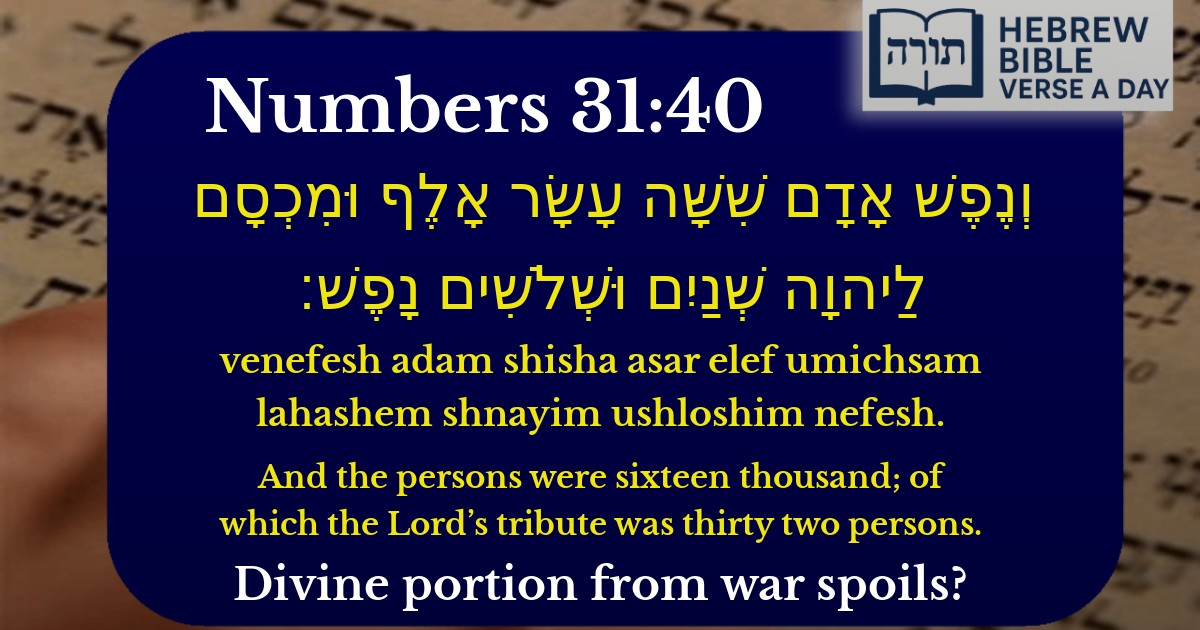
Q: What does Numbers 31:40 mean?
A: This verse describes the division of spoils after the battle with Midian. Out of 16,000 people captured, 32 were designated as a tribute to Hashem, given to the Kohanim (priests) as commanded in the Torah.
Q: Why were 32 people given to Hashem?
A: The Torah (Numbers 31:28-29) commands that 1/500 of the spoils be given to the Kohanim as a tribute to Hashem. 32 is exactly 1/500 of 16,000, fulfilling this mitzvah. Rashi explains this was in addition to other required donations.
Q: What happened to the 32 people given to Hashem?
A: According to halacha (Jewish law), these individuals became servants to the Kohanim in the Mishkan (Tabernacle), performing necessary tasks. The Rambam explains they were treated with dignity as required by Torah laws regarding servants.
Q: Why is this verse important in Judaism?
A: This verse teaches important principles about properly dividing spoils of war according to Torah law, showing gratitude to Hashem through designated portions, and the proper treatment of those in servitude - all fundamental Jewish values.
Q: How does this apply to Jews today?
A: While we don't have wars or the Temple service today, we learn from this the importance of: 1) Giving proper tithes and donations (like ma'aser), 2) Following precise Torah calculations in mitzvot, and 3) Treating all workers with dignity as the Torah requires.


Context in the Torah
The verse (Bamidbar 31:40) appears in the context of the spoils of war from the battle against Midian. Moshe and Elazar the Kohen are commanded to take an accounting of the spoils, including the human captives, and to allocate a portion to Hashem as tribute.
Numerical Significance
The Torah states that there were 16,000 human captives, of which 32 were designated as "the Lord’s tribute." Rashi (Bamidbar 31:40) explains that this allocation follows the Torah’s general principle of terumah (sacred portion), where 1 out of every 500 is given to the Kohanim. Here, 32 is 1/500th of 16,000.
The Role of the Kohanim
Rambam (Hilchot Matnot Aniyim 1:14) discusses the laws of terumat ma'aser and other priestly gifts, emphasizing that these allocations are sacred and must be treated with reverence. The 32 individuals given as tribute were likely assigned to assist the Kohanim in their service in the Mishkan, as per the halachic framework of avdei kohanim (servants of the priests).
Moral and Ethical Dimensions
Halachic Implications
The Talmud (Chullin 11a) derives from this verse that the laws of terumah apply not only to agricultural produce but also to other forms of property, including human captives. This reinforces the principle that all material gains must be sanctified in accordance with Torah law.