Frequently Asked Questions
Q: What does Numbers 31:41 mean?
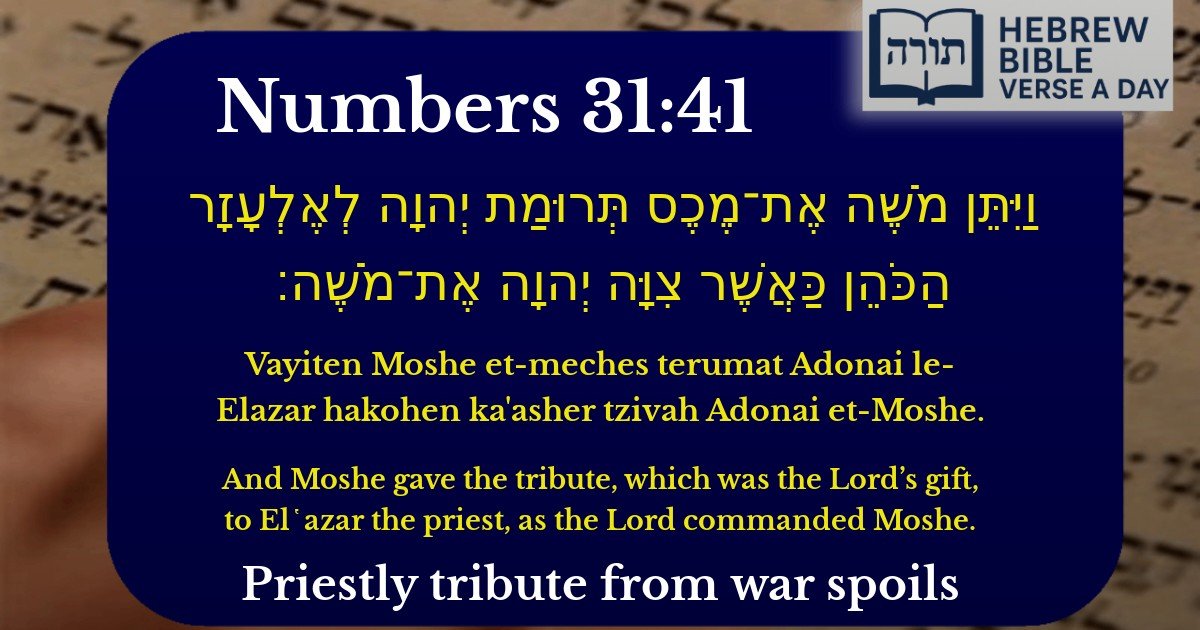
A: Numbers 31:41 describes Moshe (Moses) giving a portion of the spoils from the battle against Midian as a tribute to Hashem (God). This tribute was then given to Elazar the Kohen (priest), as commanded by Hashem. According to Rashi, this teaches us the importance of separating and dedicating a portion of our gains for holy purposes, following divine instruction.
Q: Why did Moshe give the tribute to Elazar the Kohen?
A: Moshe gave the tribute to Elazar the Kohen because Hashem commanded him to do so (Numbers 31:41). The Rambam explains that the Kohanim (priests) were designated to receive certain gifts and offerings, as they served in the Mishkan (Tabernacle) and later the Beit HaMikdash (Temple). This reinforced their role as spiritual leaders and their dependence on the community for sustenance.
Q: What can we learn from Numbers 31:41 today?
A: From Numbers 31:41, we learn the importance of giving ma'aser (tithes) and terumah (offerings) to support Torah scholars and holy causes, as taught in the Talmud (Chullin 131a). Just as Moshe followed Hashem's command to give a portion to the Kohen, we too should set aside a portion of our earnings for tzedakah (charity) and supporting Torah institutions.
Q: Why is the tribute in Numbers 31:41 important in Judaism?
A: The tribute in Numbers 31:41 is important because it demonstrates the principle of hakarat hatov (recognizing and giving thanks for blessings). By dedicating a portion of the spoils to Hashem, Bnei Yisrael (the Children of Israel) acknowledged that their victory came from Him. The Midrash (Bamidbar Rabbah) emphasizes that all success comes from Hashem, and we must express gratitude through acts of giving.
Q: How does Numbers 31:41 relate to the role of Kohanim?
A: Numbers 31:41 highlights the role of Kohanim as recipients of holy offerings, as commanded by Hashem. The Talmud (Zevachim 17b) explains that Kohanim were entrusted with maintaining the sanctity of the Mishkan and later the Beit HaMikdash. By giving them a portion, the community ensured their material needs were met so they could focus on their sacred duties.


Context of the Verse
The verse (Bamidbar 31:41) describes Moshe fulfilling the commandment to give the mekhes terumat Hashem (the tribute offering to Hashem) to Elazar the Kohen after the battle against Midian. This was part of the distribution of spoils, where a portion was designated as holy to Hashem.
Rashi's Explanation
Rashi (Bamidbar 31:41) clarifies that this tribute was the terumah (raised portion) taken from the spoils of war, as commanded earlier in the parsha (Bamidbar 31:28-29). He notes that Moshe gave it specifically to Elazar, the Kohen Gadol, rather than to Aharon, because Aharon had already passed away by this time (as recorded in Bamidbar 20:28). This demonstrates Moshe's meticulous adherence to divine command (ka'asher tzivah Hashem et Moshe).
Rambam's Perspective
In Hilchot Melachim (8:1), the Rambam codifies the laws of war spoils, stating that a portion must be separated for the Kohen, as derived from this verse. He emphasizes that this applies even in wars not directly commanded by Hashem (milchemet reshut), showing the enduring nature of this halacha.
Midrashic Insights
Halachic Implications
The Chizkuni (Bamidbar 31:41) explains that this verse establishes the precedent that terumah from spoils is given to the Kohanim, parallel to agricultural terumah. The Kli Yakar adds that this teaches that even in military conquests, recognition of Hashem's role is paramount, hence the portion given to the representatives of the divine service.