Frequently Asked Questions
Q: What was the responsibility of the sons of Gershon in the Mishkan?
A: The sons of Gershon were responsible for transporting and caring for the coverings and curtains of the Mishkan (Tabernacle), including the outer coverings and the screen at the entrance (Numbers 3:25). Rashi explains that their duties involved handling the finer materials that protected the Mishkan.
Q: Why were the Gershonites given this specific task?
A: The Gershonites, as descendants of Levi, were assigned this role because of their family lineage. The Torah divides responsibilities among the Levite families—Kehat, Gershon, and Merari—each with distinct duties. Gershon's descendants were entrusted with the lighter, fabric-based components (Rambam, Hilchot Klei HaMikdash 3:1).
Q: What can we learn from the Gershonites' role in the Mishkan?
A: The Gershonites teach us that every role in serving Hashem is important, even if it seems less prominent. Their work with the coverings was essential for protecting the holiness of the Mishkan. The Midrash (Bamidbar Rabbah 6:2) emphasizes that all contributions to holiness matter, whether great or small.
Q: How does this verse apply to us today?
A: Just as the Gershonites had a unique role in maintaining the Mishkan, every Jew has a special purpose in serving Hashem. The Talmud (Sanhedrin 17b) teaches that each person’s talents are needed for the community’s spiritual well-being, mirroring the division of labor among the Levites.
Q: What was the 'screen for the door of the Tent of Meeting'?
A: The screen (מָסָךְ) was a curtain that served as the entrance to the Mishkan. Rashi (on Exodus 26:36) describes it as a beautifully woven divider, symbolizing the transition from the mundane to the sacred. Only the Kohanim and Levites could pass beyond it.

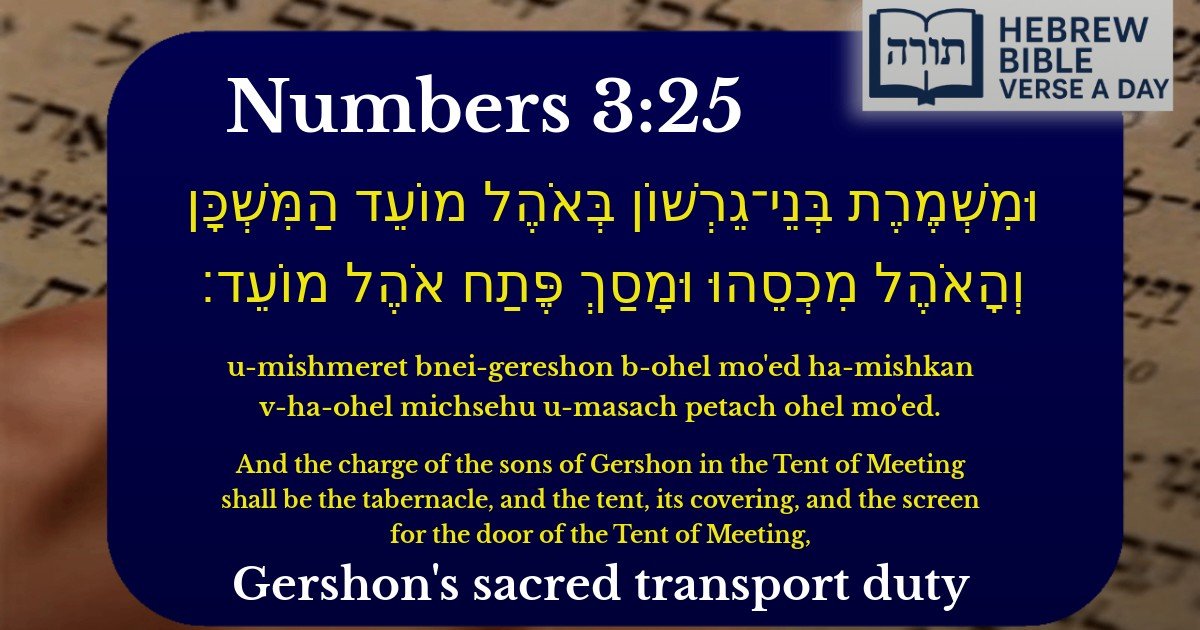

Overview of the Verse
The verse (Bamidbar 3:25) describes the responsibilities assigned to the sons of Gershon, one of the families of the Levites, regarding the maintenance and transport of the Mishkan (Tabernacle). Their duties specifically involved the coverings and curtains of the Mishkan, as well as the screen at the entrance of the Ohel Moed (Tent of Meeting).
Rashi's Commentary
Rashi explains that the "Mishkan" refers to the ten curtains forming the inner covering (Exodus 26:1), while the "Ohel" (tent) refers to the eleven curtains of goat hair that served as the outer covering (Exodus 26:7). The "covering" (מִכְסֵהוּ) is the tachash skin covering (Exodus 26:14), and the "screen" (מָסַךְ) is the curtain at the entrance (Exodus 26:36).
Rashi emphasizes that the Gershonites were responsible for transporting these items when the Mishkan was moved, as detailed later in Bamidbar 4:25-26.
Rambam's Perspective
In Hilchot Klei HaMikdash (3:9), the Rambam (Maimonides) discusses the division of labor among the Levites. He notes that the Gershonites' role was distinct from that of the Kehatites (who carried the sacred vessels) and the Merarites (who carried the structural components). The Gershonites' responsibility for the coverings and curtains highlights their role in protecting the sanctity of the Mishkan from exposure.
Midrashic Insights
The Midrash Tanchuma (Bamidbar 6) elaborates that the Gershonites' task symbolized their spiritual role in safeguarding the holiness of the Mishkan. Just as the coverings shielded the Mishkan from physical elements, the Levites' service protected the spiritual integrity of the Israelite camp.
Talmudic Discussion
In Zevachim 55a, the Talmud discusses the meticulous care required in handling the Mishkan's coverings. The Gershonites had to ensure that no part of the sacred structure was exposed during transport, reflecting the principle of kavod (honor) due to the Mishkan.
Key Responsibilities of the Gershonites
Symbolic Meaning
The Sforno suggests that the Gershonites' role teaches the importance of preserving both the inner and outer aspects of holiness. The coverings represent the need to protect the sacred from external impurities, while the screen at the entrance signifies controlled access to divine service.