Frequently Asked Questions
Q: What is the significance of the Israelites' journey from Avrona to Ezyon-gever in Numbers 33:35?
A: This verse is part of the detailed itinerary of the Israelites' travels in the wilderness. According to Rashi, these stops are recorded to show G-d's kindness—even though they were traveling in a harsh desert, He provided for their needs at each location. Ezyon-gever is later mentioned as a port area (see 1 Kings 9:26), showing this was part of their divinely guided path.
Q: Why does the Torah list all these encampments in Numbers 33?
A: The Ramban explains that listing all 42 encampments serves multiple purposes: 1) It demonstrates G-d's constant care during the 40-year journey, 2) It provides historical record of Israel's wilderness experience, and 3) It teaches that life's journeys—both physical and spiritual—consist of many steps, each with its own purpose (based on Midrash Tanchuma).
Q: Where was Ezyon-gever located?
A: Traditional Jewish sources (like Rashi on Deuteronomy 2:8) identify Ezyon-gever as being near the Red Sea, at the northern tip of the Gulf of Aqaba. It was a strategic location that later became King Solomon's port (1 Kings 9:26). The Talmud (Shabbat 118b) notes it was a place of commerce and connection to other lands.
Q: What lesson can we learn from the Israelites' constant traveling in the wilderness?
A: The Baal Shem Tov teaches that each encampment represents a spiritual station in life. Just as the Israelites had to break camp and move forward, we too must continually progress in our divine service. The Sfat Emet adds that the word 'vayis'u' (and they journeyed) shares a root with 'nesi'ah' (elevation), showing each move brought spiritual growth.
Q: How does this verse connect to the overall purpose of the Book of Numbers?
A: Numbers (Bamidbar) documents Israel's transition from receiving the Torah at Sinai to preparing to enter the Land. As the Rambam explains (Guide 3:50), these travel records show how a slave generation became a nation ready for sovereignty. Each encampment—including Ezyon-gever—was a step in their national and spiritual development.

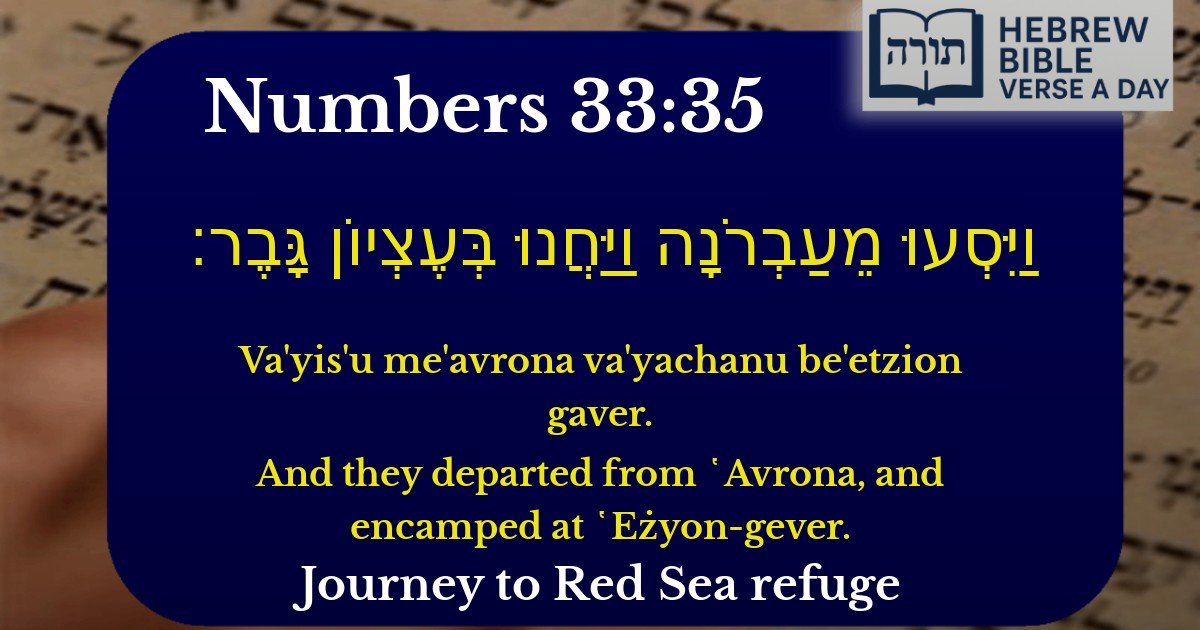

Location and Historical Context
The verse (Bamidbar 33:35) describes the journey of Bnei Yisrael in the wilderness, marking their departure from Avrona and encampment at Etzion Geber. Rashi notes that Etzion Geber was a significant location near the border of Edom, later known as a port city in the time of King Shlomo (Melachim I 9:26). The Midrash Tanchuma (Bamidbar 3) suggests that these travels symbolize the spiritual progression of the Jewish people, with each stop representing a stage in their refinement.
Geographical Significance
According to Rambam in Moreh Nevuchim (3:50), the detailed listing of encampments emphasizes Divine providence in guiding Bnei Yisrael through harsh terrain. Etzion Geber, situated near the Red Sea, was a strategic point for trade and travel. The Talmud (Shabbat 35a) associates it with the region where Bnei Yisrael later engaged in commerce, reflecting its importance in Israelite history.
Spiritual Interpretation
The Kli Yakar explains that the name Etzion Geber (עֶצְיוֹן גָּבֶר) alludes to strength (gevurah), indicating a place where Bnei Yisrael gathered spiritual fortitude before entering Eretz Yisrael. The Sforno adds that each encampment served as a test of faith, preparing them for future challenges.
Lessons from the Journey