Frequently Asked Questions
Q: What was the responsibility of the sons of Merari in the Tabernacle?
A: The sons of Merari were responsible for transporting and caring for the heavy structural parts of the Tabernacle, including the boards, bars, pillars, sockets, and all related vessels (Numbers 3:36). This was their sacred duty assigned by Hashem through Moshe.
Q: Why were different families given different Tabernacle duties?
A: The Kehatites, Gershonites, and Merarites each received different responsibilities based on their capabilities and the nature of the items (Rashi on Numbers 3:36). The division of labor teaches us that every role in serving Hashem is important, whether dealing with sacred vessels (Kehat), coverings (Gershon), or structural components (Merari).
Q: What can we learn from the Merarites' role in the Tabernacle?
A: The Merarites' responsibility for the heavy structural components teaches that even the seemingly mundane 'support' roles are holy when done for Hashem's service. The Talmud (Arachin 11a) emphasizes that all work for the Mishkan was equally important in building a dwelling place for the Divine Presence.
Q: How does the concept of 'Pekudat Mishmeret' (custodial duty) apply today?
A: Just as the Merarites had sacred responsibility for physical Tabernacle components, today we have responsibility for maintaining our synagogues and Torah institutions (Rambam, Hilchot Beit HaBechira 1:12). Every Jew has a role in upholding our spiritual infrastructure.
Q: Why does the verse specify every component the Merarites carried?
A: The detailed listing teaches that every part of the Tabernacle mattered - from large boards to small sockets (Midrash Tanchuma, Bamidbar 6). This reflects how every detail in Avodat Hashem (service of G-d) is significant and requires proper care.

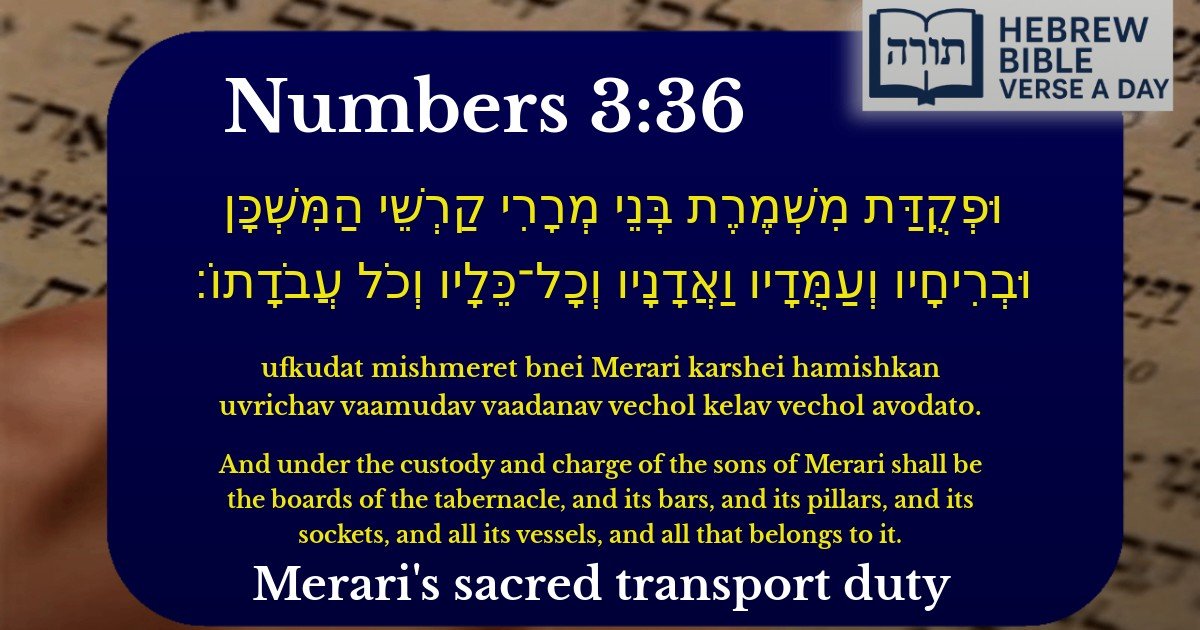

The Role of the Sons of Merari
The verse (Bamidbar 3:36) describes the specific responsibilities assigned to the sons of Merari, one of the three Levite families. Their duty was to transport and care for the structural components of the Mishkan (Tabernacle), including its boards, bars, pillars, sockets, and all related vessels. Rashi explains that the sons of Merari were entrusted with the heaviest and bulkiest parts of the Mishkan, highlighting their physical strength and dedication to the service of Hashem.
Symbolism of the Mishkan's Structure
The Midrash (Bamidbar Rabbah 3:8) teaches that each component of the Mishkan carried spiritual significance. The boards (kerashim) represent the steadfastness of the Jewish people, while the bars (briachim) symbolize unity, as they held the structure together. The pillars (amudim) and sockets (adanim) signify the foundation of Torah and mitzvot, which uphold the Jewish nation. The sons of Merari, by safeguarding these items, played a crucial role in maintaining the integrity of the Mishkan.
Lessons in Avodas Hashem
Rambam (Hilchos Klei HaMikdash 3:5) emphasizes that the Levites' service was not merely physical labor but a sacred duty. The sons of Merari, though tasked with seemingly mundane items, elevated their work to divine service. This teaches that every Jew, regardless of their role, can sanctify their actions when performed with the intention of serving Hashem.