Frequently Asked Questions
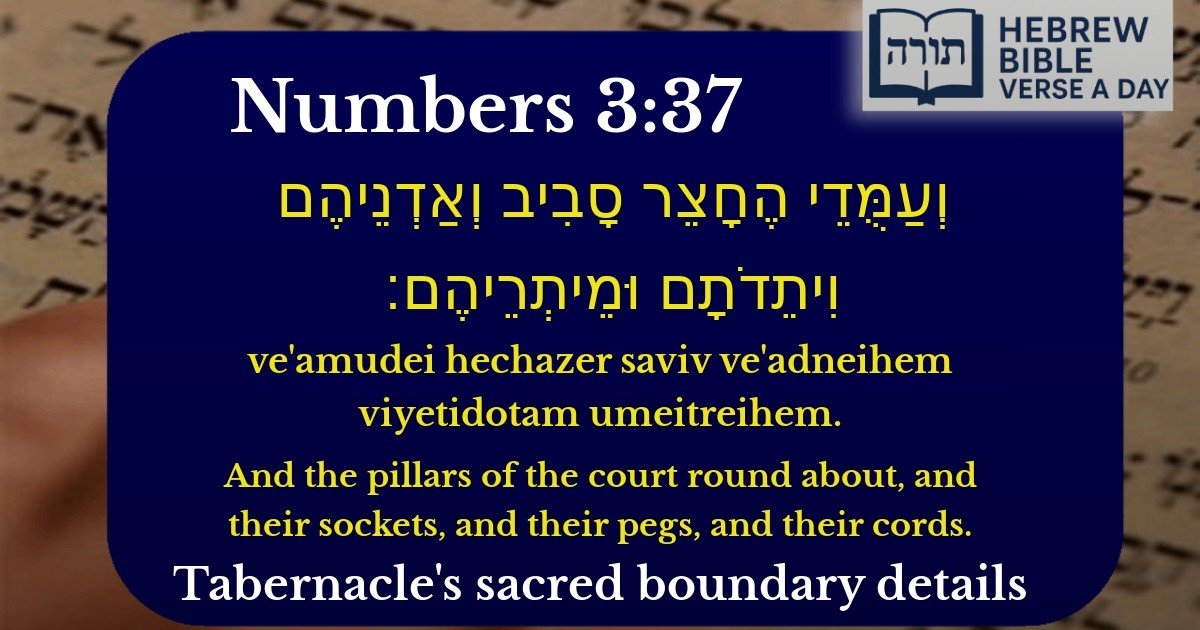
Q: What is the significance of the pillars, sockets, pegs, and cords mentioned in Numbers 3:37?
A: This verse describes the structural components of the Mishkan (Tabernacle) courtyard. The pillars held up the curtains, the sockets anchored them, the pegs secured the ropes, and the cords tied everything together. According to Rashi, these details highlight the importance of every part of the Mishkan, teaching us that every detail in serving Hashem matters.
Q: Why does the Torah list these specific parts of the Mishkan courtyard?
A: The Torah lists these details to emphasize the precision and care required in building the Mishkan, as explained in the Talmud (Yoma 72a). Each component had a spiritual purpose, symbolizing the need for structure and order in divine service. The Rambam (Hilchot Beit HaBechirah) also notes that these elements reflect the beauty and functionality of sacred spaces.
Q: What lesson can we learn from the description of the Mishkan's courtyard in this verse?
A: The Midrash (Bamidbar Rabbah) teaches that just as every part of the Mishkan had a purpose, every Jew has a unique role in serving Hashem. The pillars represent strength, the sockets stability, the pegs firmness, and the cords unity—all necessary for a meaningful spiritual life.
Q: How does this verse apply to our lives today?
A: The Mishkan's structure serves as a metaphor for community and personal growth. Just as the Mishkan needed all its parts to function, we need strong foundations (sockets), commitment (pegs), and connections (cords) in our spiritual and communal lives, as discussed in the teachings of the Chofetz Chaim on building a Torah home.


Context in the Mishkan
The verse (Exodus 38:31) describes components of the outer courtyard (Chatzer) of the Mishkan (Tabernacle). These elements—pillars (amudei hachatzar), sockets (adneihem), pegs (yitdotam), and cords (meitreihem)—were essential for the structural integrity and sanctity of the space. Rashi (ad loc.) explains that the pillars supported the curtains forming the courtyard walls, while the sockets anchored them firmly into the ground.
Symbolism of the Components
According to the Midrash (Tanchuma, Terumah 11), each part of the Mishkan reflects spiritual concepts:
Halachic Insights
The Rambam (Hilchot Beit HaBechirah 1:16-17) derives principles from these details for the construction of the Beit HaMikdash (Temple), emphasizing that every component must be made with intentionality (lishmah). The pegs and cords, though seemingly minor, teach that even auxiliary items require sanctity when used for divine service.
Practical Lessons
The Sforno notes that the courtyard's structure—enclosed yet accessible—mirrors the balance between maintaining kedushah (holiness) and engaging with the world. Just as the pegs secured the Mishkan against winds, mitzvot stabilize a Jew’s life amidst challenges (Talmud, Menachot 99b).