
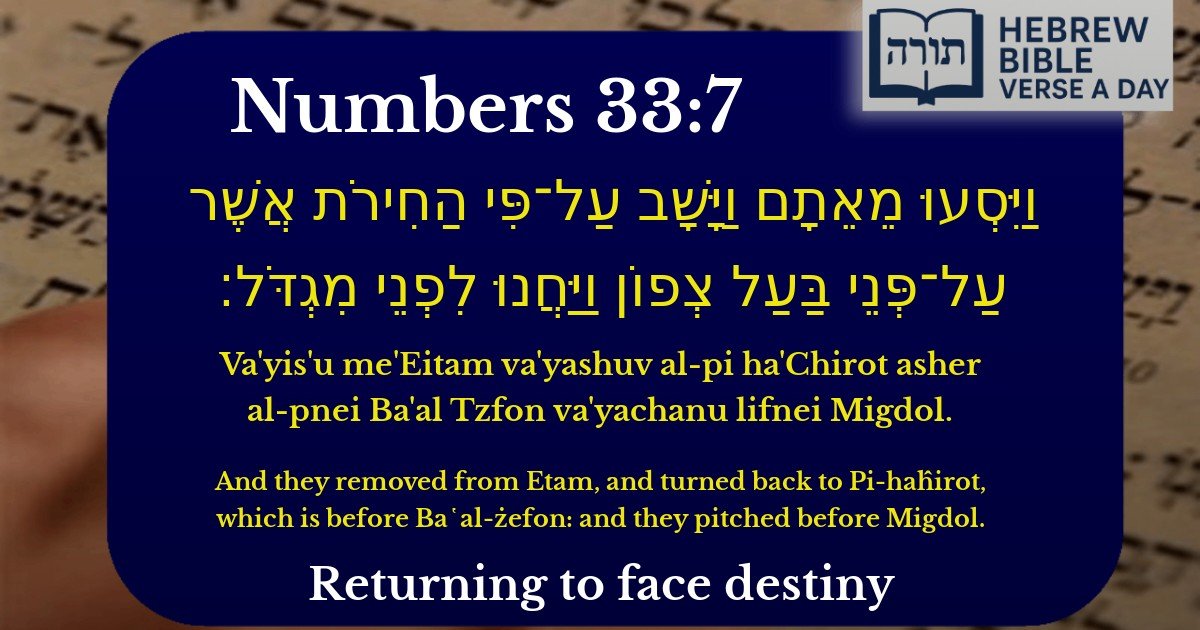

Numbers 33:7 - Returning to face destiny

Numbers 33:7 - במדבר 33:7

Hebrew Text

וַיִּסְעוּ מֵאֵתָם וַיָּשָׁב עַל־פִּי הַחִירֹת אֲשֶׁר עַל־פְּנֵי בַּעַל צְפוֹן וַיַּחֲנוּ לִפְנֵי מִגְדֹּל׃

English Translation

And they removed from Etam, and turned back to Pi-haĥirot, which is before Ba῾al-żefon: and they pitched before Migdol.

Transliteration

Va'yis'u me'Eitam va'yashuv al-pi ha'Chirot asher al-pnei Ba'al Tzfon va'yachanu lifnei Migdol.

Hebrew Leining Text

וַיִּסְעוּ֙ מֵֽאֵתָ֔ם וַיָּ֙שׇׁב֙ עַל־פִּ֣י הַחִירֹ֔ת אֲשֶׁ֥ר עַל־פְּנֵ֖י בַּ֣עַל צְפ֑וֹן וַֽיַּחֲנ֖וּ לִפְנֵ֥י מִגְדֹּֽל׃

🎵 Listen to leining

Parasha Commentary

Geographical and Historical Context

The verse describes the Israelites' journey after leaving Egypt, specifically their movement from Etam to Pi-haĥirot near Ba῾al-żefon. Rashi (Shemot 14:2) explains that this location was deliberately chosen by Hashem to mislead Pharaoh into thinking the Israelites were lost in the wilderness, thereby drawing him into pursuing them. This strategy was part of the divine plan to demonstrate Hashem's power through the splitting of the Red Sea.

Symbolism of the Locations

  • Pi-haĥirot: The name can be interpreted as "the mouth of freedom" (from the root ḥerut), symbolizing the Israelites' impending liberation. Alternatively, some Midrashim (e.g., Shemot Rabbah 20:18) associate it with narrow straits (ḥarot), reflecting the Israelites' feeling of being trapped between the sea and Pharaoh's army.
  • Ba῾al-żefon: This was an Egyptian deity associated with the north. Ramban (Shemot 14:2) notes that Hashem deliberately led the Israelites near this idol to show its impotence against the Almighty's will.
  • Migdol: Literally meaning "tower," it may refer to a watchtower or fortress. The Talmud (Sotah 11a) suggests it symbolizes the "tower of strength" that is Hashem, who would protect Israel.

Divine Strategy and Free Will

The Mechilta (Beshalach 2) emphasizes that Hashem orchestrated the Israelites' backtracking to Pi-haĥirot to test Pharaoh's free will. Despite witnessing the plagues, Pharaoh chose to pursue them, sealing his own fate. This aligns with the broader Torah theme of human responsibility even within divine providence.

Lessons in Emunah (Faith)

The Netziv (Ha'amek Davar, Shemot 14:2) highlights that the Israelites' apparent entrapment was a setup for a greater revelation of faith. By appearing to be lost, they were forced to rely entirely on Hashem, preparing them for the miracle of Kriyat Yam Suf (the splitting of the Red Sea). This teaches that moments of seeming despair can be precursors to divine salvation.

📚 Talmud Citations

This verse is not quoted in the Talmud.

Frequently Asked Questions

Q: What does Numbers 33:7 mean when it says the Israelites turned back to Pi-haĥirot?
A: According to Rashi, the phrase 'turned back' indicates that the Israelites made a deliberate detour on their journey. This was part of Hashem's plan to make Pharaoh think they were lost in the wilderness, which ultimately led to the splitting of the Red Sea (Shemot 14:3). The location Pi-haĥirot is identified as a narrow pass between mountains.
Q: Why is Ba῾al-żefon mentioned in Numbers 33:7?
A: Ba῾al-żefon was an Egyptian deity worshipped in that region. The Midrash explains that Hashem specifically led the Israelites near this place to demonstrate His supremacy over all false gods. By performing miracles there, He showed that no power could stand against the Almighty.
Q: What lesson can we learn from the Israelites' encampment before Migdol in this verse?
A: The Talmud teaches that every detail of the Israelites' journey holds meaning. Encamping before Migdol (which means 'tower') symbolizes that even when we feel surrounded or trapped (like by a watchtower), we must trust in Hashem's guidance, as He ultimately led them to freedom through the sea.
Q: How does Numbers 33:7 connect to the Exodus story?
A: This verse describes a critical moment right before the splitting of the Red Sea. As Ramban explains, the seemingly confusing route was actually divine strategy - by appearing 'trapped' between the sea, desert, and Egyptian army, the stage was set for the great miracle that demonstrated Hashem's complete control over nature and nations.