Frequently Asked Questions
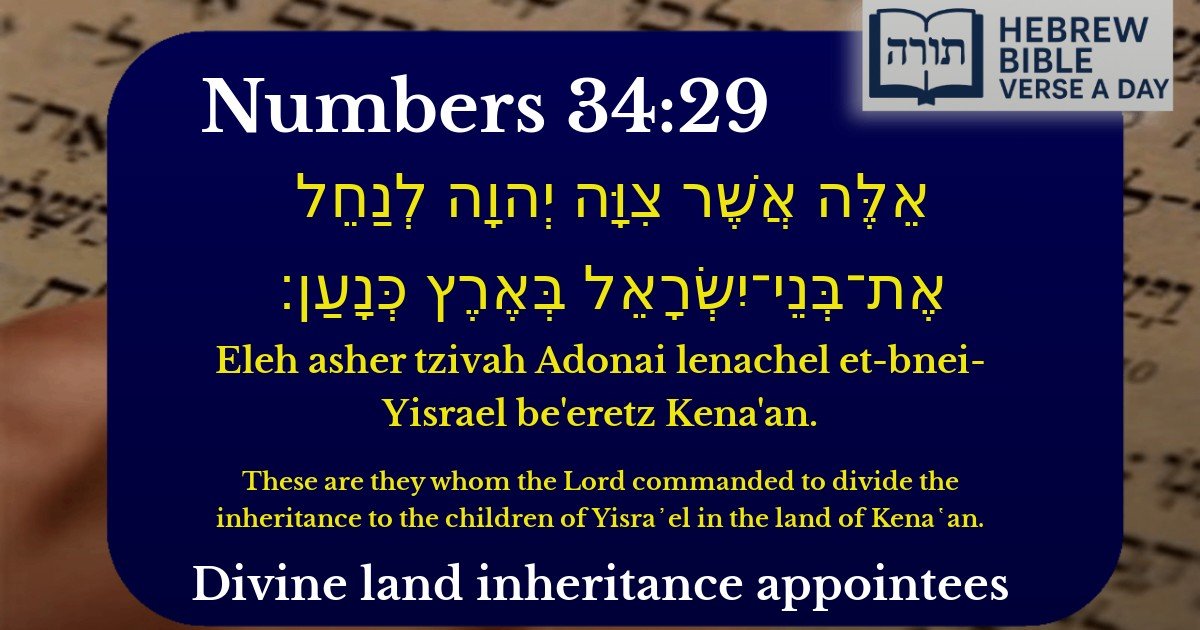
Q: What does Numbers 34:29 mean?
A: Numbers 34:29 states that Hashem commanded specific leaders to divide the Land of Canaan among the tribes of Israel. According to Rashi, these leaders were appointed to ensure a fair and orderly distribution of the land according to divine instruction.
Q: Why is the division of the Land of Canaan important?
A: The division of the Land of Canaan is important because it fulfills Hashem's promise to the forefathers (Avraham, Yitzchak, and Yaakov) that their descendants would inherit the land. The Talmud (Bava Batra 122a) discusses the precise allocations, showing that this was a sacred and deliberate process.
Q: Who were the leaders tasked with dividing the land?
A: The leaders were Elazar the Kohen and Yehoshua bin Nun, along with the heads of the tribes (Numbers 34:17-18). Rambam (Hilchot Terumot 1:2) explains that their role ensured the division followed Torah law and tribal inheritances.
Q: What can we learn from this verse today?
A: We learn that fairness and divine guidance are essential in distributing resources. The Midrash (Bamidbar Rabbah 21:8) highlights that the division was done with integrity, teaching us to handle responsibilities with honesty and adherence to Torah principles.
Q: Does this verse have any relevance to modern Israel?
A: Yes, Orthodox Judaism views the biblical inheritance of the Land of Israel as eternally significant. The Ramban (Commentary on Numbers 34:2) emphasizes that the borders described are tied to the land's holiness, reinforcing the Jewish people's connection to Eretz Yisrael.


Context of the Verse
The verse (Bamidbar 34:29) concludes the section detailing the boundaries of Eretz Yisrael and the appointment of the leaders who would oversee the division of the land among the tribes. This follows Hashem's command to Moshe regarding the inheritance of the land.
Rashi's Explanation
Rashi (Bamidbar 34:29) emphasizes that the division of the land was not left to human discretion but was carried out precisely according to Hashem's command. The leaders mentioned were entrusted with this sacred task to ensure fairness and adherence to divine will. Rashi also notes that the term "אֵלֶּה" (These) serves to exclude any later additions or changes—only those explicitly commanded by Hashem were authorized to divide the land.
Rambam's Perspective
In Hilchot Terumot (1:5), Rambam discusses the sanctity of Eretz Yisrael and how its division was a unique event, bound by halachic principles. The leaders acted as agents of Hashem, ensuring the land was apportioned according to the size of each tribe and their needs, as outlined in the Torah (Bamidbar 26:52-56).
Midrashic Insights
Halachic Implications
The Chazon Ish (Kovetz Iggrot 1:118) discusses how the division of Eretz Yisrael serves as a model for all halachic divisions of property or rights. The principles of fairness, divine authority, and communal responsibility established here remain relevant in Jewish law.