Frequently Asked Questions
Q: What does Numbers 3:43 mean?
A: Numbers 3:43 records the census count of all firstborn Israelite males who were one month old or older at the time. The total number was 22,273. This count was important because these firstborns originally had special status in serving Hashem, but after the sin of the golden calf, the Levites took over their roles (Rashi on Numbers 3:45).
Q: Why was counting the firstborn important?
A: Counting the firstborn was important for two reasons: 1) To establish that there were more firstborn Israelites than Levites (22,273 vs. 22,000), requiring a redemption process for the extra 273 firstborns (Numbers 3:46-47). 2) To formally transfer the sacred service from firstborns to the Levites, as commanded after the golden calf incident (Rambam, Hilchot Klei HaMikdash 3:1-2).
Q: Why count babies from one month old?
A: Babies were counted from one month old because before that age, their survival was less certain in ancient times (Rashi on Numbers 3:15). Additionally, the Torah considers a baby fully viable after 30 days (Talmud Niddah 44b). This age threshold showed that the counting represented those who would grow up to be part of the community.
Q: What lesson can we learn from this verse today?
A: This verse teaches us about the importance of precise counting when it comes to holy matters. The exact number (22,273) shows that every individual counts in Jewish tradition. It also reminds us that roles in serving Hashem can change based on circumstances, as the Levites replaced the firstborns (Midrash Tanchuma Bamidbar 5).
Q: How were the extra 273 firstborns redeemed?
A: The 273 extra firstborns (beyond the number of Levites) were redeemed by paying five silver shekels each to the Kohanim, as commanded in Numbers 3:47. This established the mitzvah of Pidyon HaBen (redemption of the firstborn son) which continues today (Rambam, Hilchot Bikkurim 11:1).

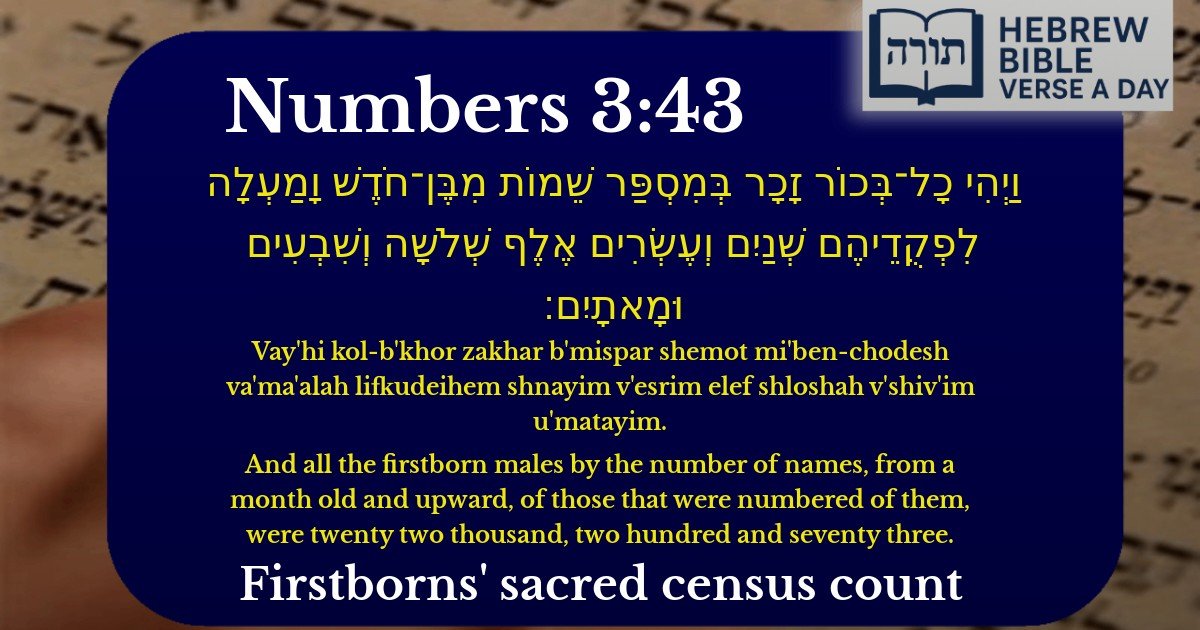

The Counting of the Firstborn in Bamidbar
The verse (Bamidbar 3:43) records the tally of firstborn males from one month old and upward among Bnei Yisrael as 22,273. This count was conducted to facilitate the exchange between the firstborn and the Levi'im, who would serve in the Mishkan in their stead (Bamidbar 3:12-13, 45).
Rashi's Explanation
Rashi notes that this number seems surprisingly low given that there were approximately 600,000 adult males who left Egypt. He explains that many firstborns died during the plague of the firstborn in Egypt (Makas Bechoros), which reduced their numbers. Additionally, not every family had a firstborn son, as some fathers were themselves firstborns (Rashi on Bamidbar 3:43).
The Discrepancy in Numbers
The Talmud (Bechoros 5a) discusses why there were only 22,273 firstborns despite the larger population:
The Significance of the Number
The Kli Yakar (R' Shlomo Ephraim of Luntschitz) highlights that the number 22,273 reflects divine precision. The difference between the number of Levi'im (22,000) and the firstborns (22,273) necessitated the redemption of the extra 273 firstborns through the payment of five shekels each (Bamidbar 3:46-48). This teaches that every individual has intrinsic value in the eyes of Hashem.
Lessons from the Count
The Ohr HaChaim (R' Chaim ibn Attar) emphasizes that the counting of the firstborn underscores the concept of pidyon haben (redemption of the firstborn), a mitzvah that reminds us of the sanctity of life and our gratitude to Hashem for sparing the Jewish firstborns in Egypt. The precise accounting also reflects the principle that every Jew is precious and must be accounted for in the service of Hashem.