Frequently Asked Questions
Q: What does Numbers 34:3 mean?
A: Numbers 34:3 describes the southern border of the Land of Israel as it was designated when the Israelites were about to enter the land. According to Rashi, this verse specifies that the border starts from the wilderness of Zin near Edom and extends to the edge of the Salt Sea (the Dead Sea) to the east. This was part of the detailed boundaries given to the Jewish people for their inheritance in the land.
Q: Why is the southern border of Israel important?
A: The borders of Israel are significant because they define the land promised to the Jewish people in the Torah. The Rambam (Maimonides) explains that these boundaries have halachic (Jewish legal) implications, particularly regarding agricultural laws, tithes, and other mitzvot (commandments) that apply only within the Land of Israel. The southern border, as described in Numbers 34:3, is one of the key markers of this sacred territory.
Q: What can we learn from the detailed description of Israel's borders in the Torah?
A: The detailed description of Israel's borders teaches us the importance of precision when it comes to fulfilling mitzvot (commandments) tied to the land. The Talmud (Gittin 8a) discusses how exact boundaries are necessary for laws like terumah (priestly tithes) and shemitah (the Sabbatical year). This verse reminds us that every detail in the Torah has purpose and significance.
Q: How does the wilderness of Zin relate to the Israelites' journey?
A: The wilderness of Zin, mentioned in Numbers 34:3, was a significant location during the Israelites' travels. Rashi notes that this was where Miriam passed away (Numbers 20:1) and where the incident of Moses striking the rock occurred. It marked a transitional area between the desert wandering and the entry into the Promised Land, symbolizing both challenges and divine providence.
Q: Does the Salt Sea (Dead Sea) have any significance in Jewish tradition?
A: Yes, the Salt Sea (Yam HaMelach) holds significance in Jewish tradition. The Midrash (Bereishit Rabbah 32:5) connects it to the destruction of Sodom and Gomorrah, as it lies in that region. Its extreme salinity serves as a reminder of divine judgment and the consequences of immoral behavior, while its inclusion in Israel's borders highlights the completeness of the land's holiness.

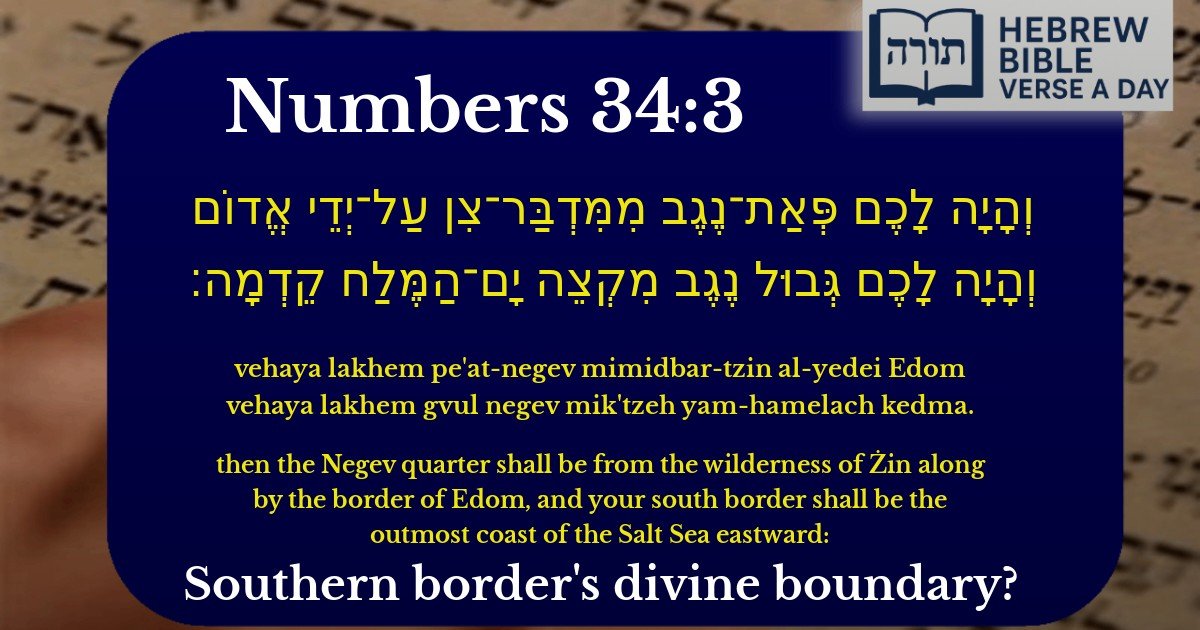

Geographical Boundaries in the Torah
The verse delineates the southern border of Eretz Yisrael, specifying its limits from the wilderness of Tzin along the border of Edom. Rashi (Bamidbar 34:3) explains that this description establishes the precise parameters of the Land's inheritance, emphasizing that these boundaries were divinely ordained and immutable. The inclusion of Edom as a neighboring territory reflects the historical and prophetic relationship between Yaakov and Esav, whose descendants became Israel and Edom respectively.
The Significance of the Salt Sea
The mention of the Salt Sea (Yam HaMelach) as part of the southern border carries deeper meaning. The Ramban (Bamidbar 34:3) notes that this body of water, known today as the Dead Sea, represents both a physical and spiritual boundary. Its extreme salinity renders it inhospitable to life, symbolizing the separation between the holiness of Eretz Yisrael and the surrounding nations. The Talmud (Bava Batra 74b) discusses how this sea marks the edge of the Land's fertility, serving as a natural demarcation point.
Lessons from the Border Descriptions
The Wilderness of Tzin Connection
The Midrash Tanchuma (Shelach 9) connects the wilderness of Tzin mentioned here with the incident of Mei Merivah (Bamidbar 20), where Moshe struck the rock. This teaches that even at the boundaries of the Land, we must maintain complete faith in Hashem's commandments. The Netziv (Ha'amek Davar) adds that the inclusion of this desert region shows that all parts of Eretz Yisrael - even its most desolate areas - are precious and integral to the Jewish inheritance.