

Join Our Newsletter To Be Informed When New Videos Are Posted
Hebrew Text
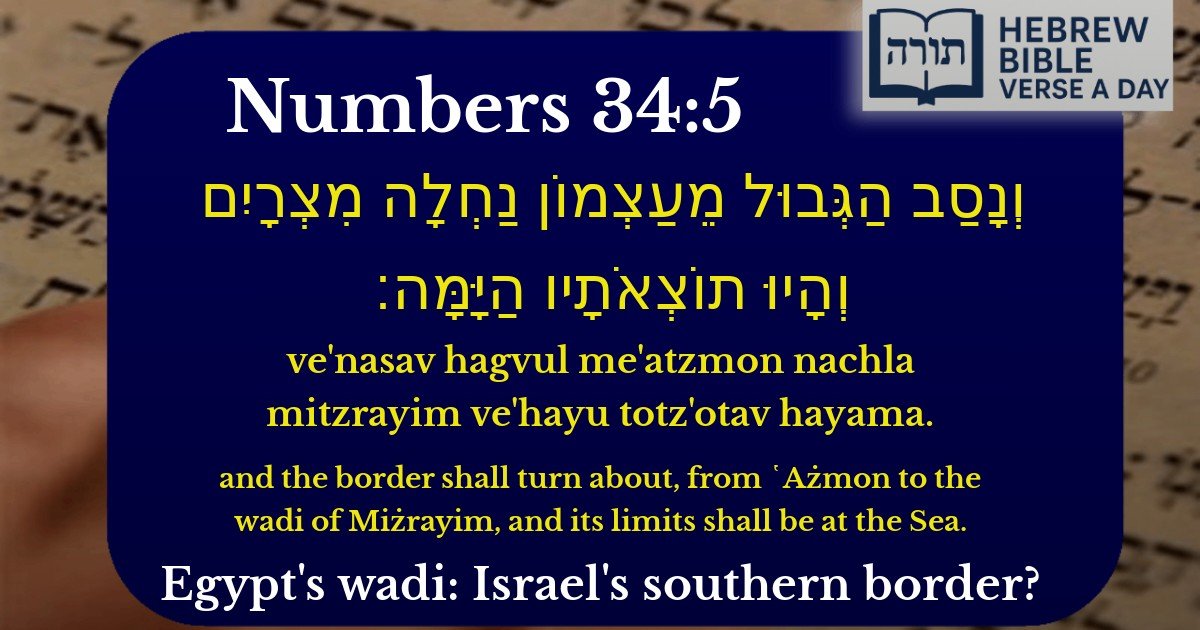
וְנָסַב הַגְּבוּל מֵעַצְמוֹן נַחְלָה מִצְרָיִם וְהָיוּ תוֹצְאֹתָיו הַיָּמָּה׃
English Translation
and the border shall turn about, from ῾Ażmon to the wadi of Miżrayim, and its limits shall be at the Sea.
Transliteration
Ve'nasav hagvul me'atzmon nachla mitzrayim ve'hayu totz'otav hayama.
Hebrew Leining Text
וְנָסַ֧ב הַגְּב֛וּל מֵעַצְמ֖וֹן נַ֣חְלָה מִצְרָ֑יִם וְהָי֥וּ תוֹצְאֹתָ֖יו הַיָּֽמָּה׃
🎵 Listen to leining
Parasha Commentary
📚 Talmud Citations
This verse is not quoted in the Talmud.
Geographical Context in the Torah
The verse (Joshua 15:4) describes the southern border of the territory allotted to the tribe of Judah as part of the division of the Land of Israel. The border runs from Atzmon to the Wadi of Egypt (Nachal Mitzrayim) and ends at the Mediterranean Sea (HaYam). This delineation is significant in establishing the boundaries of Eretz Yisrael as promised to Avraham Avinu (Bereishit 15:18).
Rashi's Commentary
Rashi (on Joshua 15:4) explains that Nachal Mitzrayim refers to the river that marks the border between Egypt and the Land of Israel. He identifies it as the same river mentioned in Bamidbar 34:5, which serves as the southwestern boundary of the Land. Rashi emphasizes that this boundary is not merely geographical but also carries halachic implications, as certain mitzvot (such as terumot and ma'aserot) apply only within these borders.
Rambam's Perspective
Rambam (Hilchot Terumot 1:6) discusses the halachic significance of these borders, noting that the Wadi of Egypt is a defining marker for the mitzvot hateluyot ba'aretz (commandments dependent on the Land). He rules that agricultural laws like shmita apply only within these boundaries, reinforcing the sanctity of Eretz Yisrael as distinct from surrounding lands.
Midrashic Insights
Halachic Implications
The Chazon Ish (Shevi'it 3:16) discusses practical applications of these borders in modern times, particularly regarding areas near Gaza and the Sinai Peninsula. He analyzes whether contemporary political boundaries align with the Torah's description, concluding that the Wadi of Egypt likely corresponds to the Wadi El-Arish, as per the consensus of earlier commentators like the Radbaz.