Frequently Asked Questions
Q: What does Numbers 3:51 mean when it says Moshe gave the money to Aharon and his sons?
A: This verse refers to the redemption money collected from the firstborn Israelites who were not Levites. Since the Levites were chosen to serve in the Mishkan (Tabernacle) in place of the firstborn, the other firstborns had to be 'redeemed' with money (5 shekels each). Moshe gave this money to Aharon and his sons, the Kohanim (priests), as commanded by Hashem.
Q: Why was the money given specifically to Aharon and his sons?
A: Aharon and his sons were the Kohanim (priests) who served in the Mishkan. The Torah (Bamidbar 3:45-50) explains that the Levites replaced the firstborn for service, and the redemption money was given to the Kohanim as part of their sacred duties and livelihood, as commanded by Hashem.
Q: What is the significance of the phrase 'according to the word of the Lord' in this verse?
A: This phrase emphasizes that Moshe followed Hashem's exact instructions regarding the redemption process. Rashi explains that this shows Moshe's complete obedience—he didn't keep the money or distribute it differently, but precisely as commanded (Shemos 38:21 also highlights Moshe's faithfulness in handling sacred matters).
Q: How does the concept of redeeming firstborns apply today?
A: The mitzvah of Pidyon HaBen (redeeming a firstborn son) still applies today. If a Jewish boy is the firstborn to his mother (with certain conditions), his parents must 'redeem' him by giving 5 silver coins (or equivalent) to a Kohen when the baby is 30 days old. This practice originates from this parsha and is detailed in the Shulchan Aruch (Yoreh De'ah 305).
Q: Why were the Levites chosen instead of the firstborns for service?
A: Originally, firstborns were meant to serve after being spared in Mitzrayim (Egypt). However, after the sin of the Golden Calf, the Levites—who didn't participate—were chosen instead (Rashi on Bamidbar 3:12). This teaches the importance of spiritual dedication over mere birthright, as the Levites proved their loyalty to Hashem.


Context of the Verse
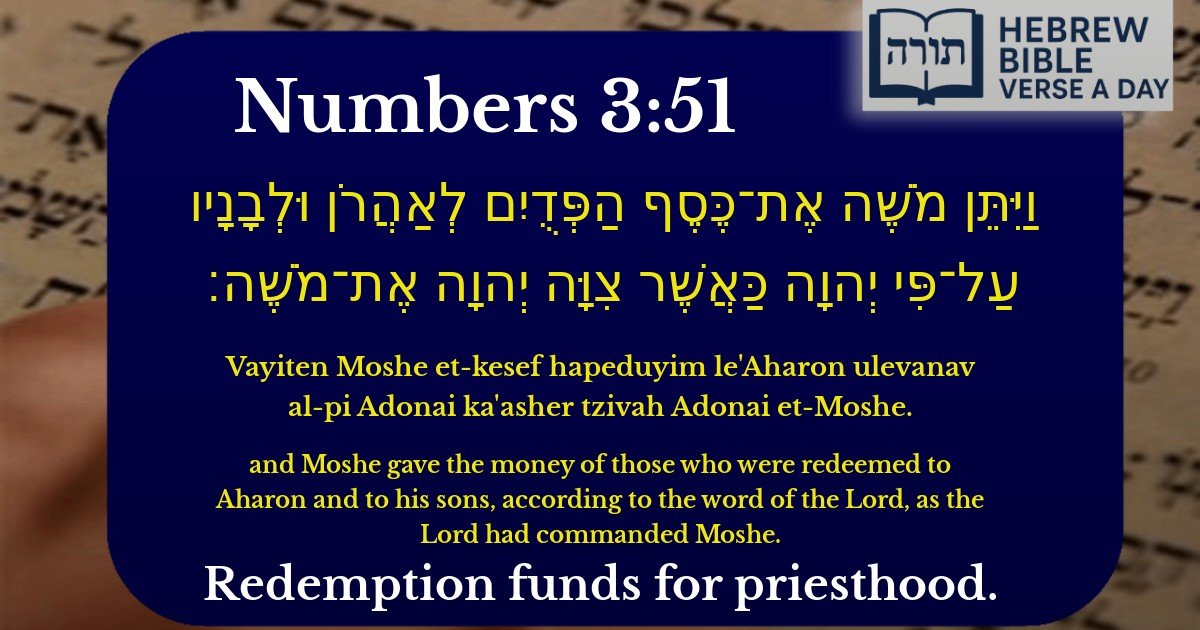
The verse (Bamidbar 3:51) describes Moshe giving the redemption money (כֶּסֶף הַפְּדֻיִם) to Aharon and his sons, following Hashem's command. This occurs after the census of the firstborn and the selection of the Levi'im to serve in place of the firstborn. The money was collected to redeem the firstborn Israelites who outnumbered the Levi'im.
Rashi's Explanation
Rashi (Bamidbar 3:51) clarifies that the redemption money was given specifically to the Kohanim (Aharon and his sons) rather than the Levi'im, as commanded by Hashem. He emphasizes that this was a one-time obligation (חיוב חד-פעמי) for the generation of the wilderness, where the firstborn needed redemption from their previous status before the Levi'im were chosen for service.
Rambam's Perspective
Rambam (Hilchot Bikkurim 11:1) discusses the laws of pidyon haben (redemption of the firstborn) and notes that the funds are given to a Kohen. This verse serves as a precedent for the mitzvah of pidyon haben, reinforcing that the Kohanim are the rightful recipients of such redemption money, as they are descendants of Aharon.
Midrashic Insights
Halachic Implications
The verse establishes a foundational principle in Halacha (Shulchan Aruch, Yoreh De'ah 305) that redemption money for a firstborn must be given to a Kohen, as derived from Moshe's action here. This mitzvah continues to apply in all generations, reinforcing the unique role of the Kohanim in Jewish life.